Testimonials
Services
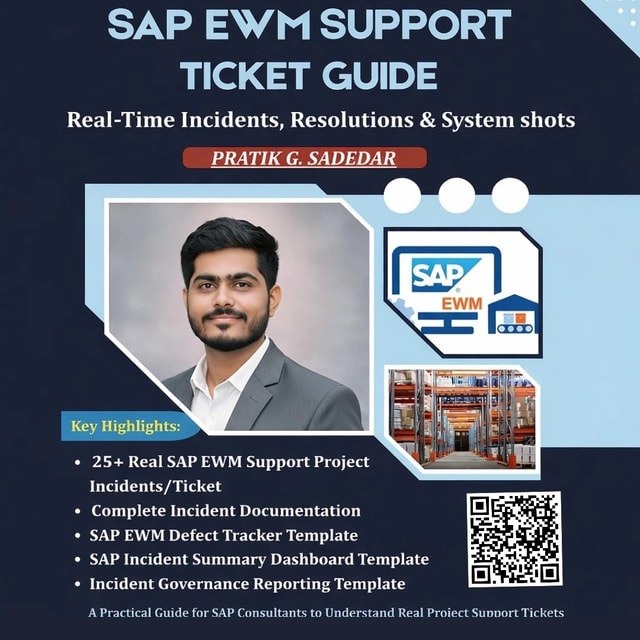
SAP EWM Support -Ticket/Incidents Guide
EWM Bundle : Support Ticket/Incidents+Interview QA
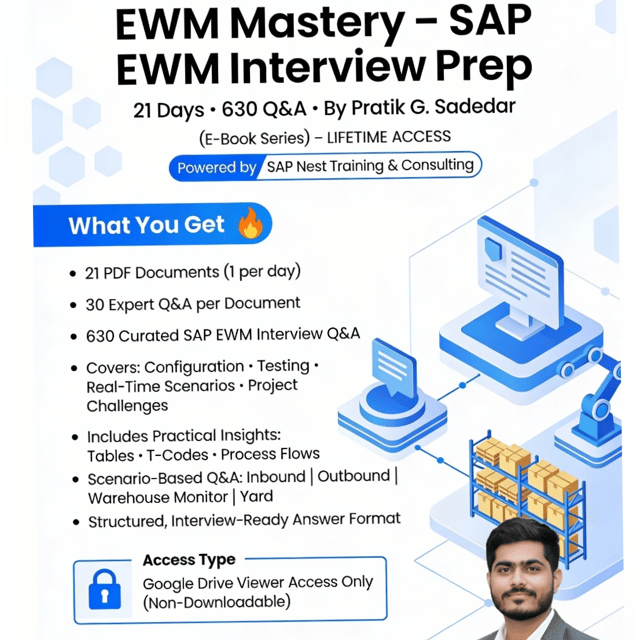
EWM Mastery SAP EWM Interview Prep – 21 D 630 Q&A
SAP Functional Consultant FREE Resume Template
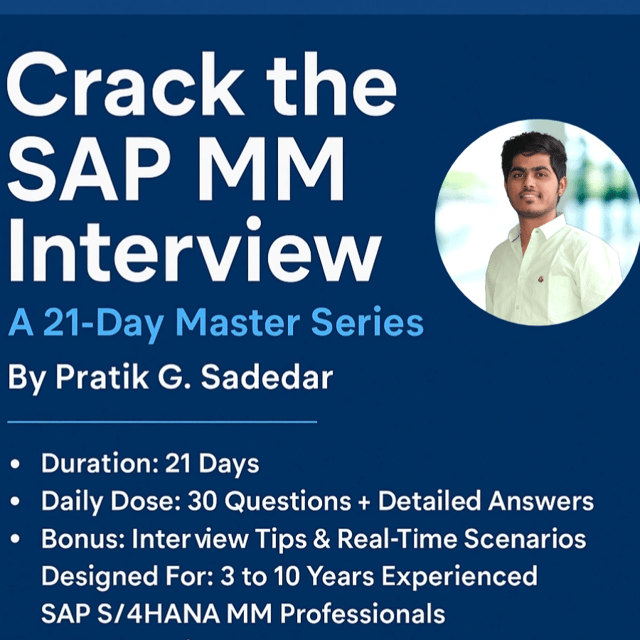
Crack SAP MM Interview 21 Day Master Series Ebook
Priority DM
SAP MM Perfect Pack Real Scenario+Interview QA
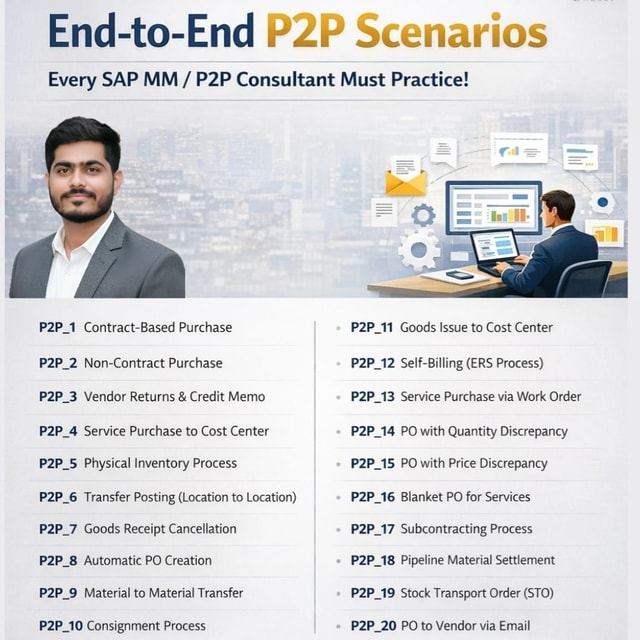
SAP MM / P2P – 20 End to End Proc +Inv Scenarios
Complete SAP MM & EWM eBook Package
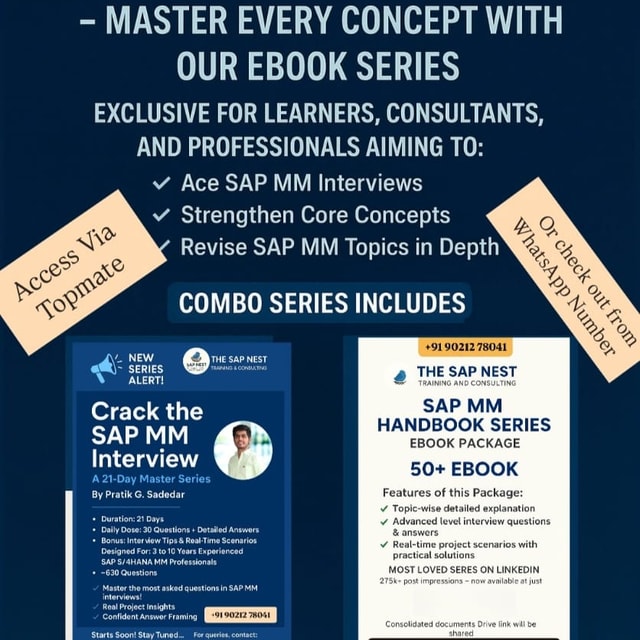
SAP MM Interview eBook COMBO (Handbook +QA Series)
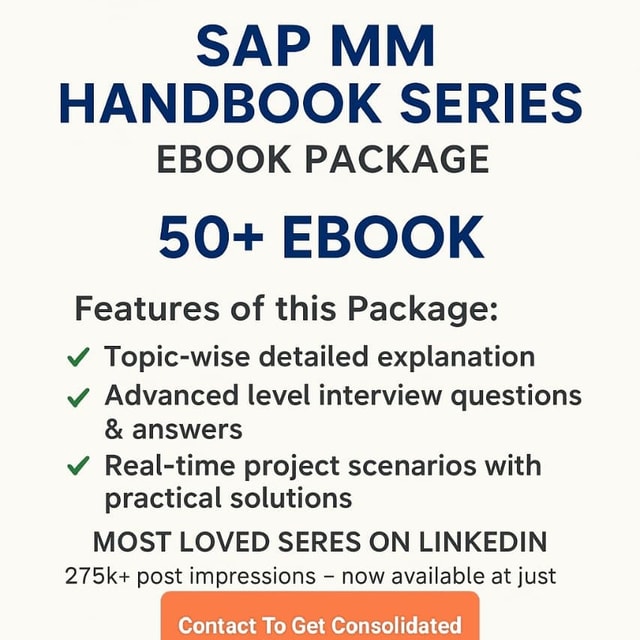
SAP MM Handbook Series (Topic Wise 50+Ebooks)
About me
- ReachOut: SAP S/4HANA Server GUI Accesshttps://wa.me/919021278041

- Pratik G. Sadedar is praised for his clear, detailed, and practical SAP EWM and MM interview materials, which boost confidence and support learners in their career growth.
 AI-generated based on testimonials
 - Follow: On Instagram The SAP Nest Communityhttps://www.instagram.com/thesapnest?igsh=MWhkZWlkaTdqYXliZw==

- Team What'sApphttps://wa.me/919021278041

Frequently asked questions
How to prepare for a SAP MM interview?
The best way to prepare for a SAP MM interview is to start with the end-to-end procure to pay cycle and inventory management basics, then go module-deep: enterprise structure, master data, purchase requisition to purchase order flow, release strategy, pricing procedure, movement types, automatic account determination, special stocks, subcontracting, stock transport orders, and invoice verification. Since most companies in India now run S/4HANA, expect S/4HANA-specific questions on Fiori apps and the business partner approach. Practice scenario-based questions daily, revise configuration concepts, and finish with mock interviews to test how clearly you explain processes.
What are the most commonly asked SAP MM interview questions and answers?
The most frequently asked SAP MM interview questions and answers cover: purchase requisition vs purchase order, movement types (101, 102, 161, 201, 261), release procedure with and without classification, pricing procedure configuration, automatic account determination (OBYC), GR/IR account reconciliation, consignment vs subcontracting, split valuation, and credit/return scenarios. S/4HANA interviews add questions on the material ledger, Fiori-based procurement, and embedded analytics. Interviewers increasingly ask scenario-based follow-ups, so prepare configuration paths and real examples, not just definitions.
Which SAP MM interview questions for freshers should I focus on first?
The SAP MM interview questions for freshers usually stay at the fundamentals level: what SAP ERP and S/4HANA are, enterprise structure (company code, plant, storage location, purchasing organisation), types of master data, the procurement cycle, purchase requisition vs purchase order, goods receipt and invoice verification flow, and basic movement types. Interviewers rarely expect deep configuration from freshers — they check concept clarity and how confidently you walk through one end-to-end P2P scenario. Prepare a strong self-introduction linking your training or projects to SAP MM.
How do SAP MM interview questions for 3 years of experience differ from fresher-level ones?
SAP MM interview questions for 3 years of experience go deeper into hands-on depth: pricing procedure configuration step by step, release strategy with classification, subcontracting and STO configuration, split valuation, MRP types and lot sizing, IDoc processing for purchase orders, GR/IR clearing issues, and real incidents from support projects. Expect "explain your project" questions about your role in implementations, rollouts, or support, plus scenario questions like "goods receipt is not posting" or "PO is stuck in release" — answer with configuration paths and transaction codes.
Where can I get a SAP MM interview questions topic-wise PDF?
A good SAP MM interview questions topic-wise PDF arranges questions by area — procurement, inventory management, valuation, MRP, release strategy, and S/4HANA-specific topics — instead of one long random list, so you can revise one topic completely before moving to the next, which is exactly how interviews progress. Choose one that includes scenario-based questions with configuration explanations and recent S/4HANA updates, not just theoretical definitions.
What is the procure to pay process in SAP MM?
The procure to pay process in SAP MM is the end-to-end flow of procuring materials from a vendor: determining requirements through a purchase requisition, source determination and vendor selection, creating and releasing the purchase order, goods receipt against the PO, invoice verification, and payment handled in accounts payable. It runs on master data such as the material master, vendor master (business partner in S/4HANA), purchasing info record, and source list. This cycle, commonly called P2P, is the single most tested area in SAP MM interviews.
What are the procure to pay process steps in SAP MM?
The procure to pay process steps in SAP MM are: 1) purchase requisition, 2) source determination and RFQ/quotation comparison where needed, 3) purchase order creation and release via the release strategy, 4) PO transmission to the vendor including IDoc/EDI output, 5) goods receipt with movement type 101, 6) invoice verification with a 3-way match of PO, goods receipt, and invoice, and 7) payment processing in accounts payable. Monitoring happens through PO history, GR/IR clearing, and reports like ME2N.
How to audit the procure to pay process?
When you audit the procure to pay process, the key checks are: segregation of duties between vendor master maintenance and PO release, 3-way match compliance, duplicate invoice checks, adherence to release strategies and any bypassed approvals, maverick buying outside contracts, vendor master change controls, open PO and GR/IR ageing, and unauthorised price or condition changes. Auditors also sample-test POs for approvals, review IDoc and invoice interface errors, and reconcile the GR/IR clearing account, then document findings with remediation actions.
How to improve the procure to pay process?
To improve the procure to pay process, focus on automating requisition-to-PO conversion for standard purchases, strengthening vendor master data quality, using contract-based sourcing to reduce maverick buying, simplifying release strategies to cut approval delays, enabling touchless invoice matching, and tracking KPIs like P2P cycle time, cost per PO, and first-pass match rate. On S/4HANA, Fiori-based purchasing apps, central procurement, and analytics dashboards make these improvements easier to roll out and monitor across plants.
What SAP EWM interview questions and answers should I prepare?
Focus on: WM vs EWM differences, EWM organisational structure (warehouse number, storage type, storage section, bin), inbound and outbound process steps, wave management, slotting and rearrangement, handling units, the RF framework, storage type search and bin type determination, stock types, PPF, VAS, labour management, and embedded vs decentralised EWM in S/4HANA. Scenario questions on putaway strategies, waves not creating warehouse orders, or HU inconsistencies are very common. Revising from a SAP EWM interview questions and answers PDF with scenario coverage helps because EWM interviews are heavily process-driven.
How are SAP EWM interview questions for 3 years of experience different?
SAP EWM interview questions for 3 years of experience usually move beyond theory into configuration and troubleshooting: storage type search sequences, warehouse order creation rules, slotting configuration, wave management settings, PPF actions, RF environment setup, capacity checks, cross-docking, kitting, and integration points like qRFC queues and CIF. Interviewers also probe support-project scenarios — handling inbound/outbound failures, bin stock inconsistencies, and incident resolution — along with your exposure to go-lives, rollouts, and hypercare. Be ready to explain configurations with paths and real examples from your project.
How do I switch from SAP MM to SAP EWM?
Your MM foundation helps more than you would expect — goods receipt, material master, and inventory concepts carry over directly. Build EWM-specific skills next: warehouse structure, inbound/outbound and wave processing, putaway and picking strategies, handling units, and how embedded EWM works in S/4HANA. Many MM consultants make this switch successfully because companies prefer consultants who understand procurement plus warehouse execution. Prepare with scenario-based EWM Q&A practice and, if possible, hands-on configuration of storage types, bins, and document flows in a system.
Are mock interviews useful for SAP MM and EWM interview preparation?
Yes — in this niche, interviewers judge how clearly you explain processes, not just what you know. Mock interviews expose weak areas like forgetting configuration paths, mixing up movement types, or losing structure in scenario answers, and they build the confidence to handle follow-up questions. Doing even a few rounds with scenario-based questions before the actual interview often makes the difference between getting shortlisted and getting rejected for SAP MM and EWM roles.