Services
How to get Into Cybersecurity by Pradip
200 Database Testing / SQL Real Time Interview Que
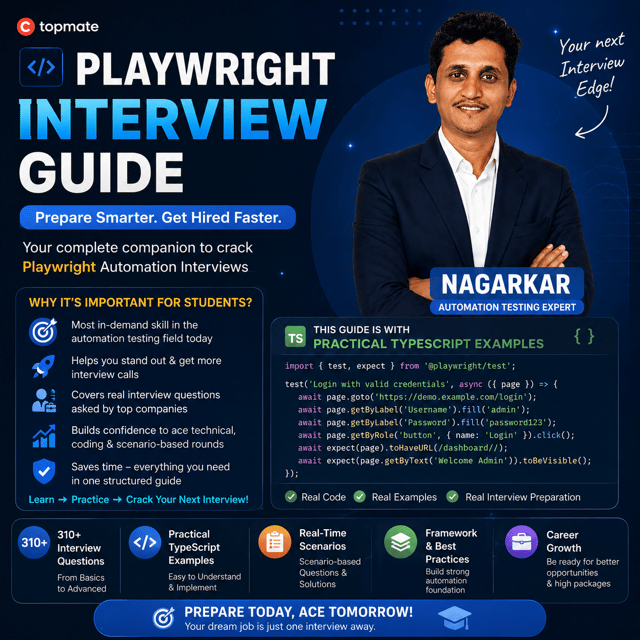
Playwright Automation with Practical TypeScript
Playwright + AI Integration Complete Guide
About me
Frequently asked questions
What is the full form of ATS in a resume?
ATS stands for Applicant Tracking System — software that most companies use to collect, scan, and filter resumes before a human recruiter ever opens them. An "ATS resume" is simply a resume formatted so these systems can read it correctly. If your resume is not ATS-friendly, it can get rejected automatically even when your skills genuinely match the role.
How to make an ATS resume that gets shortlisted?
To make an ATS resume, use a clean single-column layout, standard section headings like "Work Experience" and "Skills", simple fonts, and no tables, graphics, or text boxes that parsers cannot read. Add the keywords from each job description naturally into your skills and experience sections, and save the file as a text-based PDF or .docx. The safest ATS resume format is simple, reverse-chronological, and tailored to every individual application.
What is a good ATS resume score?
Most ATS resume checkers score a resume out of 100, and an ATS resume score of 75–80% or above is generally considered strong enough to clear automated filters. A low score usually points to missing keywords from the job description, complex formatting, or sections the parser could not read. Treat the score as a guide rather than a guarantee — once it clears the system, the resume still has to convince a human recruiter.
What is an ATS resume checker and how does it work?
An ATS resume checker is an online tool that parses your resume the way a company's ATS would and flags problems such as missing keywords, unreadable sections, tables or columns, and weak formatting. You upload your resume (usually along with a job description) and it returns an ATS score plus specific fixes. Running your resume through a checker before every application helps you catch issues that would otherwise get you silently filtered out.
Does an ATS resume template really help you get shortlisted?
Yes — an ATS resume template helps because it gives you a structure the parser can read: single column, standard fonts, and clear section headings. The template alone is not enough, though; you still need to add the right keywords from each job description. Even a free ATS resume template can perform well if it is simple and you customise it for every application instead of sending the same generic file everywhere.
What are the most common Selenium interview questions and answers?
The most common Selenium interview questions and answers start with fundamentals — what Selenium is, WebDriver architecture, types of locators (ID, XPath, CSS), and the difference between implicit and explicit waits. They then move to practical topics like handling dynamic elements, alerts, frames and multiple windows, the Page Object Model, and framework questions on tools such as Maven, TestNG, and Git. For experienced roles, expect scenario-based questions about how you built or maintained a real automation framework.
Which Selenium interview questions are asked for 5 years of experience?
Most Selenium interview questions for 5 years of experience focus less on syntax and more on framework design — building a hybrid or data-driven framework from scratch, Maven/Gradle integration, Git workflows, CI/CD basics, parallel execution, and reporting. Interviewers also probe your real project decisions: why you chose specific locators, how you reduced flaky test failures, and how you handled dynamic elements. Prepare two or three detailed stories from your own projects, because at this level "how" and "why" matter more than definitions.
How do you handle dynamic elements in Selenium?
To handle dynamic elements in Selenium, avoid absolute XPath and IDs that change on every page load. Use stable locators, or build flexible XPath with contains() and starts-with() on attributes that stay constant, and pair them with explicit waits (WebDriverWait with expected conditions) so the script waits for the element instead of failing. This is one of the most frequently asked Selenium interview questions because flaky scripts caused by dynamic content are a daily problem in real automation projects.
What is POM in Selenium?
When interviewers ask "what is POM in Selenium", they are referring to the Page Object Model — a design pattern where every page or screen of the application is represented as a separate class containing its locators and actions. Tests then call these page classes instead of touching elements directly, which makes the code reusable, readable, and much easier to maintain when a locator changes. Be ready for follow-ups on Page Factory, where to initialise elements, and how POM fits into a larger framework.
What are the most common SQL interview questions and answers?
The most common SQL interview questions and answers revolve around fundamentals: primary key vs unique key, WHERE vs HAVING, DELETE vs TRUNCATE, types of JOINs, GROUP BY, and aggregate functions. Interviewers then usually give live scenarios such as finding the second-highest salary, deleting duplicate records, or combining data from two tables. Practise writing actual queries rather than only reading answers, because explaining your query logic out loud is what clears SQL rounds.
What SQL interview questions are asked for freshers?
Most SQL interview questions for freshers stay close to the basics — CRUD operations, constraints like primary key, foreign key and NOT NULL, simple joins, filtering with WHERE, sorting, grouping, and small query-writing tasks. Interviewers rarely expect advanced optimisation at this stage; they want to see clean fundamentals and logical query thinking. Preparing the regularly asked queries with proper understanding is usually enough to handle a fresher-level SQL round confidently.
How do I prepare for SQL interview questions?
To prepare for SQL interview questions, revise the core concepts first — joins, GROUP BY, subqueries, constraints, and aggregate functions — and then write queries daily on real datasets instead of just reading solutions. Practise the classic scenario questions (second-highest salary, duplicates, department-wise totals), and if you are experienced, add indexing, query optimisation, and execution plans to your preparation. Finish with at least one mock round where you write and explain queries aloud, since SQL interviews test your thinking, not your memory.
What are SQL testing interview questions?
SQL testing interview questions are questions asked for database testing or QA roles where you validate an application's backend data and logic rather than only its UI. They typically cover writing queries to verify records after an operation, checking data integrity across related tables, validating ETL or migration results using joins and counts, and comparing expected versus actual data. Strong join and subquery skills matter more than theory here, since most of the interview revolves around writing validation queries on the spot.
Why am I not getting interview calls even though I have the right skills?
In most cases the problem is visibility, not skills. If your resume is not ATS-friendly, it gets filtered out before a recruiter sees it, and if your Naukri or LinkedIn profile does not contain the keywords recruiters actually search for, it never appears in their results. Start by aligning your resume with each job description using the same terms the posting uses, and make sure both profiles are complete and keyword-rich. Fixing this layer is usually what turns a silent profile into a steady flow of interview calls.
How do I optimize my Naukri profile to get more recruiter calls?
Recruiters find candidates on Naukri through keyword searches, so your Naukri profile needs a clear, skill-focused headline, a 100% completed profile, and skills written in the exact terms used in your target job descriptions. Update the profile regularly — even small edits refresh your visibility in recruiter searches — and keep your attached resume current and ATS-friendly. An optimized Naukri profile working together with a strong ATS resume is what converts profile views into real interview calls.