Testimonials
Services
The Clarity Call
Job Search Strategy Call
Let’s Meet In-Person (Hyderabad)
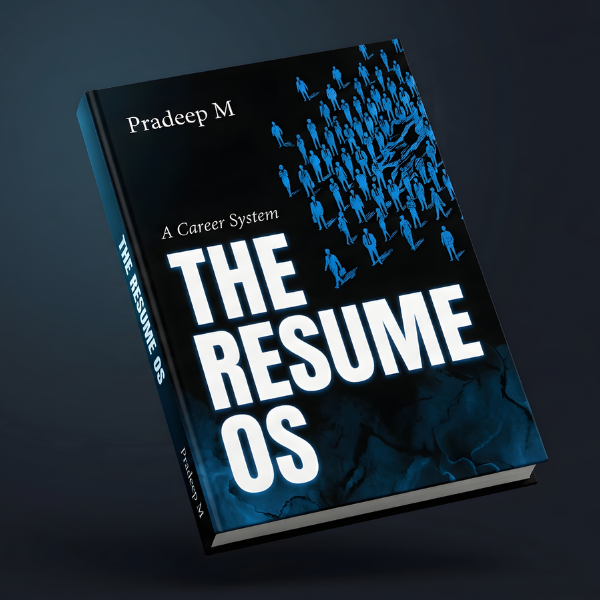
The Resume OS - Write Resumes That Get You Hired
About me
- Pradeep M is a highly praised mentor, known for his friendly demeanor and effective guidance in data analytics. His insights on resumes and interviews greatly enhance confidence.
 AI-generated based on testimonials
Frequently asked questions
How to start a data analyst career in India with no experience?
Start with the skills employers actually test for: Excel, SQL, and one BI tool such as Power BI or Tableau, plus basic statistics. Build two or three portfolio projects on real or public datasets, publish them on GitHub or LinkedIn, and then target the most common entry-level data analyst career opportunities, such as data analyst, business analyst, and reporting analyst roles. Tailor your resume for each job description instead of sending the same one everywhere, and apply consistently through Naukri and LinkedIn. If you are getting no callbacks after steady applications, the problem is usually your profile and positioning, not the market.
What is the data analyst career path and salary in India like?
The typical data analyst career path moves from Data Analyst or Junior Data Analyst to Senior Data Analyst, then BI Analyst or Analytics Manager, and eventually Lead or Head of Analytics, with some people branching into data science or analytics engineering. On the data analyst career path and salary front, freshers usually land in the ₹4–8 LPA band depending on city, company, and skills, mid-level analysts with 3–5 years of experience commonly see ₹10–20 LPA, and senior or managerial roles in product companies can cross ₹25 LPA. Growth is fastest once you shift from building dashboards to influencing business decisions.
Is a data analyst career in India still worth pursuing?
Yes, a data analyst career in India remains one of the most accessible and in-demand paths, with openings across IT services, product companies, fintech, e-commerce, banking, and healthcare. The catch is that entry-level competition is intense, so shortlists now go to candidates who can show SQL depth, real projects, and business communication, not just a course certificate. AI is automating basic reporting, which actually raises the value of analysts who can interpret data and recommend actions. It is still worth it, but only with a focused, skills-first approach.
How to optimize a resume for ATS so it actually gets shortlisted?
Use a clean, single-column layout with standard section headings like Summary, Skills, Experience, Projects, and Education, because tables, graphics, and text boxes often confuse resume parsers. Mirror the exact skill names and keywords from the job description naturally, such as SQL, Power BI, and data visualization, and quantify achievements with numbers instead of listing duties. Keep dates consistent, use recognizable job titles, and export in the format the application portal asks for. A quick test: copy-paste your resume into plain text, and if it still reads clearly, an ATS can likely parse it.
How to optimize a resume for AI screening in hiring?
Many companies now use AI tools to rank resumes before a human sees them, so relevance matters more than keyword dumping. Write your skills exactly as the industry names them, describe impact in complete sentences like "rebuilt sales reporting in Power BI, cutting manual work by 40%," and add a short summary that states your target role. AI screeners read context, so keyword stuffing can actually hurt you. Tailor each application, keep the language specific and measurable, and never claim tools or results you cannot defend in an interview.
What is CV optimization and why does it matter for job applications?
CV optimization is the process of systematically improving your CV so it ranks higher with applicant tracking systems and impresses recruiters. It involves matching keywords to the job description, quantifying results, tightening formatting, and leading with your most relevant experience. In India, "CV" and "resume" are used interchangeably, so the principles are identical. It matters because recruiters spend only a few seconds on each application, and most large employers filter resumes through software before a human ever reads them.
What is the best AI for resume optimization?
ChatGPT, Claude, and Gemini all do the job well when you give them the right inputs: the full job description, your current resume, and clear instructions. A solid resume optimization prompt for ChatGPT looks like: "Here is the job description and my resume — rewrite my bullets to include the missing keywords naturally and quantify my achievements." Claude tends to produce smoother rewrites for longer CVs, while ChatGPT is great for quick iterations. Remember that AI does not know your real impact, so review every line and get a human second opinion before applying.
How does resume optimization for job descriptions actually work?
Resume optimization for job descriptions means tailoring your resume for every role you apply to rather than using one version for everything. Read the posting, note the repeated skills and tools, and make sure those exact terms appear in your skills section and bullets. Adjust your headline and summary to match the role title, reorder bullets so the most relevant experience sits on top, and cut anything the role does not care about. This pushes your match score up in ATS filters and shows recruiters within seconds that you fit.
What is LinkedIn profile optimization and how do you optimize your LinkedIn profile?
LinkedIn profile optimization is the process of reworking your profile so recruiters find you in search and feel compelled to message you. To optimize yours, put your target role and top skills in the headline instead of just your job title, write an About section built around outcomes, add metric-rich bullets under each role, fill and reorder your skills section, use a custom URL, add projects to the Featured section, and collect recommendations. Switch on "Open to Work" for recruiters and stay active by posting or commenting in your niche, because activity feeds LinkedIn's algorithm.
How to check LinkedIn profile optimization before you start applying?
Run a simple audit: search LinkedIn for your target role plus your city, for example "data analyst Hyderabad," and see whether your profile shows up. If it does not, your keywords are weak. Check that your headline names your target role, your About section opens with value rather than history, your top three skills are the ones recruiters actually filter by, and your profile is complete with a professional photo and custom URL. Getting an outside review also helps, because blind spots are exactly what stop recruiter searches from finding you.
Does a LinkedIn profile optimization prompt for ChatGPT or Claude actually work?
Yes, for the mechanical parts. A good LinkedIn profile optimization prompt can rewrite your headline, draft your About section, and turn plain job duties into achievement bullets within minutes. Where it falls short is strategy and voice, because AI output often sounds generic and cannot know which roles you are targeting unless you explain in detail. Use the prompt to generate drafts, then edit aggressively so the profile sounds like you and matches the jobs you actually want.
Is there a free LinkedIn profile optimization tool that actually works?
A few free options cover the basics: LinkedIn's own profile strength meter and skills section, free AI chatbots for rewriting your headline and About section, and a recruiter-style keyword search to test whether your profile appears for your target role. Where free tools stop is diagnosis. They can check boxes but cannot tell you why recruiters are not messaging you. For that, you need either a structured self-audit against real job postings or feedback from someone who reviews profiles regularly.
Are LinkedIn profile optimization services worth paying for in India?
They are worth it in three situations: you are getting profile views but no recruiter messages, you are switching careers and unsure how to position yourself, or you have been applying for months with no results. Good providers go beyond rewriting and align your Naukri and LinkedIn profiles with a real job search strategy. Judge them on credibility and niche fit. Mentors who work in data themselves, like Pradeep M, a Deloitte data analyst who offers Naukri and LinkedIn profile optimization along with job search strategy calls, will position a data analyst very differently from a generalist agency.
What is LinkedIn open profile and how is it different from Open to Work?
When people search for a LinkedIn open profile, they usually mean marking themselves as approachable to recruiters. On LinkedIn, that feature is called "Open to Work," and you can show it publicly with the green banner or limit visibility to recruiters only. Naukri has its own "Open Profile" option that signals to recruiters you are open to opportunities even when you are not actively applying. If you are currently employed, choose the recruiters-only setting so your job hunt stays discreet.
How should a fresher prepare for a data analyst interview?
Expect rounds around SQL, a case study or guesstimate, a BI tool walkthrough, and an HR conversation. Practice SQL joins, aggregations, and window functions until you can solve problems live, and be ready to explain every line of your portfolio projects end to end. Work through curated SQL interview questions and Power BI interview questions so the format holds no surprises, and do at least one or two mock interviews, ideally with a working analyst, to get comfortable thinking out loud. Finally, prepare a tight "tell me about yourself" that connects your projects to the company's business.