Testimonials
Services
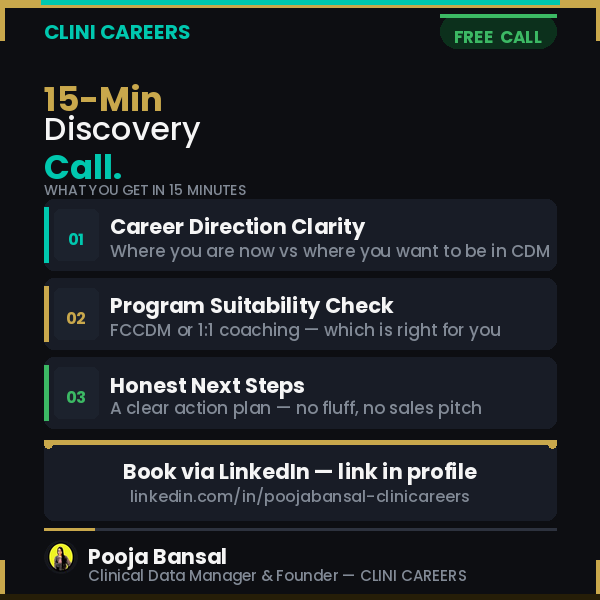
15-Min Discovery Call (Career & Program Fit)
CDM Interview Accelerator Program
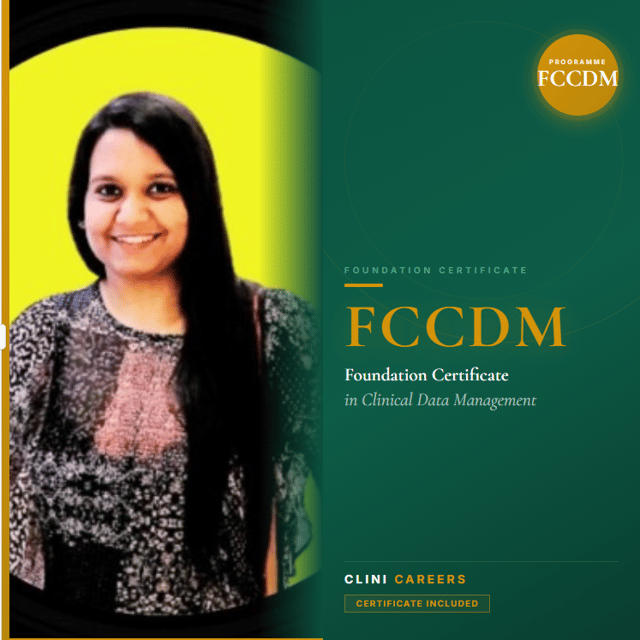
Foundation Certificate in CDM - Part II
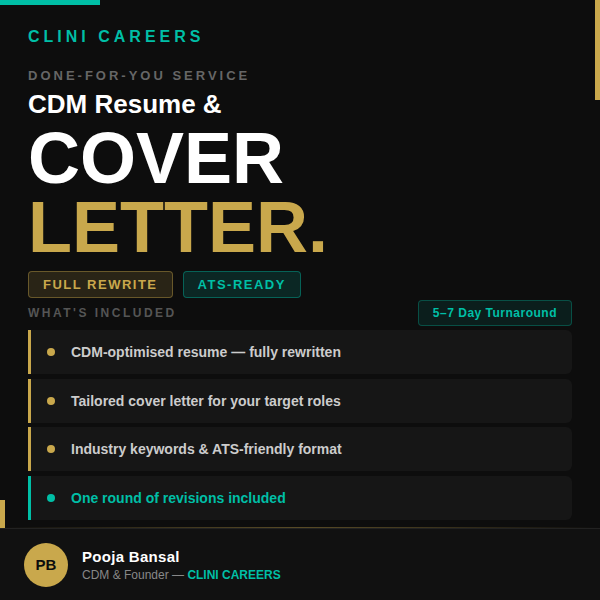
CDM Resume & Cover Letter Rewrite (Done-For-You)
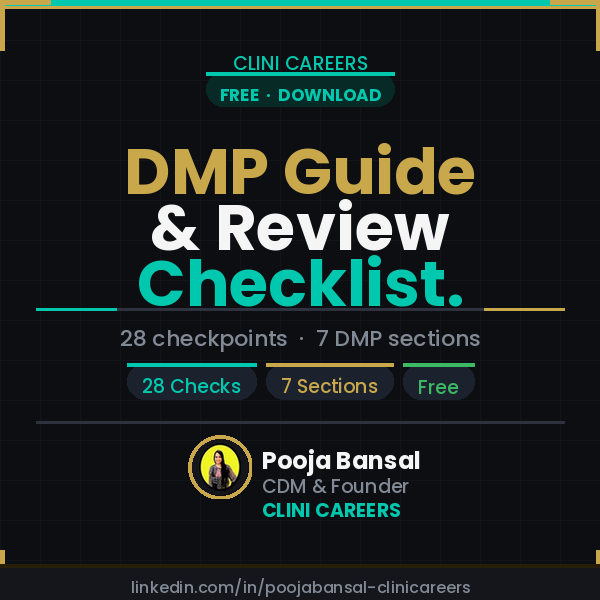
DMP Guide and Review Checklist
Foundation Certificate in CDM - Part I
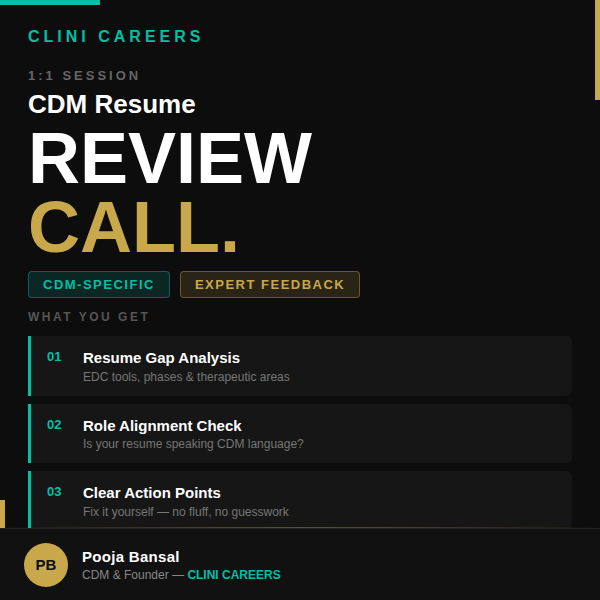
Clinical Data Management Resume Review Call (1:1)
About me
- Pooja is highly praised for her patient, insightful guidance, comprehensive resume evaluation, and genuine will to help boost career opportunities.
 AI-generated based on testimonials
Frequently asked questions
What is a clinical data management job, and what does a clinical data manager actually do?
A clinical data management (CDM) job is centred on handling the data generated during clinical trials. A clinical data manager designs and builds the study database in an EDC system, sets up edit checks, reviews and cleans incoming data, raises and resolves queries with sites, maintains key documents such as the Data Management Plan, and ensures the database is locked cleanly at study close-out so the data is reliable enough for statistical analysis and regulatory submission. The role sits at the centre of sponsor and CRO teams, working alongside biostatistics, medical monitoring, and site staff.
How to become a clinical data manager in India?
Most people enter CDM from life sciences, pharmacy, biotechnology, nursing, or allied health backgrounds. A practical roadmap: first build fundamentals — clinical trial phases, ICH-GCP, CRF/eCRF design, data validation, and discrepancy management; then get hands-on exposure to at least one EDC system and core CDM documents; and finally target entry roles such as CDM Trainee, Data Coordinator, or Data Management Associate at CROs and pharma companies. If you are unsure how to learn clinical data management in the correct sequence, a structured, mentor-led program or 1:1 guidance from an experienced CDM shortens the learning curve far more than scattered self-study.
How can a fresher get a clinical data management job in India?
Freshers usually struggle because they apply with generic resumes that are not aligned with CDM job descriptions. The realistic approach is to build core CDM knowledge, create an ATS-friendly resume that mirrors CDM keywords, prepare for standard interview questions, and apply consistently to CROs and pharma companies in hubs like Pune, Hyderabad, Bengaluru, and Mumbai. There are genuine clinical data management jobs for freshers — usually titled CDM Trainee, Data Management Associate, or Data Coordinator — and figuring out how to get a clinical data management job becomes much easier once your resume and interview story are role-aligned.
What is a clinical data management course, and what should a good one cover?
A CDM course is a structured training program that teaches how clinical trial data is collected, cleaned, validated, and delivered for analysis. A strong curriculum should cover the clinical trial lifecycle, ICH-GCP, CRF/eCRF and database design, edit checks in EDC systems, query and discrepancy management, SAE reconciliation, medical coding (MedDRA/WHO-DD), database lock, and key CDM deliverables like the Data Management Plan. Whether you are evaluating a clinical data management course in Pune or an online program, judge it on curriculum depth, hands-on EDC practice, and mentor access — not just the certificate.
What are typical clinical data management course fees in India?
Fees vary widely by format. Short self-paced modules can cost under ₹10,000, while structured, instructor-led certificate programs with live mentoring, EDC practice, and placement-oriented support typically range from roughly ₹15,000 to ₹60,000. Rather than choosing on price alone, compare what is included — hands-on EDC exposure, real CDM documents, mock interviews, and resume support matter far more for getting shortlisted than the certificate itself.
What is the clinical data management salary in India?
It depends on experience, city, and whether you work on the sponsor side or the CRO side. As a broad indication, freshers commonly start in the ₹3–5 LPA band, professionals with 4–6 years of experience often move into ₹7–12 LPA, and senior CDMs with 9–10+ years — especially in sponsor companies or large CROs in metros — frequently earn ₹15 LPA and above. Depth across multiple EDC systems and therapeutic areas is what pushes candidates to the higher end of that range.
Which cities in India have the most clinical data management jobs?
Pune, Hyderabad, Bengaluru, and Mumbai carry the densest concentration of CROs, pharma sponsors, and global capability centres hiring for CDM, with Chennai and Ahmedabad growing steadily. Pune in particular has a large CRO cluster, so you will see a constant flow of clinical data management jobs in Pune for both freshers and experienced professionals. That said, remote and hybrid data-management roles are expanding beyond metros, so it is worth applying nationally instead of limiting yourself to one city.
What are the most common CDM interview questions for freshers?
Expect questions on the clinical trial lifecycle and ICH-GCP, CRF design, the data validation plan, discrepancy and query management, SAE reconciliation, coding dictionaries like MedDRA and WHO-DD, database lock, and your familiarity with EDC systems. Interviewers also test motivation — why CDM and not pharmacovigilance or clinical operations. The best preparation is to frame every answer around the actual CDM workflow, from database build to study close-out, instead of memorising definitions; practising common CDM interview questions for freshers out loud, ideally in a mock interview, makes a visible difference.
How do I prepare for a clinical data management interview?
Start with concepts, not question banks — downloading random clinical data management interview questions and answers PDFs rarely works because interviewers always ask follow-up questions. Revise the end-to-end CDM process, prepare two or three examples of how you would handle messy data, tight timelines, or conflicting queries, refresh EDC and documentation terminology, and rehearse your answers aloud. If possible, do a live mock interview with someone who currently works in CDM — it exposes gaps that self-reading never will.
Is clinical research a good career in India?
Yes — India is now a major destination for global clinical trials, with a large base of CROs and pharma sponsors hiring across data management, pharmacovigilance, regulatory affairs, and monitoring. For life-science, pharmacy, and allied-health graduates, it offers structured progression, steady demand, and international relevance because processes follow ICH-GCP standards worldwide. The main caveat is that entry is skill-gated: candidates with structured training and clear domain understanding get shortlisted far more easily than those with generic resumes.
How to start a clinical research career in India?
Pick one entry function instead of applying everywhere. The typical clinical research career path runs from entry roles — clinical research coordinator, CDM trainee, pharmacovigilance associate, or clinical trial assistant — up to senior specialist, then lead and manager levels. If you are working out how to start a clinical research career, the practical first steps are: complete a GCP certification, build role-specific skills for the track you choose, tailor your resume to that specific role, and target CROs, pharma sponsors, and hospital research departments consistently.
What are clinical research jobs in India, and which ones suit freshers?
Clinical research jobs span multiple functions: clinical research coordinator (site-based), clinical research associate (monitoring), clinical data management, pharmacovigilance, regulatory affairs, medical writing, biostatistics programming, and quality assurance. For freshers, CDM, pharmacovigilance, and CRC roles are usually the most accessible entry points. And if you are unsure how to find clinical research jobs that actually accept freshers, look beyond job portals — CRO career pages, LinkedIn job alerts, and referrals from professionals already in the industry convert far better.
What is a clinical research associate job, and how is it different from clinical data management?
A clinical research associate (CRA) works field-side: travelling to investigator sites, verifying that the trial follows the protocol and GCP, checking source documents, and managing site compliance. CDM, by contrast, is office- and data-centric: building the study database, cleaning data, resolving queries, and locking the database for analysis. If you enjoy travel and site interaction, CRA is the better fit; if you prefer structured, system-based data work, CDM is. Both are core, well-paying tracks within clinical research.
How much do you get paid for clinical research in India?
Pay varies significantly by function and experience. Entry-level roles such as CRC, CDM trainee, or pharmacovigilance associate commonly start around ₹2.5–4.5 LPA, while CRAs and experienced CDM professionals typically earn in the ₹6–12 LPA range as they progress. Managerial and sponsor-side roles can go well beyond ₹15 LPA. Metro locations and sponsor companies generally pay more than site roles or smaller CROs at the same experience level.
Are there remote clinical research careers in India?
Yes, though it depends on the function. Data-centric roles — clinical data management, pharmacovigilance, medical writing, regulatory operations, and statistical programming — are increasingly remote or hybrid, especially with global CROs and sponsor teams working across time zones. Site-facing roles like CRCs and CRAs who monitor investigator sites require physical presence. If remote work is a priority for you, CDM and pharmacovigilance are among the strongest remote clinical research careers to build towards, and strengthening your EDC and data-review skills makes you far more competitive for them.