Testimonials
Services

🚀 Crack the Interview: 1:1 Resume & Interview Prep
Build & Implement a Real-World DevOps Project
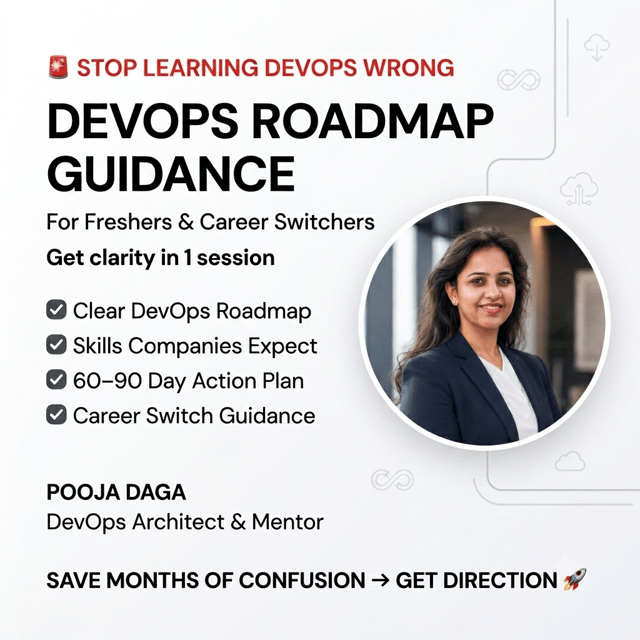
DevOps Roadmap & Guidance for Freshers & Switchers
1:1 DevOps Mentorship Session
Terraform Industry-Level Guidance
Scenario Based Kubernetes Interview Questions Vol1
DevOps Interview Preparation Bundle
🚀 DevOps Interview Success Bundle
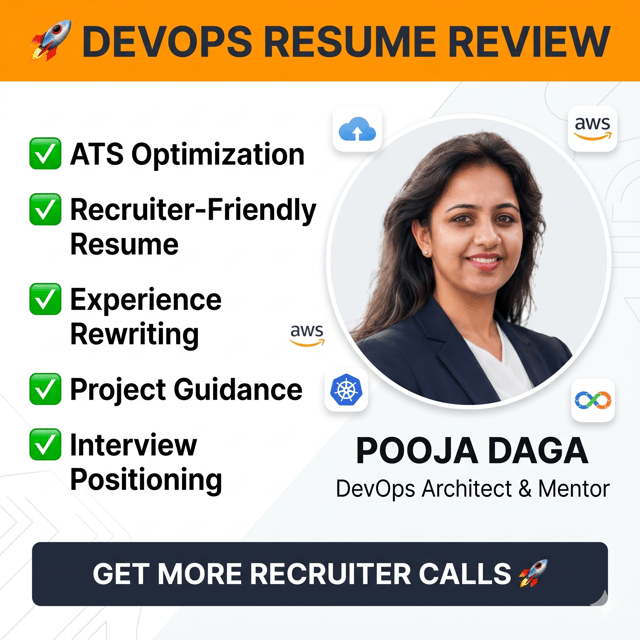
DevOps & Cloud Interview Preparation
DevOps Mock Interview & Feedback
Terraform Interview Questions – Scenario-Based
Inside DevOps: Ask Me Anything
About me
- Pooja Daga's insights and helpfulness in DevOps architecture are highly valued. She's instrumental in aiding others with her knowledge. Highly recommended.
 AI-generated based on testimonials
Frequently asked questions
What are the most commonly asked DevOps interview questions and answers?
The most commonly asked DevOps interview questions and answers revolve around fundamentals — what DevOps is, how a CI/CD pipeline works, Git branching strategies, Docker vs virtual machines, and basic Kubernetes and cloud concepts — before moving into troubleshooting scenarios like debugging a failed deployment or rolling back a bad release. Structure your preparation around Linux, one cloud platform (AWS is the most in-demand in India), one CI/CD tool, containers, and Infrastructure as Code, and always explain the reasoning behind an answer rather than memorizing it, because follow-up questions expose rote learning quickly.
What are the most important DevOps interview questions and answers for freshers?
DevOps interview questions and answers for freshers usually stay conceptual: what DevOps is and why it exists, the stages of a CI/CD pipeline, basic Linux commands, Git operations, the difference between an image and a container, and simple YAML or cloud questions. You may also get light scenarios such as "a build is failing — what do you check first?" Pair your theory with one hands-on project you can explain end to end, since that immediately separates you from candidates who only list tools on their resume.
What are the typical DevOps interview questions for 3 years of experience?
DevOps interview questions for 3 years of experience focus on working depth rather than definitions: designing and debugging CI/CD pipelines, writing Dockerfiles, deploying and troubleshooting Kubernetes workloads, writing Terraform modules, and using AWS services like IAM, VPC, and EC2 in real setups. Interviewers at this level weight your own war stories heavily — an incident you debugged, a pipeline you improved, a migration you handled — so prepare two or three detailed examples from your work.
What are scenario-based DevOps interview questions and answers for experienced candidates?
Scenario-based DevOps interview questions and answers for experienced candidates test how you think, not what you memorized. Typical examples: a Kubernetes pod keeps crashing after deployment, Terraform state has drifted from real infrastructure, or a production release failed at midnight — what exactly do you do? Answer with a framework: identify the symptom, isolate the failing layer (application, container, cluster, network, cloud), check logs and metrics, fix it, and then explain how you'd prevent recurrence. Practicing this structure out loud matters more than reading another question list.
Where can I find a reliable DevOps interview questions and answers PDF?
A good DevOps interview questions and answers PDF is fine for a first revision pass, but most free PDFs recycle the same 50–60 theoretical questions while real interviews — especially at product companies — are scenario-driven. Use the PDF to cover definitions quickly, then combine it with hands-on practice: build a small CI/CD project, break it deliberately, and fix it. Scenario-based question banks and mock interviews with feedback will prepare you far better than any static document.
What are the most commonly asked Terraform interview questions and answers?
The most frequently asked Terraform interview questions and answers cover the init/plan/apply workflow, state files and remote state, providers, modules, variables, outputs, and drift detection. Expect sharp follow-ups such as "what happens if two engineers run apply at the same time?" (state locking), "how do you manage secrets in Terraform?", and "plan succeeds but apply fails — why?" Understanding the why behind state management is where most candidates get filtered out.
How are Terraform interview questions for experienced professionals different from fresher-level ones?
Terraform interview questions for experienced professionals move from syntax to design judgment: structuring code for multi-environment setups, module design and reuse, state management across teams, workspace strategies, locking and drift handling, and integrating Terraform into CI/CD at scale. Senior rounds are judged on the trade-offs you make, so prepare real examples — a refactor you led, a state corruption you recovered from, a rollout you made safer.
How do I answer scenario-based Terraform interview questions?
Scenario-based Terraform interview questions describe a real situation and ask what you would do — for example, resources were deleted from the console but still exist in state, an apply failed halfway, or two teams keep overwriting each other's infrastructure. Answer in sequence: assess the state, mention the exact commands you'd use (state list, import, refresh, taint/untaint), and close with prevention through remote state, locking, and code review. Rehearsing these on a live project is the fastest way to sound fluent.
What are the most commonly asked Kubernetes interview questions and answers?
Core Kubernetes interview questions and answers cover pods, deployments, services, ConfigMaps, secrets, namespaces, probes, and rolling updates, followed by troubleshooting questions like "the pod is in CrashLoopBackOff — what do you check?" Interviewers usually go beyond definitions into scheduling, cluster networking basics, and how components communicate. Make sure you can narrate the full path from a Deployment manifest to a running, accessible pod, because that flow connects most of the questions you'll face.
What do Kubernetes interview questions and answers for experienced candidates usually cover?
Kubernetes interview questions and answers for experienced candidates go deeper into architecture and reliability: designing production-grade clusters, requests and limits, autoscaling with HPA, network policies, RBAC, ingress controllers, node failure handling, and GitOps deployments with tools like ArgoCD. Expect debugging chains — ImagePullBackOff, OOMKilled pods, services unreachable across namespaces — plus questions on how you'd roll out changes safely at scale. Real production examples make the strongest answers here.
What are the common Kubernetes interview questions for 5 years of experience?
Kubernetes interview questions for 5 years of experience shift from "what is a pod" to design and ownership: multi-cluster or multi-environment strategy, securing workloads, cost optimization, zero-downtime cluster upgrades, implementing GitOps, and leading incident response. Expect architecture discussions with trade-offs, such as managed node groups versus self-managed nodes, and behavioral questions about outages you've handled. Depth and production judgment are what differentiate you at this level.
Where can I find a good Kubernetes interview questions and answers PDF?
A Kubernetes interview questions and answers PDF is genuinely useful for last-mile revision — definitions, kubectl commands, and object types in one place. Just remember that PDFs rarely prepare you for the troubleshooting scenarios that dominate experienced-level rounds. Use the PDF for theory and pair it with a hands-on cluster (minikube, kind, or a cloud free tier) and scenario practice; that combination is what actually gets people through.
Is preparing from Kubernetes interview questions on GitHub enough to clear an interview?
Preparing from Kubernetes interview questions on GitHub is a strong starting point — several well-maintained repositories compile real questions asked at top companies. The gap shows up in scenario and troubleshooting rounds, because reading an answer is not the same as debugging a live cluster. Use GitHub lists to know what gets asked, then reproduce the tasks hands-on: deploy something, break it, fix it. If you can explain every step of what you did, GitHub-based preparation becomes genuinely sufficient.
What are Azure DevOps interview questions and how do I prepare for them?
Azure DevOps interview questions focus on Microsoft's DevOps platform — Azure Repos, Azure Pipelines, Boards, and Artifacts. Typical questions cover building a CI/CD pipeline (YAML versus the classic editor), agents and agent pools, service connections, variable groups, and how work tracking integrates with pipelines. If the role is Azure-based, brush up on core Azure services alongside the tool, because interviewers usually mix platform questions with cloud questions.
Why do I keep getting DevOps interview calls but not clearing the later rounds?
Getting calls but failing in later rounds almost always points to a depth gap: you know the definitions, but the second and third rounds test scenario thinking — debug this pipeline, design this deployment flow, troubleshoot this cluster — under pressure. Close the gap with hands-on practice on real-world style setups, structured scenario answers, and mock interviews with honest feedback so you learn how your explanations land. Also prepare three or four detailed project stories, because "tell me about a problem you solved" decides most final rounds.