Testimonials
Services

4 Mock interviews on your flexibility
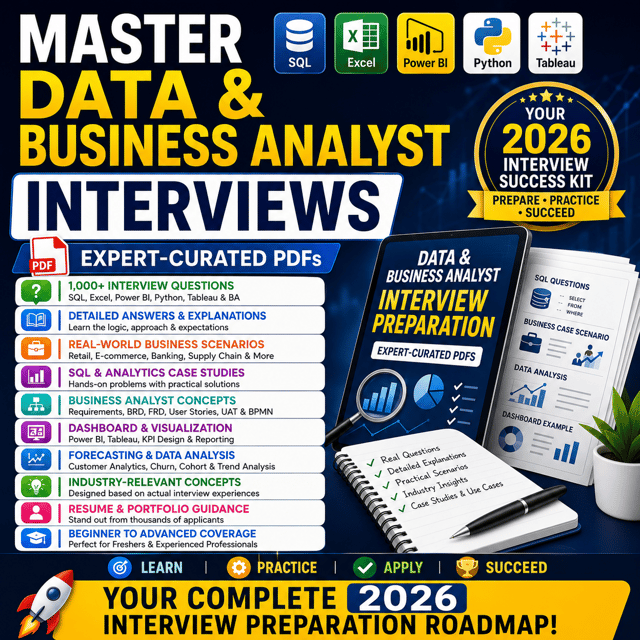
Data Analyst/Business Analyst Resources

Linkedin Profile Optimisation


21 hours Personal Mentorship ( Hand Hold Care )
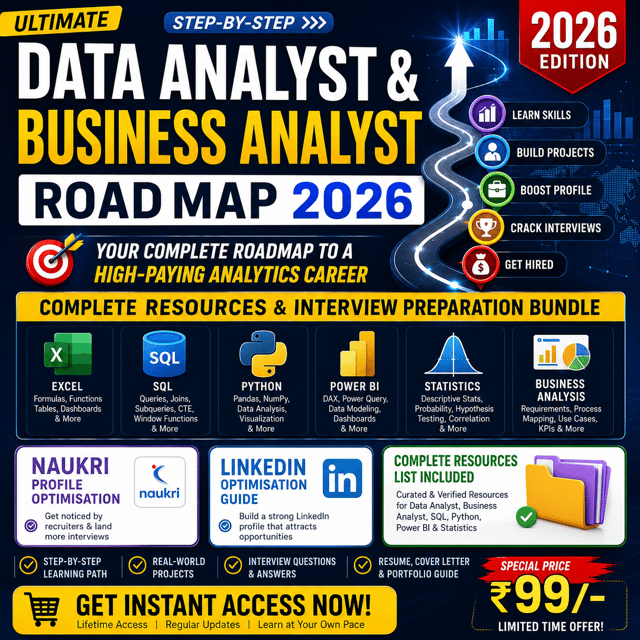
Data Analyst & Business Analyst Roadmap 2026
Interviews List - Personal
1:1 Mentorship
Naukari Profile Optimisation
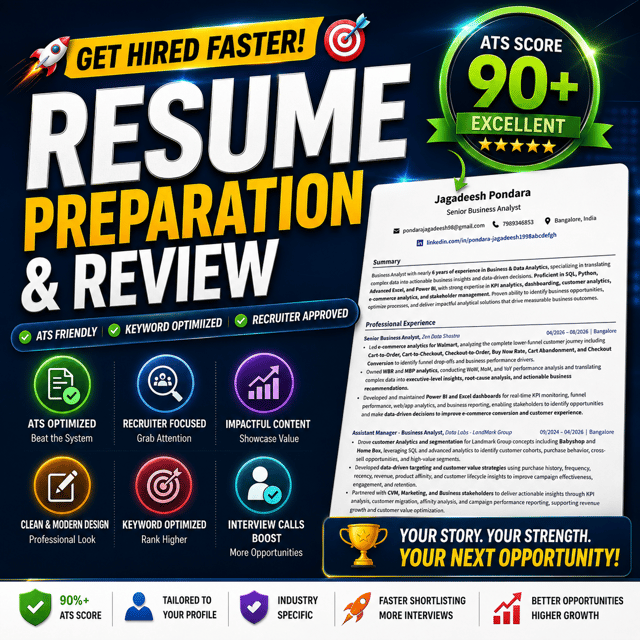
Naukari + Linkedin + Resume - Profile Optimisation
About me
- DATA & BUSINESS ANALYTICS IN MICROSOFThttps://www.linkedin.com/feed/update/urn:li:activity:7433570142493708289/

- 3 DAY WORKSHOP IN VIIT on ADVANCED DATA ANALYTICShttps://www.linkedin.com/feed/update/urn:li:activity:7431759232204640257/

- TEACHING HANDS-ON ADVANCED SQL & EXCEL ANALYTICShttps://www.linkedin.com/feed/update/urn:li:activity:7352279932158291968/
- BUSINESS ANALYTICS SESSION FOR MBAhttps://www.linkedin.com/feed/update/urn:li:activity:7428634851416621057/


Frequently asked questions
How to learn data analytics from scratch in India?
Start with Excel to build fundamentals, then move to SQL for querying data, Python for analysis and automation, and Power BI or Tableau for dashboards. Practise on free datasets from Kaggle and build 2–3 portfolio projects such as a sales dashboard or an expense tracker. The best way to learn data analytics is consistent daily practice — a structured roadmap or a time-bound challenge keeps most beginners on track better than random tutorials.
How does data analytics work in a real company?
Every project follows the same core flow: a business question is defined, data is collected from CRMs, ERPs or spreadsheets, cleaned for errors and duplicates, and then analysed using Excel, SQL or Python. The findings are visualised in dashboards and shared with stakeholders who use them to make decisions on pricing, inventory or marketing. That is why analysts who can both work with numbers and explain insights clearly are in demand across India's IT, banking, e-commerce and healthcare sectors.
What is the data analytics life cycle?
The data analytics life cycle is the end-to-end process of turning raw data into decisions: understanding the business problem, collecting data, cleaning and preparing it, performing exploratory analysis, visualising or modelling the results, and communicating recommendations. Interviewers often ask freshers to explain it with a real example, so prepare one end-to-end scenario, such as analysing why sales dropped in a particular quarter.
What is a data analytics job, and what does a data analyst do every day?
A data analytics job involves collecting, cleaning and interpreting data so a business can make better decisions. A typical day includes writing SQL queries, building Excel or Power BI reports, fixing messy data, attending stakeholder discussions and presenting insights. In India these roles are listed as Data Analyst, Business Analyst or Reporting Analyst across IT services, banks, e-commerce, consulting and product companies.
What is data analytics and data science, and how are the two different?
Data analytics focuses on examining existing data to answer business questions using tools like Excel, SQL and Power BI. Data science goes a step further by building predictive models and machine learning systems, which needs stronger statistics and programming in Python or R. Analytics is usually the easier entry point for freshers, and many professionals move into data science after gaining 2–3 years of experience.
What is a business analyst job, and what does a business analyst do daily?
A business analyst job sits between business teams and technical teams. Daily work includes gathering requirements from stakeholders, documenting processes, analysing data in Excel or SQL, preparing reports and ensuring the delivered solution matches the business need. Communication, documentation and problem-solving matter as much as tools, which is why business analysts in India come from both technical and non-technical backgrounds.
How to become a business analyst with no experience in India?
Combine transferable skills with proof of ability: learn Excel and SQL, understand basic business processes, complete 2–3 case-study projects like churn or sales analysis, and add a recognised certification. Then apply for entry-level business analyst jobs, internships and analyst trainee roles, and back this up with a well-optimised Naukri and LinkedIn profile plus referrals. Domain knowledge from a previous job in sales, operations or finance often becomes your biggest differentiator.
What is a business analyst course, and is it worth doing as a fresher?
A business analyst course teaches the skills the role demands — Excel, SQL, data visualisation, requirement gathering, documentation and usually a capstone case study. It is worth it only if the course is practical and project-based rather than just recorded videos, so check whether you will build portfolio projects, get mock interview practice and receive mentor feedback before paying.
What are the most common data analyst interview questions for freshers?
Freshers are usually tested on SQL joins and group by, Excel VLOOKUP and pivot tables, basic statistics like mean, median and standard deviation, and Python pandas basics if the role needs it. Expect walkthroughs of your projects, a guesstimate such as estimating daily sales at a railway station, and scenario questions on handling dirty data. Practise explaining each project end-to-end, because interviewers judge communication as much as technical depth.
How to crack a data analyst interview as a fresher?
Cracking a data analyst interview comes down to structured data analyst interview preparation: revise SQL and Excel daily, rebuild your two best projects so you can defend every decision in them, prepare crisp answers for common questions, and do at least 3–5 mock interviews to simulate pressure. Research the company's domain, keep a one-page summary of your projects ready, and prepare thoughtful questions to ask the panel.
What are the most asked business analyst interview questions?
Common business analyst interview questions cover requirement elicitation techniques, SDLC and Agile basics, writing user stories, handling conflicting stakeholders, and SQL or Excel fundamentals. You may also get a case study, such as improving the order flow of a food delivery app. Prepare 2–3 real examples from projects or college work in a Situation-Task-Action-Result format, since BA interviews weigh structured communication heavily.
What is the business analyst salary in India for freshers and experienced professionals?
Business analyst salary in India depends heavily on city, company type and skills. Entry-level roles generally start around ₹4–7 LPA, analysts with strong SQL, Excel and Power BI skills move into higher bands within 2–3 years, and senior or product-company BAs earn considerably more. Domain expertise in banking, insurance or healthcare, along with proven stakeholder-handling skills, are the fastest salary levers.
Which data analytics courses in India are actually worth doing?
A good data analytics course should cover Excel, SQL, Python and Power BI using real datasets, include portfolio projects and offer mentor feedback or doubt-clearing, not just lectures. Check whether there is placement or interview support, read recent learner reviews, and prefer options that let you build 2–3 end-to-end projects you can showcase on GitHub and LinkedIn. Free resources can take you far, so pay only for structure and mentorship.
How can a fresher get a data analytics internship in India?
Build 2–3 portfolio projects first, because recruiters filter internship applicants on demonstrable skills. Publish them on GitHub, add them to your LinkedIn and resume, then apply through Internshala, LinkedIn, Naukri and company career pages, and message alumni or analysts for referrals. Many internships convert into full-time data analytics jobs, so treat the internship hunt itself as proof of your consistency — the same approach works for a business analyst internship.
How do I switch to a data analyst or business analyst role from a non-technical background?
It is very doable — companies hire analysts from sales, operations, finance, HR and non-IT support roles. Start with Excel and SQL as the least intimidating entry points, learn Power BI to show visualisation skills, and build projects around data from your current domain, for example analysing your company's sales pipeline. Then reposition your resume around these projects and analytical wins, and target analyst roles in your own domain first, where your business knowledge gives you an edge over purely technical candidates.