Testimonials
Services
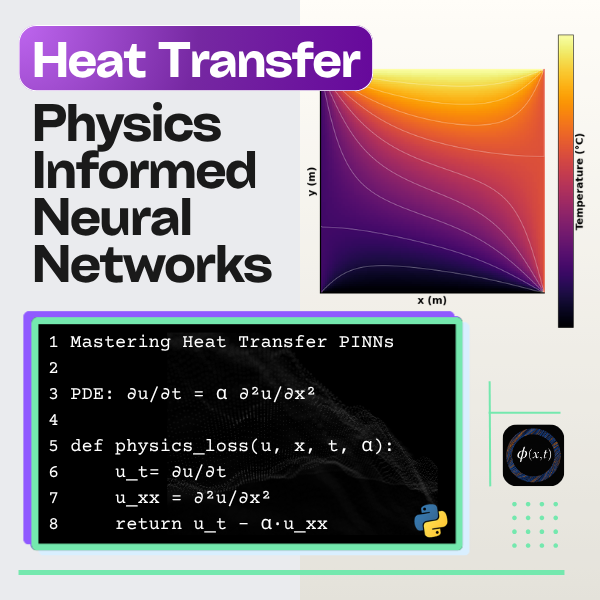
Mastering Heat Transfer PINNs: A Coding Guide
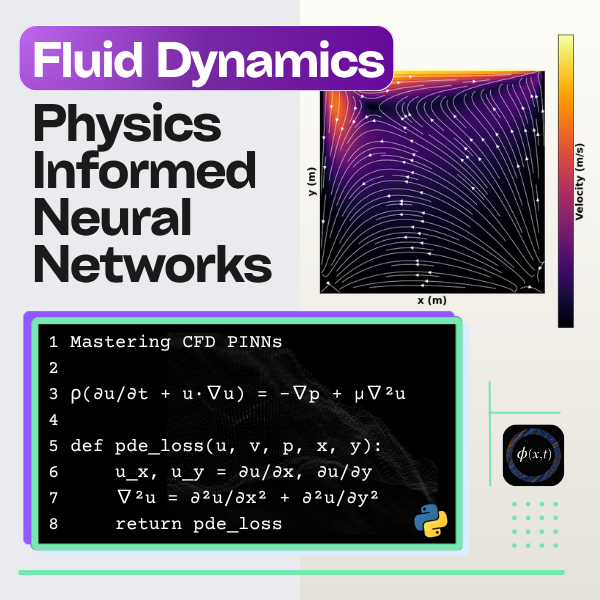
Mastering CFD PINNs: A Coding Guide

Mastering Dynamics PINNs: A Coding Guide
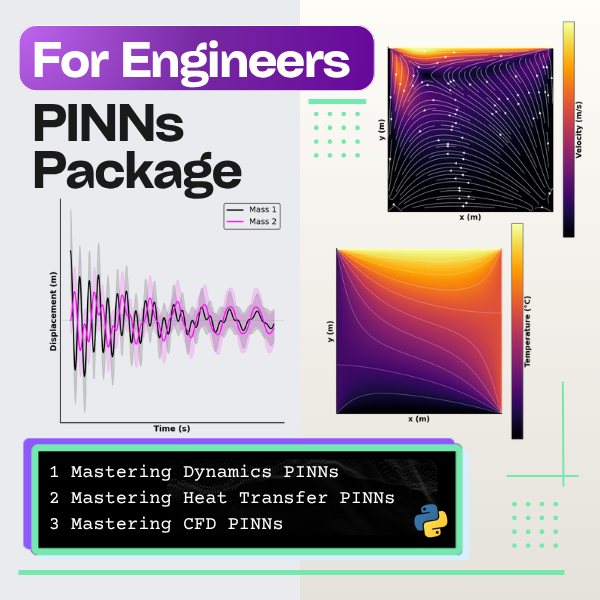
PINNs Package: Dynamics, Heat Transfer & CFD
Frequently asked questions
What is a PINN?
A Physics-Informed Neural Network is a neural network that is trained to satisfy the governing equations of a physical system, such as the Navier-Stokes equations or the heat equation, directly through its loss function. Rather than learning purely from labelled data, the network is penalised for violating the underlying physics at a set of collocation points throughout the domain. This means it can solve partial differential equations, reconstruct flow fields from sparse measurements, and identify unknown physical parameters, all without requiring a computational mesh.
Do I need a background in machine learning to take the course?
A basic familiarity with Python is helpful but no prior machine learning experience is required. The notebooks are designed for mechanical engineers who understand the physics and want to learn how to implement these methods from scratch.
What software do I need?
Everything runs in Python. The notebooks use PyTorch and are compatible with Google Colab so no local installation is required and the full set of courses can be completed in the browser.
What is an inverse PINN and why is it useful?
An inverse PINN identifies unknown physical parameters directly from measurement data. Rather than assuming you know the thermal conductivity, damping coefficient, or material constant, you make it a learnable parameter and let the training process recover it from observations. This is directly applicable to real engineering problems where parameters are difficult or expensive to measure directly.
Can PINNs replace CFD?
Not yet, and probably not entirely. PINNs are best understood as a complementary tool rather than a replacement. They excel where data is sparse, where inverse problems need solving, or where a fast parametric surrogate is needed. For high Reynolds number turbulent flows, conventional CFD remains the more reliable choice. The most practical near-term direction is hybrid approaches that combine the strengths of both, which is exactly what several of the course notebooks demonstrate.