Testimonials
Services
ATS Ready CV AI Prompt
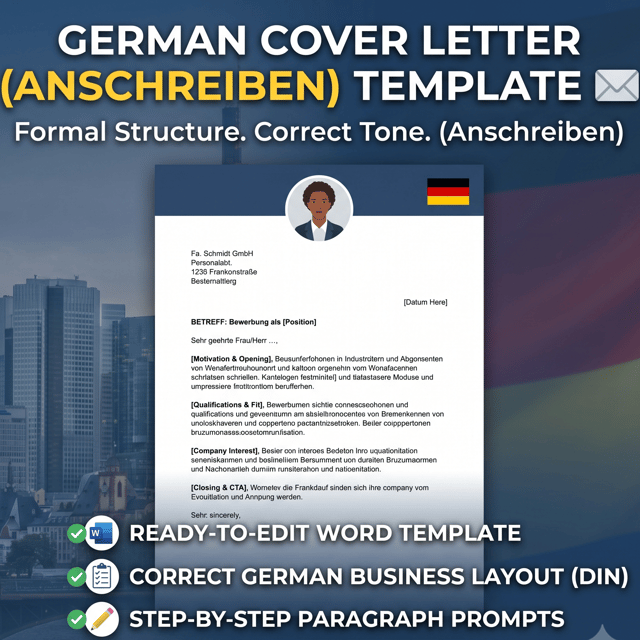
German Cover Letter Template (Anschreiben)
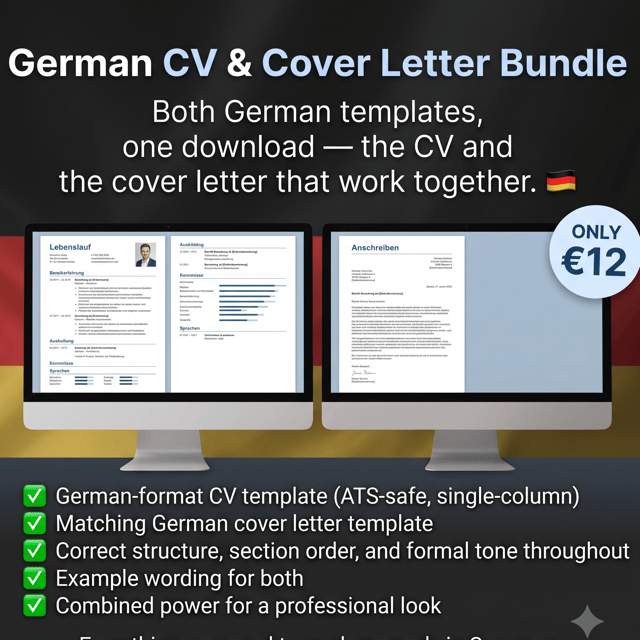
ATS proof CV + Cover Letter German Bundle
Complete Job Application Package Germany (DE)
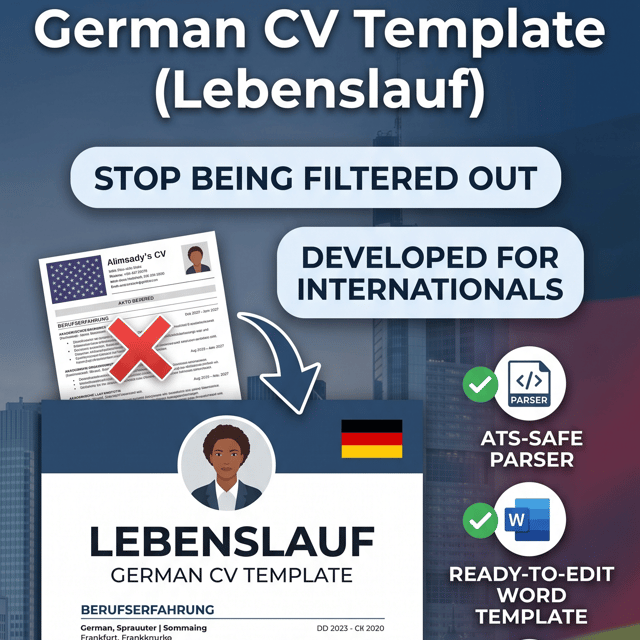
ATS Proof CV Template (English + German)
Student Job Guide (Without Perfect German)
The Germany Investment Guide 💰
Winning Jobs in Germany
About me
- Pawan Bhoyar | Jobs, Study & Life in Germany 🇩🇪 (@winningwithpawan) • Instagram photos and videoshttps://www.instagram.com/winningwithpawan/

Frequently asked questions
How to get a job in Germany when you are still applying from another country?
Start with the visa path, because most non-EU applicants need either a job offer for a skilled-worker permit or EU Blue Card, or the Opportunity Card to come and search on-site. Build a German-style CV (Lebenslauf), target sectors that hire internationally such as IT, engineering, healthcare and finance, apply through portals like LinkedIn, StepStone and Indeed Germany, and expect the process to take several months. A tailored German application for well-matched roles gets far better responses than mass applying.
Are there real jobs in Germany for English speakers?
Yes, especially in IT, software, engineering, finance, science and startups, with Berlin, Munich, Hamburg and Frankfurt hosting the most English-friendly employers. Outside these hubs and outside multinational companies, most roles expect at least B1 or B2 German. English can land you the first job, but learning German is what unlocks the wider market and better salaries.
How do I find jobs in Germany for foreigners with visa sponsorship?
Focus on shortage fields like IT, healthcare, engineering and skilled trades, where employers routinely hire non-EU candidates. Use job boards with a visa sponsorship filter, target multinationals and startups that mention relocation support, and check company career pages directly. Note that hiring foreigners in Germany is usually simpler than in the US: once a company hires you, the work visa process through the immigration office is largely procedural.
How competitive are jobs in Germany for Indians?
Germany actively wants skilled workers and the Indian community there has grown to well over 200,000 people, so the path is well-trodden, especially in IT, engineering, data and healthcare. The competition is mostly about application quality: German employers expect a properly formatted Lebenslauf, relevant keywords and realistic role targeting. Indian degrees are generally accepted, but a Germany-specific CV and a clear visa plan massively improve your response rate.
What is a mini job in Germany?
A mini job is a form of marginal part-time employment with earnings below a monthly cap (around €556 in 2025, adjusted regularly). You pay little or no tax on it, employers pay reduced social contributions, and it is common in cafés, retail, delivery, cleaning and tutoring. Internationals can do mini jobs if their residence permit allows work — students should check their permit's annual work limits first.
What is the Job Opportunity Card in Germany?
The Job Opportunity Card, called the Chancenkarte in German, is a points-based job-seeker residence permit introduced in June 2024. It lets qualified non-EU nationals live in Germany for up to a year to look for work, with part-time work up to 20 hours a week and trial days allowed. You either qualify through full recognition of your degree or vocational training, or by scoring at least six points for criteria like qualification, language, experience and age. Once you get a qualified job offer, you switch to a skilled-worker permit or EU Blue Card.
What are the main Opportunity Card Germany requirements?
You need a recognized qualification (a university degree or completed vocational training), proof that you can support yourself (typically a blocked account or, in some cases, a part-time job offer), health insurance, and either basic German or good English skills. If your qualification is not fully recognized in Germany, you go through the points route and must score at least six points. Details are updated on the official portal, so verify them before applying.
How do the Opportunity Card Germany points work?
You score points across categories: the recognition level of your qualification, professional experience in recent years, German language level (each level adds points), strong English, age (under 35 scores highest), previous time spent in Germany, and shortage occupations. You need a minimum of six points alongside the basic eligibility criteria. Most applicants improve their score fastest by adding a German language certificate.
How do I apply for the Opportunity Card Germany from India?
First confirm that your degree or training is recognized (the Anabin database is the official reference) and get your language certificate sorted. Calculate your points, prepare your documents, and book a national visa appointment at the German consulate serving your region in India — appointment waits can be long, so start early. You will show proof of funds, health insurance and your documents at the appointment, and once approved you get a year to move to Germany and job-search.
How much is the Opportunity Card Germany blocked amount, and what else should I budget for?
You generally need to show roughly €1,000 per month for your first year in a blocked account (Sperrkonto) — the exact annual figure is updated regularly, and a qualifying part-time job offer can sometimes replace it. Beyond that, the overall Opportunity Card Germany cost is modest: the visa fee is around €75, but budget extra for document translations, health insurance and initial setup costs like a rental deposit.
Is an Opportunity Card Germany extension possible?
The card is issued for one year, and an extension is possible in certain situations — mainly when you can prove your livelihood is secure, typically through qualified part-time work. In practice, the stronger move is usually switching to a skilled-worker residence permit or EU Blue Card as soon as you sign a qualifying employment contract, since those lead to long-term settlement.
Where can I find a German CV template free of charge that is actually usable?
Look for templates on the career-advice pages of major German job portals, or use the built-in CV layouts in Word and Google Docs as a base. A proper Lebenslauf is one to two pages, reverse-chronological, with clear sections for work experience, education, skills and languages, and it should be fully editable so you can tailor it for each application. Avoid heavily designed downloads with watermarks or graphics-heavy layouts, which hurt you with both recruiters and ATS software.
What makes a German CV template ATS friendly?
Simplicity: a single-column layout, standard section headings, common fonts like Arial or Calibri, no text boxes, tables or image-based elements that confuse parsing software, and keywords mirrored from the job posting. A German CV template that is ATS friendly still follows local conventions, such as consistent date formats and no unexplained gaps (the photo is now optional), so you don't trade local credibility for machine readability.
How to get a credit card in Germany when you have no SCHUFA history?
Open a current account first, which requires your Anmeldung (address registration), since most German cards are tied to a bank account. With no SCHUFA record, online banks and fintechs usually approve newcomers fastest, while traditional banks may want income proof or a few months of account history. A debit or prepaid card gets you started, and after three to six months of normal account activity you can apply for a regular credit card and start building a SCHUFA footprint.
What credit cards are accepted in Germany?
Visa and Mastercard are accepted almost everywhere that takes cards, while American Express works mainly at larger chains and hotels. Locally, the Girocard (EC card) is still the everyday default, and many smaller shops, bakeries and market stalls are cash-only, so always carry some cash. Also note that many German "credit cards" are actually debit versions of Visa or Mastercard — they work the same at terminals, but check the card type if you need it for hotels, car rentals or deposits.