Testimonials
Services
Have a question ?
About me
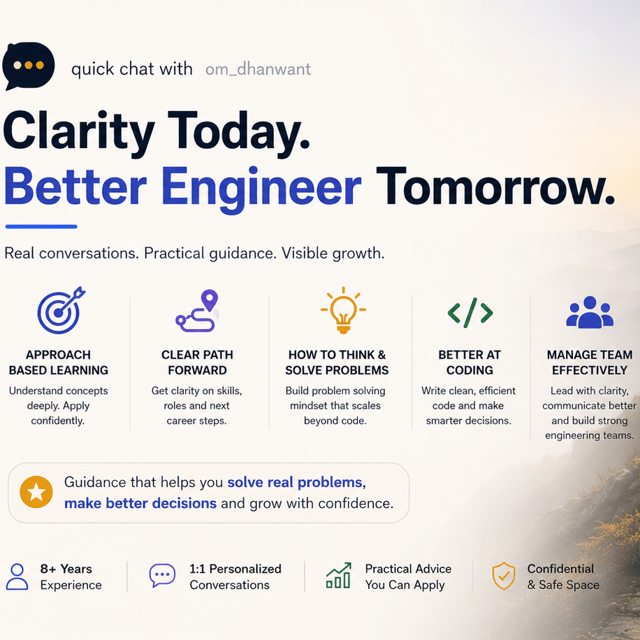
- Om Dhanwant is praised for his tech expertise, supportive guidance, and practical advice, helping others navigate their career paths effectively.
 AI-generated based on testimonials
 - Use code `FIRSTDM` to get your first priority DM service for free! Grab it!

- Use code `FIRSTTIME` to get your first Quick Chat service for free! Let's connect on a call.
Frequently asked questions
What is JavaScript used for?
JavaScript is used to make websites interactive — form validation, dropdowns, sliders, live search, and real-time updates are all powered by it. It also runs backend servers through Node.js and powers mobile and desktop apps, which is why JavaScript skills sit at the center of almost every frontend development job description in India.
Does JavaScript cost money?
No, JavaScript is completely free. It is built into every browser, there is no license or subscription, and you can learn and practice it using free tools and documentation. You may choose to pay later for structured guidance or mentorship, but the language and its core ecosystem cost nothing.
How to run JavaScript in VS Code?
Install VS Code and Node.js first, then run a file from the terminal using "node filename.js" to see the output. If you are building web pages, add an extension like Live Server so your HTML, CSS, and JavaScript reload in the browser as you type, and keep the browser console (F12) open for quick testing of small snippets.
Is it okay to practice with a JavaScript online compiler instead of a local setup?
Yes — a JavaScript online compiler is perfect when you are starting out because you can write and run code in the browser with zero installation, which is handy if you are on a shared or low-end system. Move to a local setup with VS Code and Node.js once you begin real projects and version control, since that mirrors how actual development teams work.
What are the most common JavaScript interview questions for freshers?
Most fresher interviews start with var, let, and const, hoisting, closures, data types, == vs ===, array and object methods, promises, async/await, and the event loop, followed by small programs like reversing a string or removing duplicates from an array. Prepare by writing these as actual code rather than just reading answers, because interviewers in India almost always make you code live.
How to create an Angular project?
Install Node.js, then install the Angular CLI with "npm install -g @angular/cli", create your app with "ng new my-app", and run "ng serve" to open it at localhost:4200. If setup fails, check your Node version first — a mismatch between Node and the CLI is the most common reason a new Angular project refuses to start.
How to check Angular version in an existing project?
Run "ng version" inside the project folder — it lists the Angular CLI and framework versions along with your Node details. You can also open package.json and look at the @angular/core entry under dependencies, which is useful when a job posting specifically asks for experience with a certain Angular version.
Do I need to learn the Angular latest version to get a job?
Learn on the latest version, but do not stress about older ones — components, services, dependency injection, routing, and RxJS concepts stay consistent across releases, and many companies still maintain older codebases. If your fundamentals are strong and you understand how upgrades work, adapting to whatever version a company uses is straightforward.
How do I prepare for Angular interview questions?
Be able to clearly explain components, data binding, directives, services and dependency injection, lifecycle hooks, routing, reactive vs template-driven forms, and observables. Then build one complete application end to end so you can describe real decisions and bugs you handled — that is what separates candidates who have memorized Angular interview questions from those who have actually worked with the framework.
What is the right frontend development roadmap for beginners?
A practical frontend development roadmap is HTML and CSS first, then JavaScript fundamentals, Git and GitHub, browser dev tools, and only after that one framework — Angular or React — followed by two or three real projects. The order matters more than speed, because most people who struggle later are the ones who jumped to a framework before their JavaScript basics were solid.
Which frontend development projects should I build to get hired?
Build projects that look and behave like real products: a responsive dashboard or e-commerce UI, a task manager with login and CRUD operations, and an app that consumes a public API with search, filters, and pagination. Host each one live, keep clean code on GitHub with a proper README, and be ready to explain the technical choices behind your frontend development projects — that is exactly what interviewers probe.
How can I get a frontend development internship with no experience?
Let your projects be your experience: two or three solid, live projects with clean GitHub repositories are what get you shortlisted. Apply through internship portals, your college placement cell, and LinkedIn, and reach out to startups directly with a short note linking your work. Getting your resume and code reviewed by someone experienced before applying helps a lot, since most rejections happen at the screening stage rather than the interview.
Do I need a frontend development course to get a job?
Not necessarily — many developers are self-taught, and companies hire based on what you can build. A structured frontend development course or a mentor mainly saves you from scattered tutorials, gives feedback on your code, and keeps you consistent. If you self-learn, replace that structure with a fixed roadmap, weekly targets, and projects you finish end to end.
How much do front end developers make in India?
It varies widely with skills, city, and company type. Freshers usually start with modest packages in service companies, while developers with strong JavaScript fundamentals, depth in a framework like Angular or React, and a portfolio of real projects earn significantly more, especially in product companies and funded startups. Skills like performance optimization, testing, and API handling directly push up how much front end developers make over time.
What is frontend development and backend development?
Frontend development is everything users see and interact with in the browser — layouts, buttons, forms, and animations — built with HTML, CSS, JavaScript, and frameworks like Angular. Backend development is the server side that handles databases, authentication, and business logic. Frontend is usually the easier starting point for beginners because you see results instantly, and demand stays high since every product needs a polished, usable interface.