Testimonials
Services
HTML Interview Questions & Answers
C# Interview Questions for .NET Developers
Spring Boot Interview Questions & Answers

Android Interview Questions & Answers

TypeScript Interview Questions & Answers

Vue Interview Questions & Answers
Nodejs Interview Questions & Answers

High Level Design Interview Questions & Answers

HLD + LLD System Design Interview Bundle
Java Backend Interview Bundle
React Frontend Interview Bundle
Vue Frontend Interview Bundle
Backend Interview Bundle- JS+TS+NodeJs+NestJs+DB
Java Interview Questions & Answers
React Native Interview Questions & Answers

Flutter Interview Questions & Answers
JavaScript Interview Questions & Answers

Low Level Design Interview Questions & Answers
Python Interview Questions & Answers
Nestjs Interview Questions & Answers
Angular Interview Questions & Answers
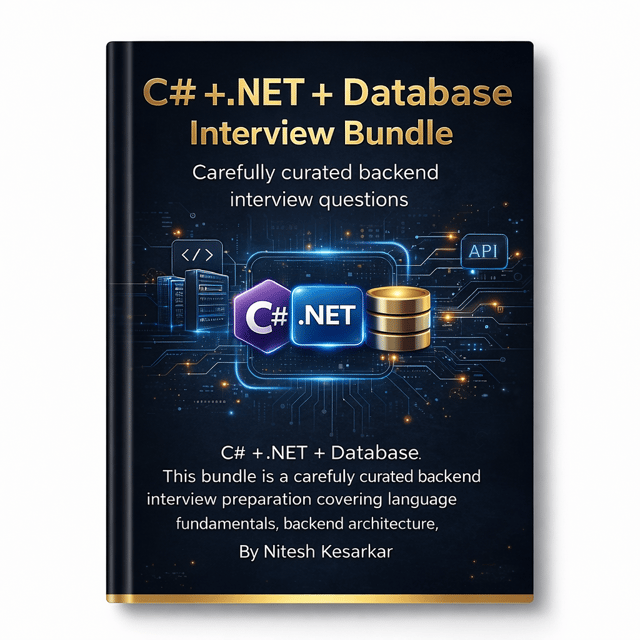
C# + .Net Backend Interview Bundle
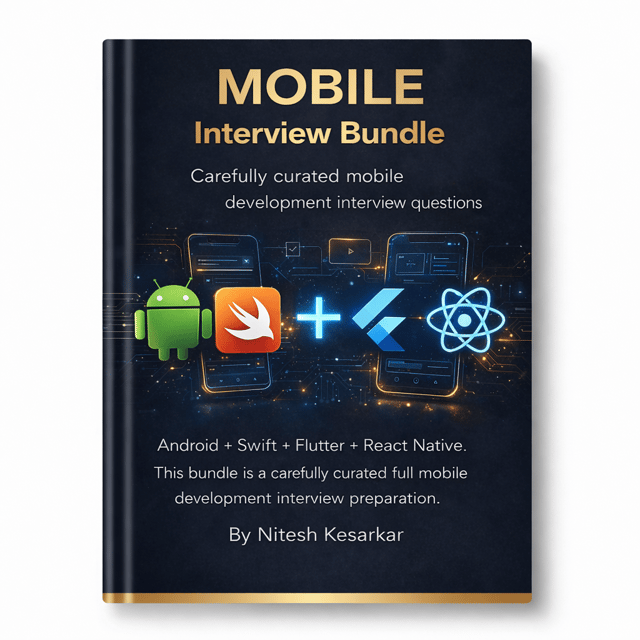
Mobile Interview Bundle
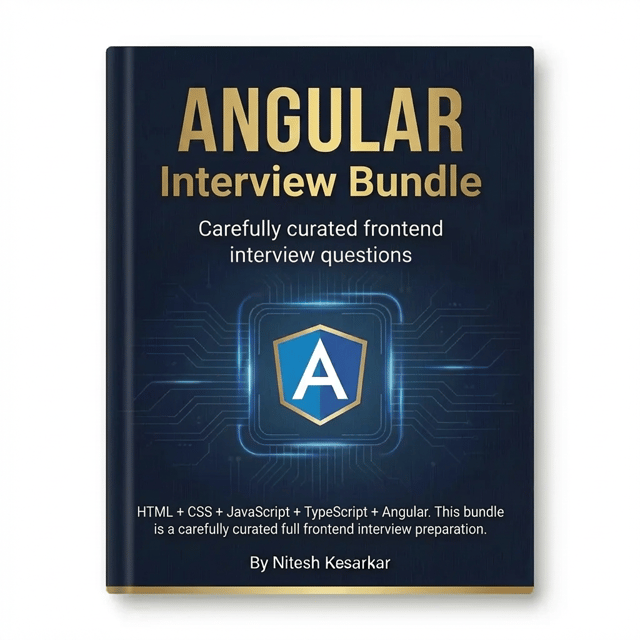
Angular Frontend Interview Bundle
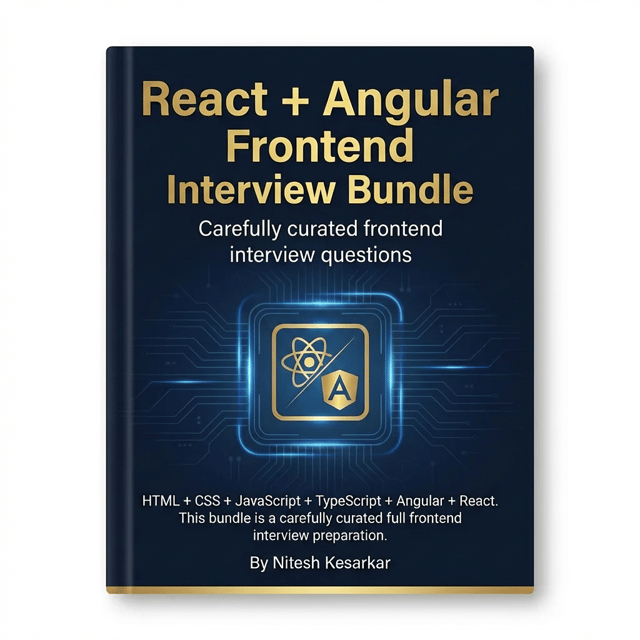
React + Angular Frontend Interview Bundle
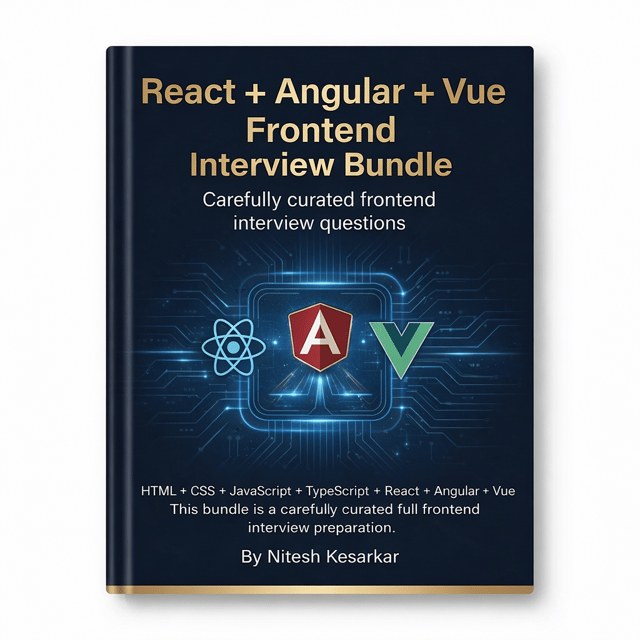
React + Angular + Vue Frontend Interview Bundle
About me
Frequently asked questions
What are the most commonly asked frontend interview questions and answers?
The frontend interview questions and answers that appear most often cover JavaScript fundamentals such as closures, the event loop, promises and prototypal inheritance, CSS topics like flexbox, grid and specificity, browser rendering, and framework-specific concepts including component lifecycle and state management. Product companies also test performance optimization, TypeScript and accessibility. What matters more than memorizing answers is understanding the reasoning behind them, because almost every answer is followed by a deeper "why" or a practical scenario.
Which frontend interview questions for freshers are asked most often?
Frontend interview questions for freshers usually stay close to the basics: var, let and const, == vs ===, hoisting, closures, callbacks versus promises, the box model, flexbox versus grid, semantic HTML and basic DOM manipulation. If your resume mentions React or Angular, expect a few entry-level questions on components, props, state or data binding. Freshers are evaluated mainly on conceptual clarity and how logically they approach a problem, not on advanced architecture.
What do frontend interview questions for 5 years of experience usually focus on?
Frontend interview questions for 5 years of experience move from syntax to design decisions: structuring large applications, managing state at scale, optimizing load time and rendering performance, designing reusable component systems, and handling security. Expect scenario-based questions such as debugging a slow page, reducing bundle size or migrating a legacy codebase, along with trade-off questions about choices you made in past projects. At this level, interviewers are validating architectural thinking, not syntax recall.
Where can I find reliable frontend interview questions in a PDF or on GitHub?
Searching for a frontend interview questions PDF or browsing frontend interview questions on GitHub will give you plenty of options, but most free material is scattered, outdated or lists questions without proper answers. A more effective approach is to pick one structured guide that covers fundamentals through advanced topics with clear explanations of what interviewers actually expect, then use GitHub repos and mock practice to test yourself. Always check how recently the material was updated and whether answers explain reasoning instead of giving one-line definitions.
What are the most asked React interview questions and answers?
The React interview questions and answers asked most frequently cover the virtual DOM and reconciliation, JSX, components versus elements, props versus state, useState and useEffect, controlled versus uncontrolled components, keys in lists and lifting state up. Senior rounds extend into memoization, context versus external state libraries, lazy loading, code splitting and re-render optimization. Preparing these topics with short real-world examples makes your answers far more convincing than textbook definitions.
How are React interview questions for experienced developers different from fresher-level questions?
React interview questions for experienced developers focus on architecture and trade-offs rather than definitions: designing scalable component structures, choosing between state management approaches, avoiding unnecessary re-renders, handling side effects cleanly and optimizing large lists with virtualization. You may also get a mini system design task, such as building an autocomplete or a data-heavy dashboard, where performance, maintainability and edge cases matter more than syntax.
Which React Hooks interview questions come up most often?
The most common React Hooks interview questions dig into useState and useEffect — dependency arrays, cleanup functions and stale closure bugs — along with the difference between useMemo and useCallback, the rules of hooks, and when to write a custom hook. Interviewers frequently show a snippet with a broken useEffect and ask you to identify the problem, so practise tracing hook behaviour line by line instead of relying on memorized definitions.
Are React Native interview questions different from React web interview questions?
Yes. React Native interview questions include the core React concepts such as components, state and hooks, but add mobile-specific areas: navigation with React Navigation, native modules and bridging, StyleSheet and mobile Flexbox behaviour, device permissions, FlatList optimization and performance tuning on low-end devices. If you are moving from web React to React Native, expect questions on platform-specific code and debugging on real devices rather than browsers.
What are the most frequently asked Angular interview questions and answers?
The Angular interview questions and answers that recur most often cover components and data binding, directives, services and dependency injection, lifecycle hooks, routing with guards, RxJS observables and change detection. Experienced rounds go deeper into the OnPush strategy, signals, standalone components, lazy loading and performance optimization. Because Angular is a complete framework, interviewers expect you to connect these concepts to how a real enterprise application is structured and scaled.
How should I prepare for Angular interview questions for 5 years of experience?
Angular interview questions for 5 years of experience concentrate on architecture and performance: standalone components versus NgModules, change detection and zone.js, signals versus RxJS for reactive state, advanced dependency injection, custom directives and pipes, and optimizing large component trees. Prepare two or three concrete examples from your own projects, such as reducing bundle size or improving runtime performance, since at this level interviewers check how you have actually applied the framework, not just its features.
What is an observable in Angular, and how is it different from a promise?
An observable in Angular is a stream that can emit multiple values over time and can be cancelled before it completes. Unlike a promise, it is lazy — nothing runs until you subscribe — it can emit many values instead of just one, it supports operators like map, filter and switchMap, and you can unsubscribe to stop it. This comparison is one of the most common Angular interview checks because it reveals whether a developer genuinely understands reactive asynchronous programming.
What is RxJS in Angular, and why do interviewers focus on it?
RxJS in Angular is a reactive programming library for handling asynchronous data streams using observables, observers and operators. Angular is built around it — HttpClient returns observables, reactive forms emit value changes through them, and the router exposes events as streams. Interviewers focus on RxJS because comfort with operators such as map, mergeMap, switchMap and debounceTime, along with subscription management and error handling, separates developers who truly understand Angular's asynchronous model from those who use it superficially.
What is an interceptor in Angular, and when is it used?
An interceptor in Angular is a special service that intercepts every HTTP request and response handled by HttpClient. Typical uses include attaching authentication tokens, adding headers, logging, global error handling, retrying failed requests and showing or hiding loaders. Interviewers often ask for a practical example, and the classic one is injecting a JWT into all outgoing requests from a single place instead of duplicating that logic in every API service.
How to respond to tell me about yourself in an interview?
Keep the answer to about 60–90 seconds and follow a simple flow: your current role and tech stack, two or three highlights that match the job description, and a closing line on why this role interests you. Since "tell me about yourself" is almost always the opening question, rehearsing a clear, structured answer sets a confident tone for the rest of the interview. Tailor the details to the company instead of reciting your resume from top to bottom.
What is the best way to respond to interview questions about weaknesses?
Most candidates overthink how to respond to interview questions about weaknesses. The formula that works is to name a genuine, non-critical weakness, acknowledge it without excuses, and describe the specific steps you are taking to improve — for example, a developer might admit to spending too long perfecting UI details and explain how time-boxing fixed it. Avoid clichés like "I work too hard" and never mention a weakness that directly breaks a core requirement of the role.