Testimonials
Services


Selenium Interview Questions
Manual Testing Handwritten Notes
150+ Java Coding Questions for Interviews
4000+ Manual Testing Interview Questions
Selenium Handwritten Notes
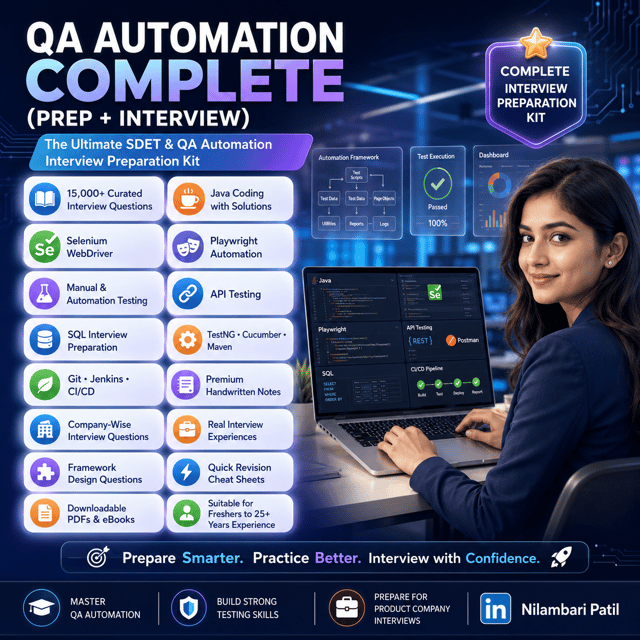
QA Automation Complete (Prep. + Interview)




Playwright Handwritten Notes
Java & Core Java Handwritten Notes
3000+ Automation Testing Interview Questions
2000+ Playwright Interview Questions
5000+ Company-Wise QA Interview Questions
About me
Frequently asked questions
How to learn Selenium automation testing?
The most practical path to learn Selenium automation testing is: first get comfortable with one programming language (Java is the most in-demand choice in India) and basic manual testing concepts, then move to WebDriver topics like locators, waits, and handling dropdowns, frames, and pop-ups. After that, learn TestNG, Maven, and Git, and build a small Page Object Model framework on demo websites. Push your project to GitHub — recruiters value a working framework far more than certificates alone.
What is Selenium used for in automation testing?
Selenium is an open-source suite used to automate web browsers, which makes it the go-to tool for regression testing, cross-browser testing, and smoke suites for web applications. It is usually paired with TestNG or Cucumber for structuring tests, Jenkins for continuous integration, and Postman or SQL checks to cover API and database layers. Since it works only on web applications, strong QA engineers combine it with API and database testing skills to cover the entire product.
Is learning Selenium worth it?
Yes — for anyone building a QA career in web testing, learning Selenium is worth it because Selenium plus Java is still the most demanded automation skill combination in the Indian job market. Automation roles consistently pay more than manual-only roles, and the concepts you master — locators, waits, framework design, CI integration — transfer directly to Playwright and Cypress. Just make sure you treat Selenium as a programming-first skill rather than a record-and-playback tool, because interviews expose that gap quickly.
What are the most common Selenium automation testing interview questions?
Selenium automation testing interview questions typically cover locator strategies (XPath vs CSS selectors), implicit vs explicit waits, handling dynamic elements, alerts, frames, and multiple windows, the Page Object Model, and TestNG annotations. Candidates with 3+ years of experience also face framework architecture, parallel execution, Jenkins integration, and "how would you debug a flaky test" scenarios. Prepare real examples from your own projects — interviewers probe deeper the moment you mention a framework you built.
What kind of Selenium automation testing jobs can I get in India?
Selenium automation testing jobs in India include Automation Test Engineer, SDET, QA Analyst, and Software Test Engineer across IT services, product startups, banking, healthcare, and e-commerce. Most job descriptions ask for Selenium with Java, TestNG, REST API testing, SQL, and some Jenkins or Git exposure. Freshers usually enter through trainee or manual QA roles and move into automation within 1–2 years, while experienced manual testers use Selenium to transition into higher-paying SDET positions.
How do I start Selenium automation testing with Java?
Starting Selenium automation testing with Java works best in a fixed sequence: Core Java first (OOPs, collections, exception handling), then WebDriver basics (setup, locators, waits, actions), then TestNG, Maven, and the Page Object Model. Automate 10–15 real user scenarios on demo websites and combine them into one small, reusable framework instead of isolated scripts. Weak Java fundamentals are the most common reason people stall, so don't rush that first step.
Can I do Selenium automation testing with Python instead of Java?
Yes — Selenium supports Python bindings, and Selenium automation testing with Python is often quicker to learn and write because of its simpler syntax. In India, a larger share of QA openings still list Java, but Python-based automation demand is rising fast, especially in product companies and AI-adjacent testing roles. If you already know Python, start with it; if you're starting from scratch and targeting service-based companies, Java gives you a wider pool of opportunities.
Which Selenium automation testing courses are worth taking?
The best Selenium automation testing courses are the ones that make you build a complete framework, not just watch videos. Check whether the syllabus covers WebDriver in depth, TestNG or pytest, Git, Jenkins basics, and API and database validation, and whether you finish with a portfolio project. Free courses with certificates are perfectly fine for fundamentals — just remember that recruiters shortlist based on your GitHub projects and practical interview rounds, so invest your main effort there.
What is the difference between Playwright and Selenium?
The difference between Playwright and Selenium comes down to how each tool talks to the browser. Selenium drives browsers through the W3C WebDriver protocol using a separate driver per browser, works with many programming languages, and has the largest community and job market. Playwright connects directly to modern browser engines, so it auto-waits by default, runs faster, and supports parallel execution and network interception out of the box — though its ecosystem and job demand are still smaller than Selenium's.
Playwright vs Selenium: which is better?
In the Playwright vs Selenium debate, "better" depends on your context. Playwright is better for modern web apps where speed, stability, and minimal setup matter; Selenium is better when you need wide language support, legacy browser coverage, mature integrations, and access to the biggest pool of QA jobs. Many teams actually run both, and testers who add Playwright on top of Selenium make their profiles stand out in the market.
Playwright vs Selenium architecture: how are they different?
The Playwright vs Selenium architecture difference is the root of most of their behavioural differences. Selenium uses the W3C WebDriver protocol, where commands pass through a separate browser driver over HTTP, adding latency and forcing testers to manage waits manually. Playwright maintains a persistent WebSocket connection directly with modern browser engines, enabling faster execution, automatic waiting, network mocking, and multi-tab or multi-origin testing without extra plugins.
What are the most asked Playwright vs Selenium interview questions?
Common Playwright vs Selenium interview questions include: when would you choose Playwright over Selenium, how their architectures differ, why Playwright tests are less flaky, how auto-waiting compares with explicit waits, and how you would plan a migration from Selenium. Expect scenario rounds on parallel execution, cross-browser strategy, and CI/CD integration. The strongest answers connect each tool to a specific project situation rather than reciting feature lists.
What are the most asked manual testing interview questions for freshers?
The most asked manual testing interview questions for freshers revolve around SDLC vs STLC, the bug life cycle, severity vs priority with examples, test case design techniques like equivalence partitioning and boundary value analysis, and the difference between smoke, sanity, retesting, and regression testing. You'll also get practical prompts such as "write test cases for a login page," plus basics of JIRA and Agile/Scrum. Pair every definition with a small example — that's what separates selected candidates.
Where can I find manual testing interview questions with answers?
Good manual testing interview questions with answers are available in curated question banks compiled by working QA professionals — look for sets organised by topic and experience level rather than random lists. The right way to use them: attempt each question yourself first, then compare your answer with the model answer and rewrite it in your own words with a real example. For scenario questions, practise structuring answers around your own projects, since Indian interviewers increasingly prefer practical explanations over textbook theory.
How are manual testing interview questions for experienced testers different from fresher-level ones?
Manual testing interview questions for experienced candidates shift from definitions to judgement: test planning and estimation, risk-based testing, regression strategy in tight release cycles, defect triage with developers, and handling bugs that escaped to production. Expect deep dives like "walk me through your last project's test approach" and growing expectations of automation awareness even in manual roles. Prepare three or four detailed project stories with measurable outcomes — that's where experienced-level interviews are won or lost.