Testimonials
Services
2026 E2E SDET FULL INTERVIEW KIT+ New JOB Updates

2026 Genuine SDET/QA AUTOMATION FULL INTERVIEW KIT
About me
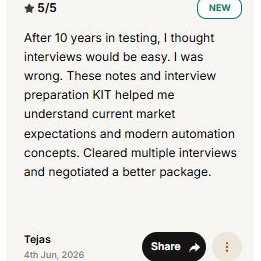
- TheUnstoppable Tester is praised for effective interview prep materials that lead to successful job placements and clear guidance, transforming careers.
 AI-generated based on testimonials
Frequently asked questions
What are the most commonly asked SDET interview questions and answers?
Most SDET interviews follow a predictable pattern: core Java (collections, multithreading, OOPs), Selenium WebDriver (locators, waits, window and frame handling), Rest Assured API testing, framework design, TestNG, SQL, and one or two coding/scenario rounds. For experienced roles, interviewers rarely stick to theory — they expect you to explain how you built or improved a framework and handled real project challenges. Preparing topic-wise SDET interview questions and answers with detailed explanations, and practising them out loud, works far better than reading random question dumps.
What are common SDET interview questions for 5 years of experience?
At the 5-year mark, interviewers test depth over basics. Expect questions on designing a framework from scratch, justifying architecture decisions, Java coding rounds, Rest Assured, BDD/Cucumber, handling flaky tests, CI/CD integration with Jenkins, and scenario questions on release pressure or production escapes. You should also be ready with two or three detailed stories about frameworks you built and measurable outcomes like reduced execution time or improved coverage.
Where can I find scenario-based SDET interview questions?
Scenario-based SDET interview questions appear in almost every experienced-level interview, especially in hiring manager rounds. Typical scenarios include intermittent build failures, flaky tests in CI, last-minute requirement changes, automating a regression suite under tight deadlines, and testing without proper requirements. Look for question banks that group scenarios by topic (Selenium, API, framework) with model answers, and practise structuring your response as situation, approach, and outcome.
How are SDET interview questions for product based companies different from service company interviews?
SDET interview questions for product based companies are usually more hands-on: expect DSA-style coding problems, writing clean Java code live, designing a framework on a whiteboard, API automation with Rest Assured, and tricky debugging scenarios. Service companies tend to weight tool knowledge, process, and framework familiarity more heavily. If you are targeting product companies, spend most of your preparation time on coding practice and framework design rather than only definitions.
Where can I get a reliable SDET interview questions and answers PDF?
Look for a structured, topic-wise compilation rather than a random dump. A good SDET interview questions and answers PDF should cover core Java, Selenium, Rest Assured, framework design, TestNG/BDD, SQL, and scenario questions — with detailed, step-by-step answers instead of one-liners. Materials prepared by experienced interviewers are far more dependable than free files circulating online, which are often outdated or incorrect. Check buyer reviews before purchasing, and use the PDF as a revision tool after hands-on practice, not as a substitute for it.
Which topics come up most in SDET interview questions in Java?
SDET interview questions in Java usually revolve around collections (ArrayList vs LinkedList, HashMap internals), multithreading, exception handling, OOPs with real examples, and String programs like reversing words or finding duplicates. For senior rounds, add Java 8 features (streams, lambdas), design patterns used in frameworks such as singleton and factory, and writing thread-safe code. Practise writing these programs in a timed, live-coding environment because many companies make you code on screen or on paper.
What are the top Selenium automation testing interview questions?
The most frequently asked Selenium automation testing interview questions include the difference between implicit, explicit, and fluent waits; choosing locators for dynamic elements; handling windows, frames, and alerts; stale element exceptions; Page Object Model vs Page Factory; TestNG annotations and DataProviders; and how your framework reduces flakiness. Almost every interview also includes "walk me through your current framework." Answering with real project examples instead of bookish definitions instantly sets you apart.
How to learn Selenium automation testing?
Follow this sequence: strengthen manual testing fundamentals, pick one language (Java has the highest demand in India), then learn Selenium WebDriver locators, actions, and waits, followed by TestNG, and build a small Page Object Model framework with reporting. After that, add Rest Assured for API testing and Git plus Jenkins for CI/CD, practising on demo e-commerce and HR applications. Two to three months of consistent daily practice — building things yourself rather than only watching tutorials — is what actually gets interview-ready.
What is Selenium used for in automation testing?
Selenium is used to automate web browsers, which makes it the backbone of functional and regression testing for web applications. Teams use it for cross-browser testing on Chrome, Firefox, and Edge, running smoke suites inside CI/CD pipelines, and data-driven test execution. It handles only web UIs — desktop and native mobile automation need other tools like Appium — and when combined with Java or Python, TestNG, and Maven, it becomes the core of most QA automation setups in companies.
Should I learn Selenium automation testing with Java or Python?
For the Indian job market, Selenium automation testing with Java is the safer bet — the majority of SDET and QA automation openings, especially at product companies and large MNCs, run on Java, and interviewers expect strong Java fundamentals for SDET roles. Python is easier to pick up and popular in startups, but the volume of Java-based interviews is significantly higher. Choose Python only if you already know it well or are targeting companies that specifically use it.
How to create a test automation framework from scratch?
Start by choosing your language and tool (Java with Selenium, or Playwright), set up a Maven or Gradle project, and build page classes using the Page Object Model. Then add utilities for waits and screenshots, externalise configuration, use TestNG or JUnit as the runner, and integrate reporting like Extent and logging like Log4j. Finish with Git for version control and Jenkins for scheduled execution. Begin with a minimal smoke suite and evolve it — and be ready to justify every choice, because interviewers frequently ask exactly this question.
How to explain a test automation framework in interviews for Selenium?
Structure your answer in layers: architecture (test, page, utility, and config layers), tech stack, design patterns used (POM, factory, singleton), how test data is managed, reporting and logging, CI/CD integration, and how you handle parallel runs and flaky tests. Interviewers care more about the "why" behind each decision — for example, moving to explicit waits to fix flakiness — than memorised definitions. Prepare a 2-3 minute summary version and a 10-minute deep-dive version, and mention outcomes like reduced execution time if asked.
What test automation framework design interview questions should I be ready for?
Common test automation framework design interview questions include designing a framework for a web application from scratch, making it reusable across projects, handling dynamic test data, deciding where assertions belong, running tests in parallel and across browsers, integrating failed-test retries with screenshots, and onboarding new QA engineers quickly. Many interviewers turn this into a whiteboard exercise, so practise explaining abstraction levels, the separation of test data from test logic, and maintainability trade-offs out loud.
How to build a test automation framework using Playwright?
Install Playwright with TypeScript or JavaScript, organise page objects and fixtures in a POM-style structure, and leverage its built-in auto-waiting and web-first assertions instead of manual sleeps. Add a config file for multiple browsers and environments, use the trace viewer and screenshots for debugging, enable parallel execution, and wire the suite into GitHub Actions or Jenkins. Playwright's auto-wait model significantly reduces flakiness compared to traditional setups, and since many teams are adopting it alongside Selenium, adding a test automation framework using Playwright to your skill set widens your interview options.