Testimonials
Services

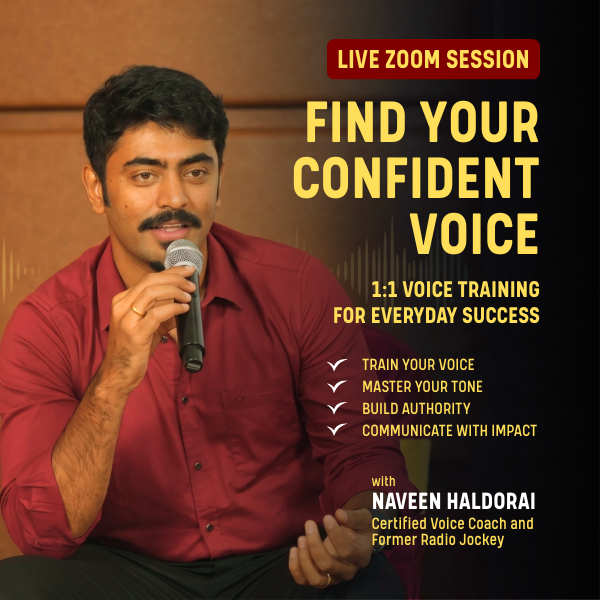
Find Your Confident Voice: 1:1 Coaching

About me
Frequently asked questions
What is voice modulation in communication, and why does it matter?
Voice modulation is the conscious control of your pitch, tone, pace, volume and pauses while speaking. A flat, monotone delivery makes even strong content forgettable, while good modulation helps you emphasise key points, hold attention and sound authoritative. This is why broadcasters and presenters sound so engaging — they vary their delivery deliberately. The same techniques work in meetings, presentations and interviews, and it is a learnable skill rather than a natural gift.
What are public speaking skills, and which ones matter the most?
Public speaking skills include structuring your thoughts clearly, vocal delivery (modulation, pace, volume), body language, audience awareness, storytelling and handling questions confidently. The most underrated of these is vocal delivery — most people obsess over content, but listeners judge confidence and credibility largely through the voice. Clarity of structure comes next, because a well-organised message is easier to deliver and easier to follow.
How to improve public speaking skills for meetings and presentations?
Work on it in layers. First, structure: open with your main point, support it with two or three ideas, and close with a clear takeaway. Second, voice: slow down, use pauses after key points and vary your tone instead of speaking in a monotone. Third, practice: rehearse out loud, record yourself and recreate real settings rather than practising only in your head. Fifteen minutes of daily practice beats one long weekly session, and feedback from a coach or structured programme speeds up progress significantly.
What are some practical public speaking tips and tricks for working professionals?
Prepare your first two sentences word for word so you start strong instead of fumbling. Speak about 10–20% slower than feels natural, and end statements with a downward tone instead of an upward, unsure one. Use notes as keywords, not a script. Pause deliberately after important points instead of filling silence with "umm". Finally, warm up your voice before big presentations — humming and a few deep breaths instantly steady your delivery.
What are the best public speaking tips for students?
Know your opening line by heart, since nerves are worst in the first thirty seconds. Follow a simple structure — introduction, two or three points, conclusion — so you never lose track mid-way. Replace filler words with short pauses. Practise in front of friends or a mirror, and use everyday opportunities like class discussions, seminars and viva sessions as low-stakes rehearsal. The more frequently you speak in front of people, the faster the fear fades.
How to change your voice so it sounds more confident?
You cannot change your vocal anatomy, but you can absolutely change how you use it. Start by recording yourself to spot habits like rushing, mumbling or trailing off. Then build breath support through diaphragmatic breathing, speak from the chest rather than the throat, slow your pace and use deliberate pauses. Most people notice a difference within weeks of daily practice, and a voice coach can pinpoint habits you cannot hear in your own recording.
How to train your voice to be deeper without straining it?
A fuller, deeper tone comes from breath and resonance, not from forcing your throat downward — forcing causes strain and sounds unnatural. Practise diaphragmatic breathing, hum gently at the lower end of your natural range, relax your jaw and neck, and speak while exhaling rather than holding your breath. Aim for a steady, resonant tone at your natural pitch rather than an artificially low one. A trained coach can help you find your optimal pitch safely.
What are some simple voice training exercises I can practise daily?
Start with humming or lip trills to warm up, then do diaphragmatic breathing — lie down with a book on your belly and watch it rise as you inhale. Practise tongue twisters slowly for articulation, read a paragraph aloud with exaggerated variation in pitch and pace, and glide your voice from low to high like a siren to build flexibility. Even ten to fifteen minutes a day makes your voice clearer and more controlled, and many people feel the difference right after warming up.
Is voice training for speaking different from voice training for singing?
Yes. Both share fundamentals like breath control and resonance, but the goals differ. Singing training develops musical range and pitch accuracy, while speaking-focused training develops clarity, articulation, vocal stamina, modulation and authority for everyday situations like meetings, presentations and hosting. This is why a music class alone may not fix issues like mumbling or a flat tone — for those, you need training designed specifically for spoken communication.
Is a voice training app enough, or do I need a coach?
An app is useful for building a daily habit — warm-up reminders, pacing drills and self-recording tools all help. However, even the best voice modulation app cannot hear the specific habits holding you back, such as rushing through sentences, mumbling or a flat tone, and it cannot correct them in real time. The most effective approach is a combination: use an app for daily practice and get periodic feedback from an experienced voice coach, especially if you are preparing for interviews or high-stakes presentations.
How do I choose the right voice modulation course in India?
Check four things. First, the trainer's real-world background — someone with broadcasting, radio jockeying or voiceover experience teaches techniques that actually work, not just theory. Second, whether the course includes live practice and personal feedback, since recorded-only courses give slow results. Third, cohort size, because smaller groups get more speaking time. Fourth, fit with your goal — presentations and meetings need different emphasis than anchoring or voiceover work. A short trial or clarity call is the easiest way to judge fit before committing.
What should a good voice training course include?
At minimum: breathing and breath support, pitch and tone control, articulation and clarity drills, pace and pause control, warm-up routines, modulation practice, and application to real scenarios like presentations, meetings or anchoring. Personalised feedback is the ingredient that separates real progress from passive learning — if a course only hands you videos and no correction, improvement will be slow regardless of how good the content is.
Where can I find a useful public speaking tips PDF?
You will find many free public speaking PDFs on university soft-skills portals and communication coaching blogs. The limitation is that a static PDF gives you tips but no feedback or practice structure. If you prefer a downloadable guide, look for a public speaking e-book written by a coach with a broadcasting or training background, and check that it includes practical frameworks and exercises rather than theory alone — then pair the reading with speaking practice out loud.