Testimonials
Services
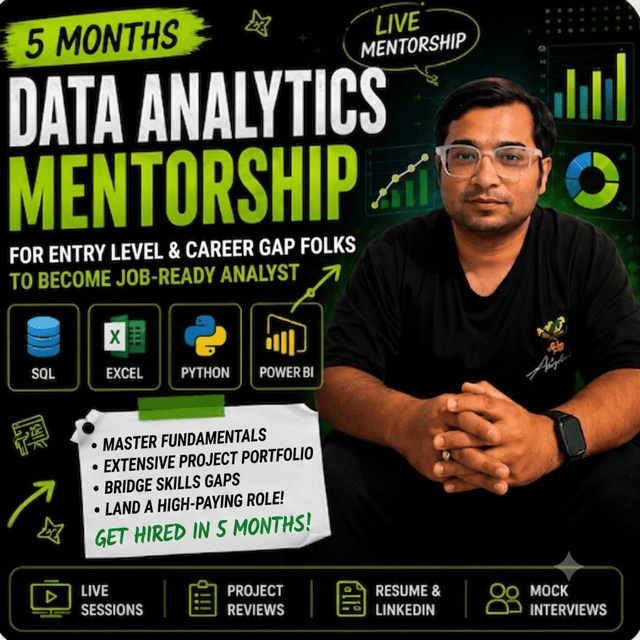
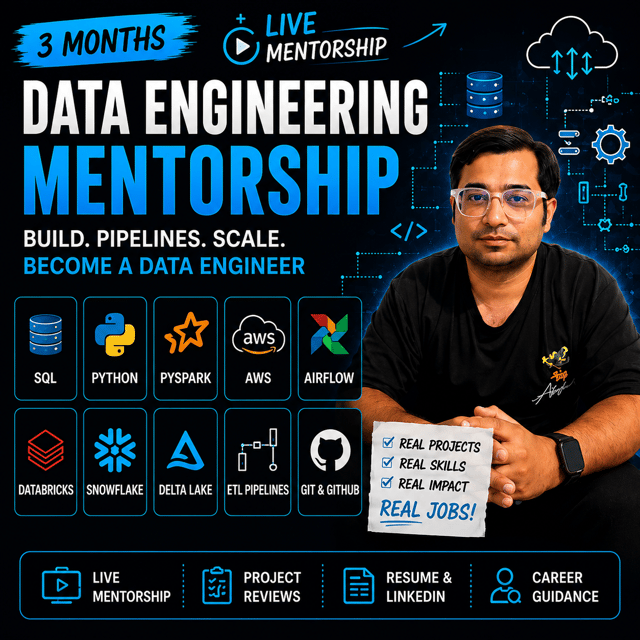
LinkedIn Profile Optimization for Analytics Roles
Complete Placement Guidance

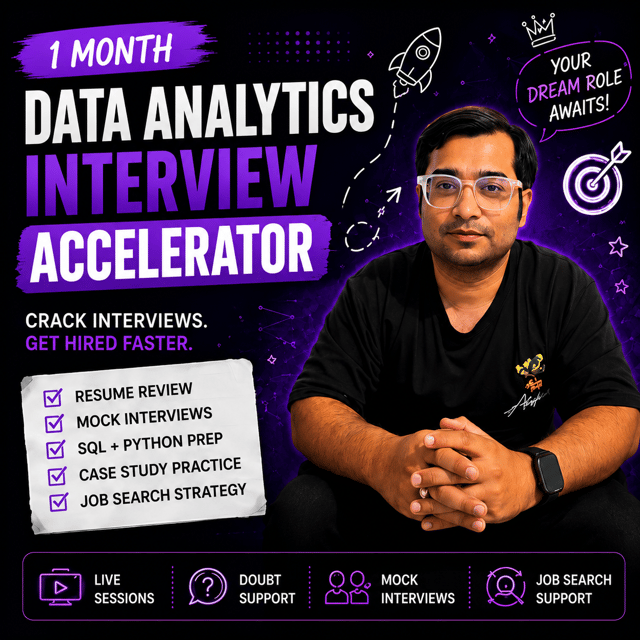
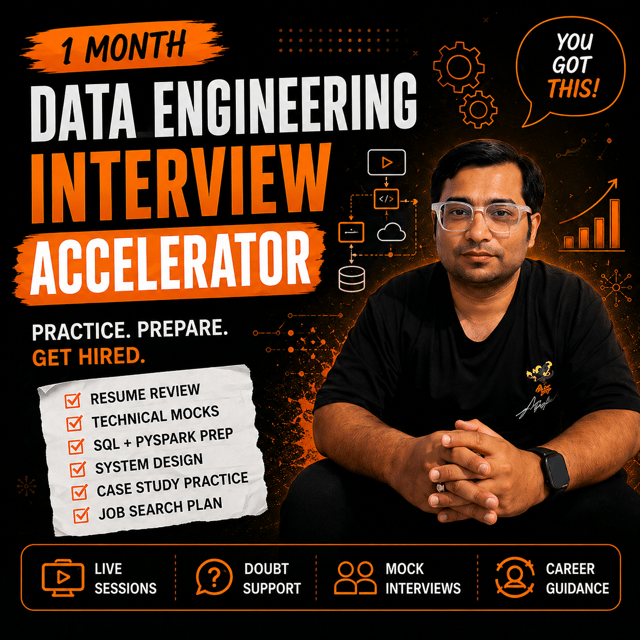
🚀 Data Analytics Interview Accelerator (1 Month)
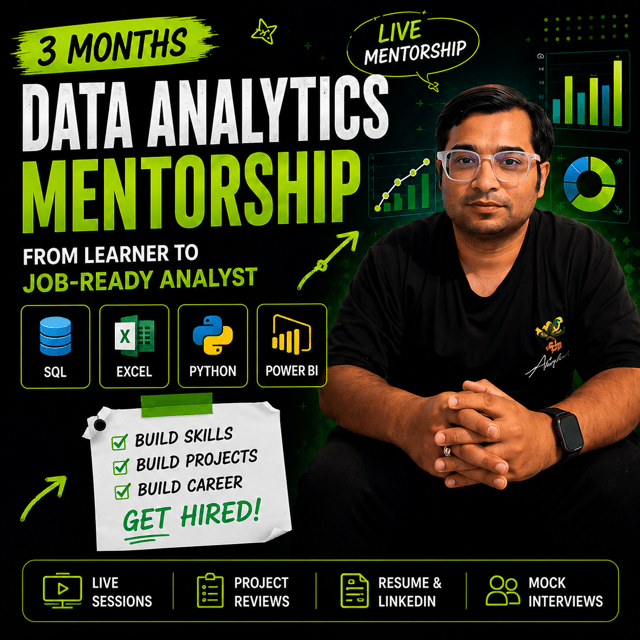
Resume writing & Ask anything about your career
Analytics Mock Interview + Detailed Feedback
Portfolio Building for Project
About me
- Mukesh Sablani is an outstanding mentor in data analytics, known for his clear explanations, supportive guidance, and impactful insights that boost confidence and career direction.
 AI-generated based on testimonials
Frequently asked questions
How to start a data analytics career in India as a fresher?
Start by building the core toolkit every recruiter expects: SQL, Excel, and one visualisation tool such as Power BI or Tableau, supported by basic statistics and Python. Build 2–3 portfolio projects on publicly available datasets (sales, e-commerce, cricket, or HR data) and publish them on GitHub or a dashboard portfolio so you have proof of work. Then optimise your LinkedIn profile, apply to entry-level titles like data analyst, business analyst, MIS executive, and reporting analyst, and rehearse SQL-based screening rounds. Freshers from any stream can break in — hiring managers in India prioritise demonstrable projects over your degree stream.
How to switch to a data analytics career from a non-tech background?
Treat your current domain knowledge as an asset — HR, finance, sales, and operations backgrounds all translate well into analytics roles within those same functions. Spend 4–6 months learning SQL, Excel, and Power BI/Tableau, then basic Python. Rebuild your resume around 2–3 end-to-end projects connected to your existing domain, and target hybrid roles like business analyst, operations analyst, or reporting analyst, which are far more open to career switchers. A structured long-term mentorship plan can also shorten the learning curve by keeping you accountable and interview-ready.
What does a typical data analytics career path look like in India?
A typical data analytics career path in India begins with roles like data analyst, junior analyst, or associate analyst, followed by senior data analyst within 3–5 years. From there it branches: lead analyst or analytics manager for stakeholder-oriented professionals, BI developer or analytics engineer for tooling specialists, and data engineer or data scientist for those going deeper technically. Progression is skills-driven — SQL and dashboards matter early, statistics and Python in the middle, and business storytelling plus stakeholder management at senior levels.
What are the data analytics career opportunities in India?
Data analytics career opportunities in India span IT services, banking and fintech, e-commerce, consulting, healthcare, and the fast-growing GCCs in Bengaluru, Hyderabad, Pune, Chennai, and Gurugram. Common roles include data analyst, business analyst, product analyst, MIS analyst, BI analyst, and reporting analyst, with data engineering emerging as a well-paid adjacent track. Since marketing, finance, HR, and operations teams all run on data, openings exist at every experience level, and the same skills also unlock remote and overseas roles.
What does data analytics career growth look like in the long run?
Data analytics career growth in India is strong: freshers typically begin in the ₹4–8 LPA band, and analysts who add Python, advanced SQL, statistics, and cloud or data engineering skills often cross ₹15–20 LPA within 5–7 years. Growth accelerates once you move from producing reports to influencing decisions — owning metrics, running experiments, and presenting insights to leadership. Long term, the field branches into data engineering, data science, product analytics, and analytics management, so your ceiling depends more on continuous upskilling than on the title you start with.
How to crack a data analyst interview as a fresher?
Prepare for the three rounds most Indian companies use: technical (SQL queries, Excel, statistics, basic Python), a project or case discussion, and HR. Practise writing joins, group-bys, and window functions without an IDE, and prepare a crisp 2-minute walkthrough of each portfolio project covering the business problem, your cleaning steps, and the insight you delivered. Structured data analyst interview preparation — including mock interviews and answers to staples like WHERE vs HAVING or handling missing data — consistently outperforms last-minute memorisation, because interviewers judge how you think, not what you recite.
What are the most common data analyst interview questions and answers for freshers?
Fresher interviews cluster around four areas: SQL (joins, aggregate functions, subqueries, filtering), Excel (VLOOKUP/XLOOKUP, pivot tables, conditional logic), statistics (mean vs median, standard deviation, correlation, outliers), and scenario questions such as "sales dropped 10% last month — how would you investigate?" You will almost always be asked to explain a project you have built, so rehearse the dataset, the tool stack, and the business impact of your findings. Frame answers as reasoning out loud rather than one-line definitions — that is what separates selected candidates in fresher pools.
What are the common data analyst interview questions for 3 years of experience?
At this level, interviewers probe real ownership: which metrics you managed, dashboards you built and got adopted, queries you optimised, and business decisions your analysis changed. Expect advanced SQL (window functions, CTEs, performance tuning), statistics around A/B testing and significance, data modelling and warehouse basics, plus behavioural rounds on handling conflicting stakeholder demands. Prepare 3–4 STAR-format stories with hard numbers — for example, cutting report turnaround from two days to two hours — since experience rounds are scored on impact, not tool vocabulary.
How to make a data analyst resume that gets shortlisted?
Fit it on one page and open with a skills section covering SQL, Excel, Python, Power BI/Tableau, and statistics so recruiters see relevance in the first six seconds. Convert duties into achievement bullets with numbers — "automated a weekly sales report in SQL, saving 6 hours per week" reads far better than "responsible for reporting." Add a projects section with 2–3 end-to-end analyses showing the problem, method, and measurable insight, mirror keywords from each job description to clear ATS filters, and link a live portfolio or GitHub.
How to make a data analyst resume with no experience?
Let projects stand in for work history. A data analyst resume for freshers should lead with 2–3 portfolio projects — dataset used, tools applied, and the insight or business outcome — followed by certifications, relevant coursework, and transferable wins from internships or a previous non-analytics role. Write each project bullet with a result attached, such as "cleaned 50,000 rows of order data in SQL and flagged the three regions driving 60% of revenue." Recruiters hiring for entry-level analytics roles screen for demonstrated skill, so a project-heavy, keyword-optimised resume can absolutely earn you interviews without prior employment.
What should a data analyst resume look like?
Clean, single-column, ATS-friendly, and one page until you cross roughly five years of experience. The proven structure is: contact details and a 2–3 line summary, a skills section, experience or projects with quantified bullets, education, and then certifications. Stick to standard fonts and clear headings, avoid tables, graphics, and two-column layouts that ATS parsers frequently misread, and start every bullet with an action verb followed by a metric — scannable, measurable achievements matter far more than visual design.
Where can I find a good data analyst resume template?
Start with the free, ATS-safe templates built into Google Docs and Microsoft Word, plus simple LaTeX templates on Overleaf if you are comfortable there. Designer templates with icons, skill-rating bars, and multi-column layouts look attractive but often break in applicant tracking systems used by Indian employers, so avoid them for job-portal applications. The template matters far less than customising it for each job description — a plain, well-structured format filled with role-specific keywords and quantified results will outperform a beautiful generic template every time.