Testimonials
Services
CLAT PG 2026 Roadmap (4 months)
February 2026 Case Laws Summary
January & February 2026 Case Law Summaries Combo
The Law School Blueprint
January 2026 Case Laws summary
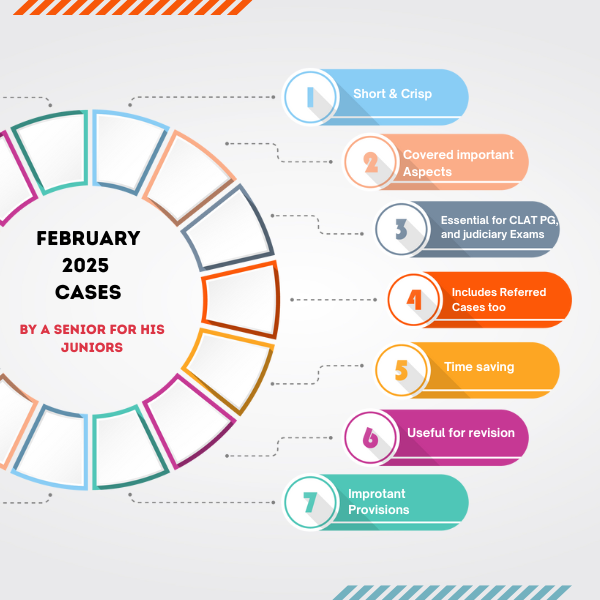
February 2025 Cases for CLAT PG & Judiciary Exams
CLAT PG & AILET PG Blueprint| The Personal Roadmap
About me
- Mridul Pareek is helpful, knowledgeable, and supportive, offering clear guidance and useful resources.
 AI-generated based on testimonials
Frequently asked questions
How to start CLAT PG preparation?
The smartest way to start CLAT PG preparation is with the official syllabus and previous years' question papers, so you know exactly what the exam tests before you open a single book. Build your base in the core LLB subjects first, fix a realistic daily study schedule, and begin tracking recent judgments and legal developments from day one. Starting with a clear roadmap helps you avoid the most common mistake — studying everything in random order and retaining very little.
How to prepare for CLAT PG?
Prepare subject-wise: cover the core law areas from standard sources, make crisp short notes for quick revision, solve previous years' papers, and take full-length mock tests regularly to build speed for comprehension-based questions. Maintain a separate file for recent judgments and legal updates, and revise it weekly. Consistency over a few focused months beats irregular slogging right before the exam.
How much CLAT PG preparation time is enough?
Most aspirants need around 4–6 months of focused CLAT PG preparation time, though this varies with how strong your LLB fundamentals already are. If you are preparing alongside a job or final-year exams, start earlier and stretch the timeline instead of compressing everything into the last few weeks. Reserve the final 6–8 weeks almost entirely for mocks and revision.
Which CLAT PG preparation books do I actually need?
Keep it minimal: bare acts and one standard textbook each for constitutional law, jurisprudence, contracts and criminal law, plus one reliable source for recent case laws. Add previous years' question papers and a good mock series. Hoarding too many CLAT PG preparation books is a classic trap — a small set revised repeatedly works far better than ten books barely touched.
Is self-study enough for CLAT PG, or do I need coaching?
Self-study works if you are disciplined and have the right resources, but many aspirants struggle with planning, filtering material and staying consistent. A structured CLAT PG preparation course mainly adds value through a ready-made roadmap, curated notes and doubt-solving — especially when you are juggling a job or final-year LLB. Whichever route you choose, make sure your CLAT PG preparation material includes updated case-law summaries, past papers and mocks, because assembling all of that on your own takes time.
What is the AILET exam?
The AILET (All India Law Entrance Test) is conducted by NLU Delhi for admission to its BA LL.B. (Hons.) and LLM programmes. NLU Delhi does not accept CLAT scores, so if you are targeting an LLM seat there, you must prepare for AILET PG separately, with its own pattern and syllabus.
Is there negative marking in AILET?
Yes. AILET follows a negative marking scheme in which 0.25 marks are deducted for every incorrect answer, so blind guessing can seriously pull down your score. Attempt questions where you can eliminate at least some options, and leave the ones you are completely unsure about.
What is the AILET PG exam pattern?
In recent years, the AILET PG exam has been an objective, MCQ-based paper focused on law subjects and legal reasoning, with negative marking for wrong answers. The exact number of questions, duration and marking scheme are announced in each cycle's official notification, and small changes from year to year are common — so always confirm from the latest notification before planning your prep.
What is the AILET PG exam syllabus?
The AILET PG exam syllabus broadly covers core LLB subjects such as constitutional law, jurisprudence, contracts, criminal law, torts, family law, commercial law and international law, along with current legal developments and landmark judgments. Treat the official notification as your final checklist, since the syllabus details are refined every admission cycle.
When will the AILET PG exam date be announced?
NLU Delhi announces the AILET PG exam date through its official notification for each admission cycle, and the application window usually stays open for a limited period before the exam. Since the schedule shifts from year to year, track the official AILET portal regularly once the notification season begins rather than relying on old articles or second-hand information.
How do I fill out the AILET PG exam form?
The AILET PG exam form is submitted online through the official AILET portal once NLU Delhi releases the notification. Keep scanned copies of your photograph, signature, LLB marksheets and category certificate (if applicable) ready, complete the fee payment online, and verify every field before final submission, as post-deadline corrections are rarely permitted.
Is there any entrance exam for LLM?
Yes — LLM admission in India is largely entrance-based. For the LLM entrance exam 2026 cycle, the main options are CLAT PG (for the National Law Universities), AILET PG (for NLU Delhi) and CUET PG (for central and several participating universities), along with tests conducted by some state and private universities. Shortlist your target universities first, because that decides which exam you actually need to prepare for.
What is the syllabus for the LLM entrance exam?
The syllabus for the LLM entrance exam is broadly similar across major tests: constitutional law, jurisprudence, contract law, criminal law, torts, family law, international law and IPR, along with recent judgments and current legal developments. What changes between CLAT PG, AILET PG and CUET PG is the pattern, weightage and question style, so download the specific syllabus for each exam you are writing and plan accordingly.
How to prepare for the LLM entrance exam?
Start by locking your target exams, since CLAT PG, AILET PG and CUET PG differ in pattern and focus. Then revise your LLB fundamentals subject by subject, maintain an updated file of recent Supreme Court judgments, and move into previous papers and full-length mocks in the final stretch. A fixed weekly revision cycle is what helps you actually retain this vast syllabus instead of merely covering it.
Are recent Supreme Court judgments important for CLAT PG?
Very much so — CLAT PG tests your awareness of current legal developments, and recent landmark judgments regularly appear in the paper. Instead of reading full judgments at the last minute, follow concise case-law summaries regularly and revise them in the weeks before the exam. This one habit often separates an average score from a top rank, because most aspirants neglect current legal developments until it is too late.