Testimonials
Services
Navigating Finance in Germany
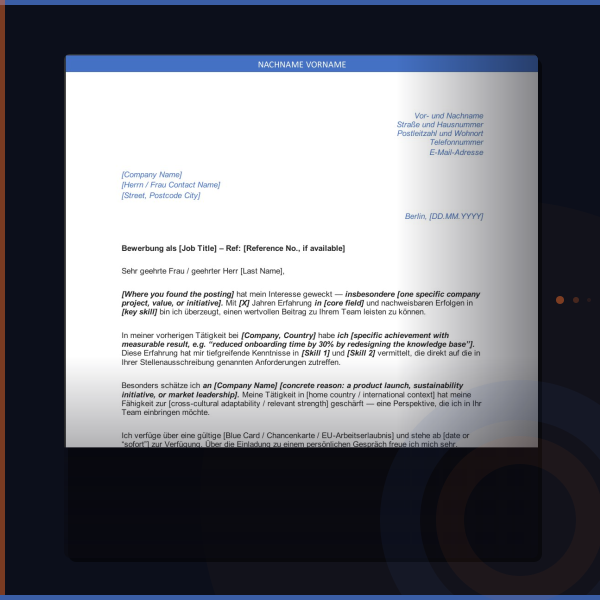
German Cover Letter Template (Google Docs)
CV Review
Professional Outreach Toolkit- Job Search Strategy
Job Search Strategy Session
List - All Recruiting Agencies in Germany
Quick Germany question? Drop me a DM
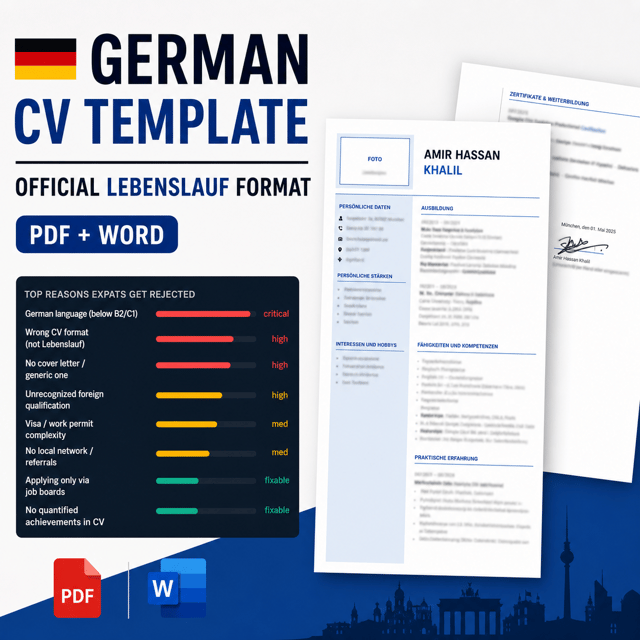
German CV Template - Official Lebenslauf Format
XING DM Strategy
1:1 Consultation
About me
Frequently asked questions
How to move to Germany?
Most people move to Germany through one of three routes: a job, university admission, or a job-search permit like the Opportunity Card (Chancenkarte). The broad sequence is: check which route you qualify for, secure a job offer or admission, apply for the matching visa or residence permit, arrange mandatory health insurance, and after arrival register your address (Anmeldung) and set up a bank account for salary and bills. Sorting out the job or admission first makes every other step far easier.
What is required to move to Germany?
The essentials are a valid passport, a visa or residence permit that matches your reason for moving (work, study, job seeking, or family), proof of financial means — for students this is usually a blocked account — and health insurance, which is compulsory from day one. After arriving, you must register your address at the local citizens' office (Bürgeramt), and for work-based routes you will generally need a recognised qualification or a concrete job offer.
How to move to Germany from the US?
US citizens can enter Germany visa-free for up to 90 days, but living and working there long-term requires a residence permit. The typical path is to secure a job offer or university place first, then apply for the right permit — options include the EU Blue Card for qualified professionals, the points-based Opportunity Card for job seekers, a student visa, or a freelancer visa. Since documents often need certified translations and appointments at the Ausländerbehörde get booked out, start preparing several months in advance.
What should I know before moving to Germany from India?
The biggest difference is that most Indian applicants must have their visa approved before travelling — you cannot simply arrive and switch status. Common routes are the student visa (with a blocked account and, for students, the APS certificate), the EU Blue Card or Skilled Worker visa with a job offer, and the points-based Opportunity Card for job seekers. Build in extra time for document collection, translations and embassy appointments, and plan your first weeks around Anmeldung, health insurance and opening a local bank account.
How much does moving to Germany cost?
Costs fall into three buckets: upfront costs (visa fees, document translations, flights, and for students a blocked account deposit), arrival costs (health insurance, initial rent, and a deposit of up to three months' cold rent), and living costs for the first two to three months before your first salary. The city matters a lot — rent in Munich, Frankfurt or Hamburg can be double that of smaller towns — so a realistic buffer for a single person usually runs into several thousand euros.
What is a cover letter in German?
A cover letter in German is called an "Anschreiben", and unlike in many other countries it is still expected with virtually every application, alongside the CV (Lebenslauf). It is a formal, one-page business letter with your contact details, the company's address, a subject line naming the role, a formal salutation, and a focused argument for why you fit that specific job — considerably more formal and role-specific than a typical US-style cover letter.
How to write a German cover letter?
Follow the standard structure: a contact header, the company's address and date, a subject line (Betreff) with the job title and reference number, a formal salutation, two to three focused paragraphs, and a closing such as "Mit freundlichen Grüßen" with your signature. Address the requirements from the job posting one by one, keep it under one page, and write in a direct, factual tone — German recruiters respond better to concrete claims ("I managed X, delivering Y") than to enthusiasm-heavy language.
How to start a German cover letter?
With the subject line and a formal salutation. "Sehr geehrte Damen und Herren" is the acceptable default when you cannot find a name, but a personalised greeting such as "Sehr geehrte Frau Weber" or "Sehr geehrter Herr Schulz" always lands better — check the job ad, the company website or LinkedIn for the hiring manager. Your first sentence should state exactly why you are writing and why you fit the role, skipping worn-out openers like "Herewith I am applying…" that recruiters see hundreds of times.
What does a German cover letter look like?
It looks like a formal business letter, not a casual email: your contact details at the top, then the company's address and the date, a subject line (Betreff) with the position and any reference number, a formal salutation, three to four compact paragraphs, and a sign-off such as "Mit freundlichen Grüßen". The accepted German cover letter format follows the DIN 5008 letter layout, fits on exactly one page, and visually matches your CV so the application reads as one coherent document.
Where can I find a German cover letter template?
You can find a German cover letter template on job portals, university career centres and career blogs, usually as a free Word or Google Docs download. Before using one, check that it actually follows German conventions — contact block, Betreff line, formal salutation and formal closing — because many templates circulating online are simply translated US or UK letters. Then customise it fully for every application; recruiters can spot an unchanged template immediately.
How do I write a German cover letter for Ausbildung?
A German cover letter for Ausbildung has to compensate for limited work experience, so focus on motivation and fit: explain why you want exactly this trade or profession, point to school subjects, internships, part-time jobs or hobbies that prove genuine interest, and show you understand what the training involves. German employers read Ausbildung applications for reliability and long-term commitment, so be sincere and specific, keep it to one page, and attach your latest school reports (Zeugnisse) and an up-to-date tabular CV.
Where can I find a free German CV template?
Job portals, university career pages and template libraries all offer a free German CV template, typically in Word or Google Docs. Look for the classic tabular Lebenslauf: reverse-chronological order, clear sections for personal details, education, work experience, skills and languages, and — still customary in Germany — a professional photo. If you are hunting for a German CV template for 2026, do not overthink it: this tabular layout remains the standard, so skip heavily designed templates that deviate from it.
Do I need an ATS-friendly German CV template?
Increasingly yes — larger German companies and job platforms screen applications with software before a human sees them. An ATS-friendly German CV template is single-column, uses standard fonts and clear section headings, and avoids text boxes, icons, sidebars and graphics that parsing tools cannot read. The traditional tabular Lebenslauf is already well suited to this, so the main trap is over-designed templates — and since German recruiters still commonly expect a photo, include one as a simple, properly placed image.
Should I use a German CV template for Word or Google Docs?
Both work, as long as the structure is right. A German CV template for Word is the most universally compatible choice, since .docx opens cleanly in every system recruiters use. Google Docs is equally fine for building the CV — just export the final version as a PDF (or .docx if the job posting asks for one) so the layout does not shift on someone else's screen. The software matters far less than following the German tabular format and keeping the document clean and error-free.