Testimonials
Services
Masters in Financial Engineering (USA)
Resume for Risk & Quant Roles (QFI Students)
Quick Call (Ask Anything about Quant Finance)
Market Risk (Become Job Ready)
About me
Frequently asked questions
What is quantitative finance and risk management?
Quantitative finance is the use of mathematics, statistics, and programming to price financial instruments, build trading strategies, and model market behaviour. Risk management is the applied side of the same field, focused on measuring and controlling potential losses using tools like Value at Risk (VaR), stress testing, and model validation. Banks, hedge funds, asset managers, and trading firms all employ quants for these functions. For students from engineering or maths backgrounds, this mix of coding and finance is exactly what makes the field appealing.
What is a quantitative finance course and what does it cover?
A quantitative finance course teaches you how to apply mathematical models to financial markets. Core topics usually include derivatives pricing, stochastic calculus, probability, time-series analysis, portfolio theory, risk models, and programming in Python or C++. These courses are offered as full-time degrees such as an MSc or MFE, as diplomas, and as online certificate programs. If you are coming from an engineering or science background, a structured course is usually the fastest way to build job-ready quant skills.
How to learn quantitative finance from scratch?
Start with the mathematical core: calculus, linear algebra, probability, and statistics, followed by stochastic processes and derivatives pricing. Learn Python first (and later C++ if you are aiming at trading or low-latency roles), then apply it through small projects like backtesting a trading strategy or pricing options using Monte Carlo simulation. Combine this with standard textbooks, free online lectures, and mock interview practice. Consistency over six to twelve months usually matters more than any single expensive program.
How to become a quant in finance after an engineering degree?
Engineering graduates form one of the largest pools of successful quant candidates, so your background is an advantage, not a limitation. Build strong probability, statistics, and coding skills, then either pursue a dedicated quantitative finance degree such as an MFE or MSc in Quantitative Finance, or enter through quant developer roles where software skills matter first. Internships, GitHub projects, and preparation for maths-heavy interviews (puzzles, mental math, stochastic calculus questions) are what separate shortlisted candidates from the rest.
What are quantitative finance jobs and who hires for them?
Common quantitative finance jobs include quant researcher (designing trading strategies), quant trader, quant developer, risk quant, model validation analyst, and derivatives pricing analyst. Employers range from investment banks and hedge funds to proprietary trading firms, asset managers, and fintech companies. In India, most quant hiring is concentrated in Mumbai, Bengaluru, and Gurugram, while New York, Chicago, London, Singapore, and Hong Kong are the biggest global hubs.
How to get a quant finance job as a fresher in India?
Focus on three things: demonstrable maths and coding skills, relevant projects or internships, and serious interview preparation. Recruiters for entry-level quant roles typically test probability, statistics, brainteasers, and programming in Python or C++. Campus placements, referrals, quant competitions, and open-source contributions all help you get noticed. Applying through a referral from someone already working in a quant role significantly improves your response rate compared to cold applications.
Is quantitative finance a good career?
Yes, if you genuinely enjoy mathematics, statistics, and programming — people who choose it only for the money tend to struggle with the interview bar and the daily analytical workload. Quantitative roles are among the highest-paying and most intellectually demanding careers in finance, and demand in India has grown quickly with the rise of algorithmic trading firms and the risk and technology centres of global banks. The trade-offs are a steep learning curve, highly competitive hiring, and work that is intensely analytical rather than client-facing.
What is the quantitative finance salary in India compared to the US?
There is no single number, but quant pay sits at the top of the finance salary scale in both countries. In India, entry-level roles at high-frequency trading firms and global banks' India centres usually pay several times a typical engineering or finance fresher package, with rapid growth for strong performers. In the US, total compensation for quant roles is among the highest of any entry-level career, and experienced quants at hedge funds earn substantially more. Exact figures vary widely by firm, city, role, and bonus structure, so treat any online figure as a range rather than a rule.
What does a typical quant finance career path look like?
Most people enter as a quantitative analyst, quant developer, or risk analyst, then move into senior quant or quant researcher roles within three to five years. From there, the quant finance career path usually branches into specialist tracks — derivatives pricing, trading strategy research, or risk modelling — and later into leadership positions like head of quant or desk lead. Many quants also move from sell-side banks to buy-side hedge funds, or from India to the US, UK, Singapore, or Hong Kong, where the deepest quant job markets are.
What are MFE programs and who should pursue them?
MFE stands for Master of Financial Engineering — a specialised master's degree (also offered as Master of Mathematical Finance or Computational Finance) that trains students for quantitative roles. Most MFE programs run 12 to 24 months and cover stochastic calculus, derivatives pricing, machine learning for finance, risk management, and C++/Python programming. They suit engineering, maths, or physics graduates targeting quant trading, research, or risk roles, and most well-regarded programs in the US are STEM-classified, which matters for international students seeking work opportunities after graduation.
Is MFE worth it for Indian students?
It depends on your target role and the strength of the program you get into. For Indian students aiming at quant roles in the US, a strong MFE from a program with solid placement outcomes can justify the significant tuition and living costs, because the degree opens interviews that are hard to access directly from India. If you already have strong programming skills, entering through a quant developer role or gaining work experience first can be a cheaper alternative. Always check recent placement reports, class sizes, and career support before deciding, because the value of MFE programs varies widely.
Which are the best MFE programs in the USA?
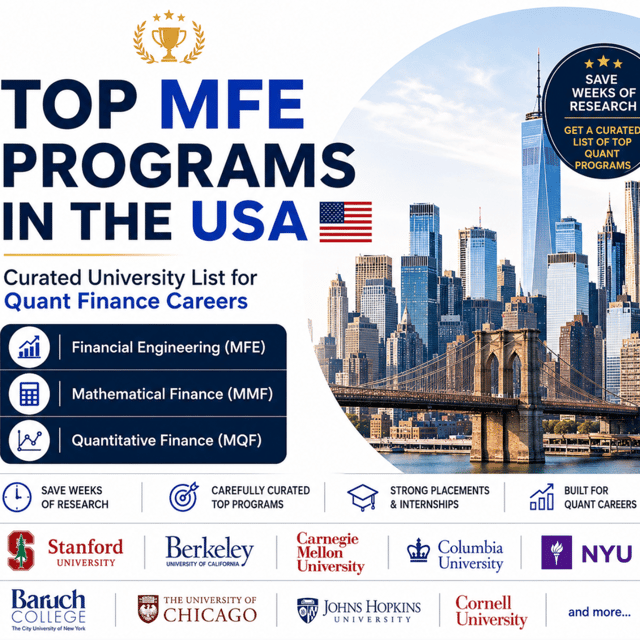
The best MFE programs in the USA, based on long-standing reputation and placement outcomes, typically include Carnegie Mellon's MSCF, Princeton's Master in Finance, Baruch College's MFE, Columbia, UC Berkeley, and Cornell, though rankings shift slightly every year. Rather than chasing rankings alone, compare placement statistics, curriculum depth in stochastic calculus and machine learning, class size, and location relative to trading hubs like New York and Chicago. For Indian students, alumni presence inside quant firms is also a practical factor worth weighing.
Are MFE programs in Europe and Canada good alternatives to the USA?
Yes. MFE programs in Europe, particularly in the UK, Switzerland, France, and the Netherlands, are often shorter (around one year) and cheaper than US equivalents, though the local quant job markets are smaller and visa factors matter. MFE programs in Canada, especially in Toronto, benefit from a growing quantitative finance scene and more predictable post-study work and immigration pathways, which many Indian students value. Choose based on where you actually want to work after graduating, since regional hiring networks strongly influence placements.
Which quantitative finance books should I read as a beginner?
Start with accessible quantitative finance books such as Quantitative Finance for Dummies to get the lay of the land, then move to John Hull's Options, Futures, and Other Derivatives, which is the standard reference worldwide. For the mathematical core, Steven Shreve's Stochastic Calculus for Finance volumes are the classic choice, and Mark Joshi's Quant Job Interview Questions and Answers is excellent for interview preparation. Read one book at a time alongside coding practice rather than collecting materials you never finish.
Are there any free quantitative finance courses with certificates?
Yes, though truly free quantitative finance courses with certificates are limited — platforms like Coursera and edX often let you audit top university courses for free but charge for the certificate itself. MIT OpenCourseWare offers full quantitative finance lectures free of cost without certification, and WorldQuant University runs a tuition-free online program in financial engineering that grants a credential on completion. Keep in mind that a free certificate adds less value in quant hiring than demonstrated skills, so prioritise courses with projects and rigorous content over the certificate alone.