Testimonials
Services
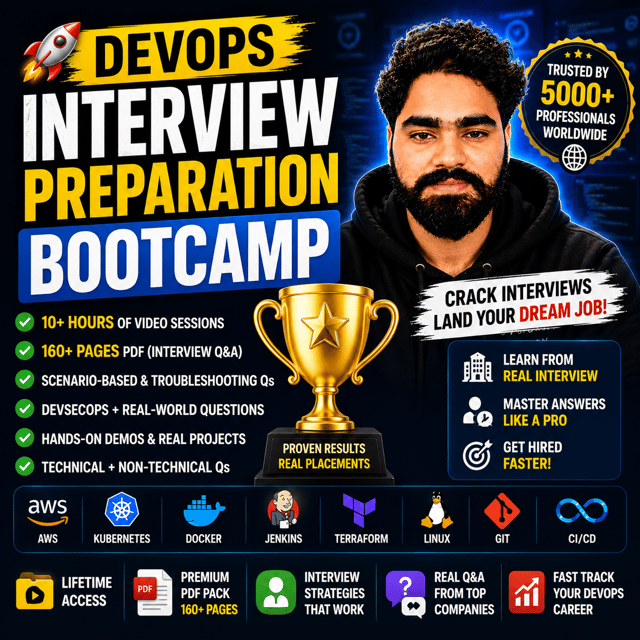
DevOps Interview Preparation Bootcamp
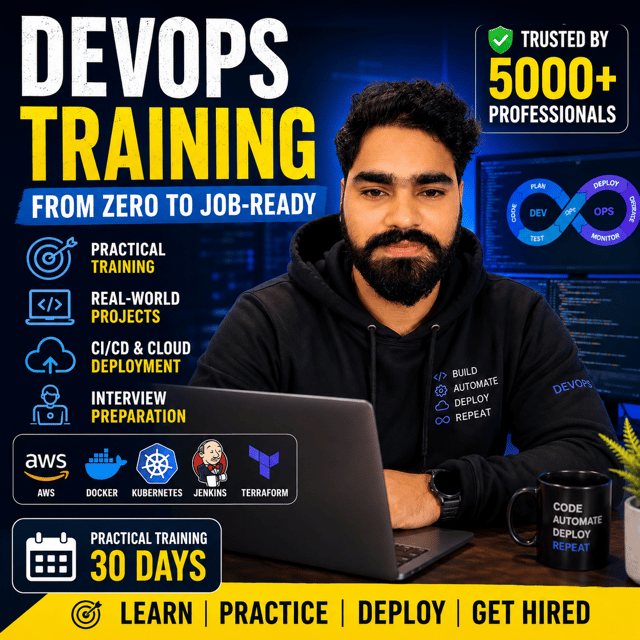
DevOps Training | Job Ready in 30 Days
Interview Preparation Tips
All in One Interview Preparation
DevOps Interview Success Package

About me
- Manish Tiwari is praised for his personalized feedback, friendly guidance, and confidence-boosting mentorship in resume reviews and DevOps preparation.
 AI-generated based on testimonials
 - 🎯 Book now & get a FREE personalized DevOps Interview Roadmap. Limited slots!

Frequently asked questions
What are the most common DevOps interview questions and answers?
Most product-based companies start with fundamentals and then go deeper based on your projects, so the most frequently asked DevOps interview questions and answers revolve around Linux troubleshooting, Git branching and merge conflicts, Docker images vs containers, Kubernetes objects like pods, deployments and services, Terraform state, Jenkins pipelines, and CI/CD design. Expect practical follow-ups such as "your pod is in CrashLoopBackOff — what do you check?" instead of plain definitions. A strong answer follows a pattern: explain the concept, connect it to a real project you handled, and mention the outcome. Memorised answers without hands-on context are the most common reason candidates get rejected.
How do I prepare for a DevOps interview?
The most effective way to think about how to prepare for a DevOps interview is to work in layers: first strengthen Linux, Git and networking basics, then get hands-on with Docker, a CI/CD tool like Jenkins, Kubernetes, one cloud platform (AWS is the most in-demand in India) and Terraform. After that, shift towards scenario-based troubleshooting, designing pipelines end to end, and explaining your projects the way an interviewer would probe them. In the final stretch, take mock interviews — practising with a mentor who has actually interviewed candidates, such as Manish Tiwari, a Lead DevOps Engineer at American Express, exposes gaps that self-study never reveals.
What kind of DevOps interview questions are asked for 3 years of experience?
DevOps interview questions for 3 years of experience usually move beyond definitions into applied troubleshooting. Interviewers typically probe one cloud platform in depth, ask you to debug a failing pipeline or a crashing container, test your Kubernetes understanding around deployments and networking, and expect you to walk through a CI/CD pipeline you personally built or improved. At this level they are checking whether you can independently handle day-to-day production work, so prepare real examples of incidents you resolved, deployments you automated, and measurable results like reduced build or release time.
How are DevOps interview questions for 5 years of experience different from those for 3 years of experience?
DevOps interview questions for 5 years of experience focus far less on tool syntax and far more on design, scale and trade-offs. Expect questions on architecting multi-environment CI/CD across teams, Kubernetes cluster design and upgrades, infrastructure-as-code at scale, cost optimisation, security, and migration strategies. Interviewers also assess leadership — how you mentor juniors, handle production outages, and make build-vs-buy decisions. At this level you are being evaluated as a future lead, so your answers should demonstrate decision-making, not just execution.
What are some scenario-based DevOps interview questions and answers for experienced candidates?
The most common scenario-based DevOps interview questions and answers for experienced candidates revolve around situations like a deployment succeeding in staging but failing in production, a Kubernetes node under memory pressure, a Jenkins pipeline failing intermittently, or Terraform showing drift from actual infrastructure. The best approach is to think out loud in a structured flow — assess impact, check logs and events, form a hypothesis, fix it, and suggest a preventive measure. Interviewers judge your troubleshooting approach more than the exact answer, so practise narrating real incidents from your own work.
What are the common DevOps interview questions and answers for freshers?
DevOps interview questions and answers for freshers stay close to fundamentals: basic Linux commands and permissions, Git operations like merge and rebase, containers vs virtual machines, what a CI/CD pipeline is, cloud basics, and simple networking such as DNS, ports and HTTP status codes. Since freshers rarely have production experience, projects carry the most weight — build one end-to-end project, for example containerising an app and deploying it through a CI/CD pipeline on a cloud free tier, and be ready to explain every command and design choice you made.
Is a DevOps interview preparation course worth it, or are free resources enough?
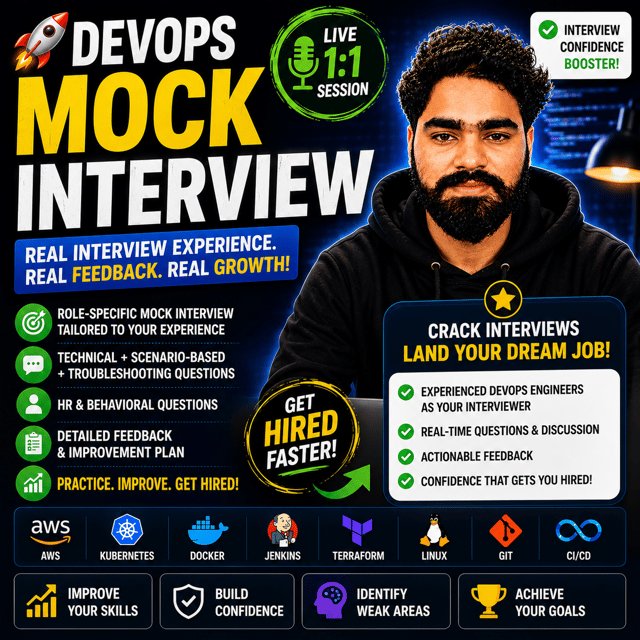
Free resources — YouTube, GitHub repos and Reddit threads — are genuinely good for learning individual tools, but many engineers stay stuck because there is no sequence, no feedback and no exposure to real hiring patterns. A structured DevOps interview preparation course is worth it mainly for the feedback loop: a clear roadmap, scenario practice, resume and LinkedIn review, and mock interviews that tell you exactly why you are getting rejected. If you are self-motivated and getting shortlists but no offers, targeted mock interviews with a working DevOps mentor like Manish Tiwari often give a better return than starting another full course.
What should I look for in a DevOps interview preparation bootcamp?
Judge a DevOps interview preparation bootcamp on four things: whether the mentor currently works as a DevOps engineer, since interview patterns change fast; whether it covers real hiring-pattern questions and scenario practice instead of only recorded theory; whether mock interviews with detailed feedback are included; and whether resume and LinkedIn optimisation are part of it, because most rejections happen at the shortlisting stage. A bootcamp that builds a personalised plan around your experience level will always beat a generic recorded curriculum.
What is a realistic DevOps interview preparation roadmap?
A practical DevOps interview preparation roadmap looks like this: weeks 1–2 for Linux, Git and networking, weeks 3–4 for Docker and a CI/CD tool such as Jenkins, weeks 5–6 for Kubernetes, and weeks 7–8 for Terraform plus one cloud platform, with hands-on labs throughout. Reserve the final two weeks for scenario-based practice, mock interviews and resume refinement. If you already know some tools, compress those weeks and spend the saved time on mock interviews — that is where most working professionals in India actually have gaps.
How do I make a DevOps resume that gets shortlisted?
When deciding how to make a DevOps resume, keep it to one or two ATS-friendly pages and lead every bullet with impact rather than tools. Instead of "worked on Jenkins", write "built a Jenkins CI/CD pipeline that cut deployment time from 40 minutes to 10 across 12 services". Structure it as a sharp summary tied to the target role, a skills section grouped by cloud, containers, CI/CD and IaC, experience bullets with metrics, and two or three strong projects. Mirror keywords from each job description, since product companies shortlist largely on keyword and metric match.
How do I mention DevOps in a resume?
Knowing how to mention DevOps in a resume correctly matters as much as having the skills. Add a dedicated skills section where DevOps tools are grouped by category — cloud (AWS/Azure), containers (Docker, Kubernetes), CI/CD (Jenkins, GitLab CI) and IaC (Terraform, Ansible) — so both recruiters and ATS software can find them easily. Then reinforce the same tools inside your experience bullets with context and outcomes, and use the exact title you are targeting, such as "DevOps Engineer", in your headline. Listing every tool you have barely touched backfires, because interviewers probe the top few items on your resume.
What should a DevOps resume for 3 years of experience include?
A DevOps resume for 3 years of experience should prove independent ownership of production systems. Highlight the environments you supported, the pipelines you built or migrated, incidents you debugged, and the scale you handled — number of services, deployments per week, uptime maintained. Recruiters at this level look for depth in at least one cloud, working Kubernetes knowledge, and a CI/CD tool used beyond basic builds. Two or three quantified achievements will do far more for your shortlist chances than a long list of tools.
How do I write a DevOps resume for freshers?
A DevOps resume for freshers should lead with proof of hands-on work rather than education. Place two or three practical projects at the top — for example, containerising an application, automating a deployment through a CI/CD pipeline, or provisioning infrastructure with Terraform — and link your GitHub so recruiters can verify them. Add relevant certifications such as AWS, Azure or CKA, mention internships or lab experience if any, and keep it to a single page. Never list tools you have only watched videos on, because fresher interviews go deep into whatever appears on the resume.
Where can I find a good DevOps resume template?
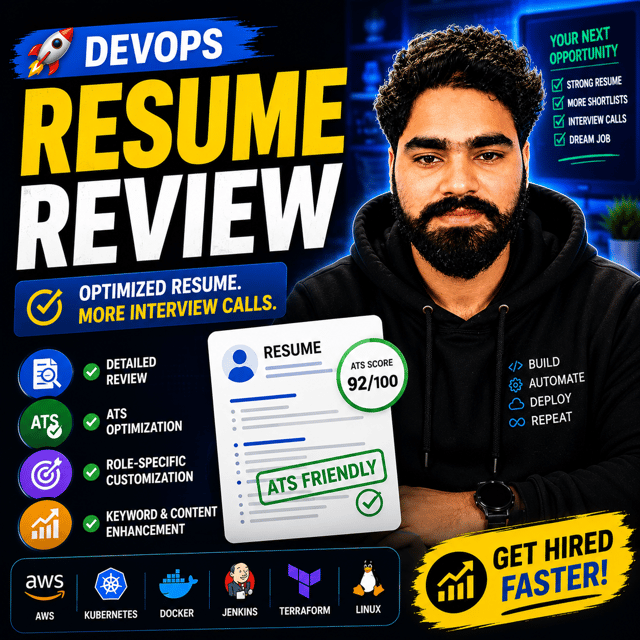
Good DevOps resume templates are available on GitHub, Overleaf and Canva, and most follow the same structure: summary, skills grouped by category, experience with metrics, and projects. The template, however, is rarely what gets you rejected, so treat DevOps resume samples as references for format only and rewrite every line with your own tools, scale and numbers. If your resume is not converting into interviews despite multiple applications, a focused review from someone who works in the field — Manish Tiwari offers dedicated DevOps resume review and optimisation sessions — will expose weak bullets faster than endless template switching.
What are Azure DevOps interview questions?
Azure DevOps interview questions focus on Microsoft's DevOps platform rather than general DevOps theory, so expect topics like YAML pipelines, classic vs multi-stage pipelines, self-hosted vs Microsoft-hosted agents, service connections, Azure Boards work items, branch policies in Azure Repos, and artifact management. Interviewers usually pair these with general CI/CD concepts, since pipeline triggers, environments and approvals transfer across tools. If the role is Azure-centric, build one end-to-end project on Azure Pipelines using the free tier — hands-on answers separate candidates far better than feature lists.