Testimonials
Services
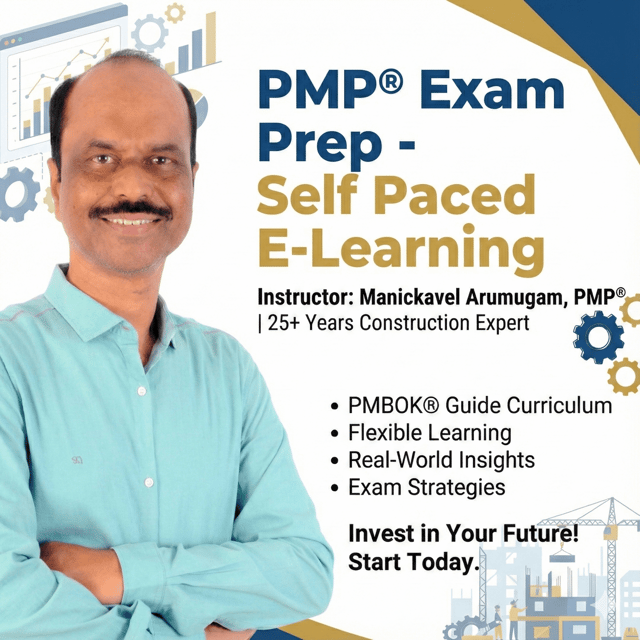
PMP® Exam Prep - Self Paced E-Learning
About me
Frequently asked questions
What is the full form of PMP certification?
PMP stands for Project Management Professional. It is a globally recognized certification offered by the Project Management Institute (PMI) that validates your ability to lead and direct projects. In India, it is highly valued across IT, construction, infrastructure, manufacturing, and consulting.
What is a project management course?
A project management course teaches you how to initiate, plan, execute, monitor, and close projects successfully. Common project management course subjects include scope and schedule management, cost and budgeting, risk management, quality management, stakeholder and communication management, procurement, and agile or hybrid delivery methods. Many programmes also introduce tools such as MS Project, Primavera, and Jira.
How to get PMP certified?
First, confirm you meet the eligibility criteria, then complete 35 hours of project management education through a recognized training provider. Next, submit your application on the PMI website, clear the application audit if you are selected, pay the exam fee, and schedule your test online or at a test centre. The exam has 180 questions to be answered in 230 minutes, and most candidates need about two to three months of focused preparation.
What are the PMP certification eligibility requirements?
You need either a four-year degree with 36 months of experience leading projects, or a secondary degree (such as a high school diploma) with 60 months of experience — in both cases along with 35 hours of project management education. Your experience should fall within the last eight years. If you do not yet have the required experience, the CAPM certification is a good starting point.
What is the PMP certification cost in India?
The exam fee is approximately ₹23,000–₹24,000 for PMI members and roughly ₹42,000 for non-members; optional PMI membership is billed separately but lowers the exam fee. On top of this, budget for the mandatory 35 hours of training, which typically costs between ₹10,000 and ₹30,000. Most candidates should plan a total budget of around ₹40,000–₹60,000. Since PMI revises fees periodically, confirm the current amounts on the official PMI website before applying.
How much is project management training in India?
It varies widely by format. Short online courses start around ₹5,000, comprehensive PMP exam preparation with the mandatory 35 contact hours generally falls between ₹10,000 and ₹35,000, and live instructor-led or corporate programmes can go up to ₹75,000. Judge a programme by trainer experience, mock test quality, and doubt support rather than price alone.
How to get PMP certification for free?
A completely free PMP certification is not realistic, because the exam fee and the mandatory 35 hours of training always apply. You can still cut costs by using free study material, joining PMP study groups, choosing affordable self-paced training instead of classroom programmes, and asking your employer about sponsorship. Be cautious of websites promising a "free" PMP certificate — credentials issued without PMI's examination hold no value with employers.
How to prepare for the PMP exam?
Most successful candidates spend 6–10 weeks preparing. Start with the 35 contact hours of training, then study the three exam domains — people, process, and business environment — covering predictive, agile, and hybrid approaches. Read the PMBOK Guide and the Agile Practice Guide, and practice full-length, timed mock exams with scenario-based questions. Whether you plan to attempt the exam in 2025 or 2026, focus on the PMI mindset of collaborative, value-driven decision-making, because most questions test judgment rather than memory.
What is the best PMP exam prep course?
Look for a course that grants the 35 contact-hour certificate, follows the latest PMP exam content outline, includes realistic mock exams, and is taught by someone with genuine project delivery experience. Manickavel Arumugam's self-paced PMP Exam Prep course, for example, draws on his 30+ years of managing large construction and metro projects, and his learners highlight the real-life examples and practice questions that closely mirror the actual exam. Compare two or three options, read recent reviews, and pick the one whose teaching style fits how you learn.
What is the best PMP exam prep book?
There is no single best book, but the most recommended combination is the PMBOK Guide (current edition) as the reference text, the Agile Practice Guide for agile and hybrid questions, PMP Exam Prep by Rita Mulcahy for exam-style drills, and PMP Exam Prep Simplified by Andrew Ramdayal if you prefer a concise, easy-to-read summary. Use books to supplement a structured course and mock tests rather than as your only resource.
What are the benefits of PMP certification?
The main benefits of PMP certification are global recognition, better salary prospects — salary surveys consistently show certified project managers out-earn their non-certified peers — and stronger credibility with employers. It also gives you a structured framework for running projects, access to project roles across IT, construction, manufacturing, banking, and consulting, and entry into a worldwide community of practitioners.
What is the PMP certification validity period?
PMP certification is valid for three years from the date you pass the exam. To keep it active, you must earn and report 60 professional development units (PDUs) during each three-year cycle and pay the renewal fee. If you do not, your certification moves into suspended status and can eventually lapse.
How to renew PMP certification?
Log in to PMI's Continuing Certification Requirements (CCR) dashboard, earn 60 PDUs over your three-year cycle — at least 35 through education, with the rest from giving-back activities such as mentoring, volunteering, or creating content — report them, and pay the renewal fee, which is lower for PMI members. PDUs can be earned through project management courses, webinars, conferences, and similar learning activities.
How to train to become a project manager?
Start by building hands-on experience in your industry — coordinating tasks, managing schedules, and leading small teams — then back it with structured learning. A project management course or the CAPM certification works well for beginners, while the PMP suits professionals with a few years of experience. Learning from practitioners who have actually delivered large projects speeds things up; trainers like Manickavel Arumugam, a chartered engineer and PMP with 30+ years on metro and construction projects in India and Singapore, teach largely through real project scenarios.