Testimonials
Services
Free 1-to-1 Data Analytics Conversation
About me
- Maira Nawaz is praised for her engaging mentorship, valuable insights, and generous support in skill development and career transitions.
 AI-generated based on testimonials
 - I had the opportunity to take career counseling sessions with Maira, and I was deeply impressed by her exceptional analytical approach.Recommended by Raja Wahaj on

Frequently asked questions
What is the best data analytics roadmap for beginners?
A simple, proven order is Excel or Google Sheets first, then SQL, then Python, then a BI tool such as Power BI, with basic statistics learned alongside. Give each stage a few weeks and practise on small, real datasets instead of only watching tutorials. Following one structured data analytics roadmap for beginners like this prevents the most common mistake beginners make — jumping between random courses without direction.
Will AI replace data analysts?
No, but it is changing what analysts do every day. Routine tasks like writing basic queries and building standard charts are increasingly AI-assisted, while judgement, business context, and storytelling with data remain human strengths. If you are following a data analytics roadmap for 2026, make sure it includes AI-assisted analytics tools so your skills stay relevant rather than replaceable.
How to become a data analyst without a degree?
You can become a data analyst without a degree by proving skills instead of credentials. Focus on SQL, Excel, Python, and Power BI, complete two or three solid portfolio projects, and add a recognised certification or two if you want structure. For junior roles, employers usually care more about what you can demonstrate with real data than about your degree, so start applying for internships and trainee analyst positions as soon as your portfolio is presentable.
How to start a data analytics career with no experience?
To start a data analytics career with no experience, learn SQL, Excel, Power BI, and basic Python first, then build two or three projects using public datasets and publish them on GitHub. Add a certification if you want structure, optimise your LinkedIn around analytics skills, and apply for internships, trainee analyst roles, and freelance data work. Experience compounds quickly once your first project or internship is on record.
How to switch to a data analytics career from a non-technical background?
Your background is an advantage, not a disadvantage. The most reliable way to switch to a data analytics career from a non-technical field is to learn SQL, Excel, and Power BI, then build one or two projects using data from your own industry — finance, marketing, operations, or education. Hiring managers value that mix of business context and analytical skill in career switchers, and it gives you strong stories to tell in interviews.
What is the data analytics career path?
The typical data analytics career path runs from junior or associate data analyst, to data analyst, to senior data analyst, and then branches into analytics manager, analytics engineer, data engineer, or data scientist roles. It is rarely linear — strong SQL, Python, and cloud skills such as GCP or Snowflake open doors across all of these directions depending on what you enjoy most.
What are the data analytics career opportunities in Pakistan?
Demand is strong across banking, fintech, telecom, e-commerce, and IT services, where companies need people who can turn raw data into decisions. Beyond local employers, many analysts in Pakistan work remotely for international companies and freelance platforms, often earning in stronger currencies. Data analytics career opportunities are therefore broader than most beginners realise, spanning data analyst, BI analyst, MIS, and reporting analyst roles.
How to build a data analyst portfolio with no work experience?
To build a data analyst portfolio with no work experience, use public datasets from platforms like Kaggle or government open-data portals and create three types of projects: a data-cleaning project in SQL or Python, an exploratory analysis with clear insights, and an interactive Power BI or Tableau dashboard. Document every project — the problem, your process, and the business takeaway — because the write-up often impresses recruiters more than the code itself.
What should a data analyst portfolio look like?
Clean and focused. Two to four strong data analyst portfolio projects beat a dozen half-finished ones — each with a clear problem statement, well-documented steps, visualisations, and a short summary of the business insight. Recruiters spend only a few minutes reviewing, so putting your best work upfront on a simple GitHub profile or landing page is far more effective than a cluttered site.
Do I need a data analyst portfolio website, or is GitHub enough?
GitHub alone is enough to get started, especially if your repositories have clear readmes and organised notebooks. A personal website becomes useful later when you want a single link combining your projects, dashboards, and write-ups, with interactive dashboards hosted publicly alongside it. Spend most of your time on project quality first — a data analyst portfolio website is polish, not a prerequisite.
Is a free data analyst portfolio template worth using?
Templates are fine for structure because they show you which sections a portfolio needs and save setup time. Just customise the design, write your own project descriptions, and avoid submitting the exact layout everyone else uses, since recruiters can spot an unedited data analyst portfolio template instantly. Treat it as a starting point, never the finished product.
What is credit risk analysis in machine learning?
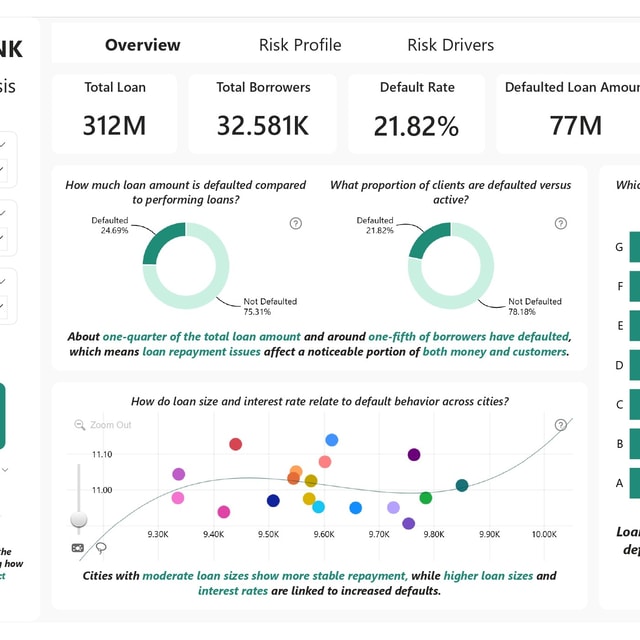
It is the use of historical loan data and classification models to predict how likely a borrower is to default, helping banks and fintech firms decide whom to lend to and on what terms. For learners, it is one of the most practical project areas because it combines data cleaning, feature engineering, and model evaluation on a realistic business problem — and it is especially valuable if you are targeting analytics roles in banking or financial services.
Are data analytics certifications worth it for getting a job?
They help you learn in a structured way and pass CV filters, but they rarely get you hired on their own. Hiring managers consistently weight hands-on projects and demonstrated skills — SQL assessments, dashboard work, portfolio walkthroughs — above certificates. A good rule is to use certifications to build knowledge quickly, then invest most of your effort into projects that prove you can apply it.