Testimonials
Services
Priority 1-on-1 Tech Doubt Support
About me
- Best Coding eBooks for Developers, Students & Job Seekers | Logic Lensehttps://logiclense.com/coding-ebooks/
Frequently asked questions
What are the most common JavaScript interview questions for freshers?
Fresher rounds mostly test fundamentals: var/let/const, hoisting, scope, closures, == vs ===, array and object methods, ES6 features, DOM manipulation, and basic async. Many interviews also include a short live-coding task like reversing a string or flattening an array. Practicing topic-wise JavaScript interview questions and answers out loud — instead of just reading them — is what helps freshers clear rounds confidently.
Where can I find JavaScript interview questions for experienced candidates?
For 3–10 years of experience, expect deeper questions on closures and memory, the event loop, prototypal inheritance, debouncing and throttling, Promises and async/await internals, error handling, performance optimization, and security basics like XSS. Curated question banks, senior developer blogs, and structured interview-prep eBooks organize these by topic and difficulty, which saves far more time than random searching.
What is a Promise in JavaScript and why is it asked in interviews?
A Promise is an object that represents the eventual completion or failure of an asynchronous operation. It has three states — pending, fulfilled, and rejected — and lets you handle results using .then(), .catch(), and .finally() instead of nesting callbacks. Interviewers love this topic because it tests whether you genuinely understand asynchronous JavaScript, so expect follow-ups on chaining, Promise.all() vs Promise.race(), and how async/await works under the hood.
What is MERN stack development and why is it so popular in India?
MERN stands for MongoDB, Express.js, React, and Node.js — four JavaScript-based technologies used together to build complete web applications. MongoDB handles the database, Express and Node power the backend, and React renders the frontend. Since the entire stack runs on one language, it is one of the most beginner-friendly and job-heavy stacks in the Indian market right now.
What is the best MERN stack development roadmap for beginners?
If you are figuring out how to learn MERN stack development in the right order: first strengthen JavaScript fundamentals, then learn React for the frontend, then move to Node.js and Express for building APIs, and finally add MongoDB and connect everything into full projects. Building two or three portfolio-worthy apps, like an authentication-based CRUD project, matters far more than collecting certificates.
How to become a MERN stack developer and what is the MERN stack developer salary in India?
Learn the four technologies through hands-on projects, upload your work to GitHub, deploy at least one live app, and start applying for internships or junior full-stack roles. Salaries vary by company type and city: freshers typically land around ₹4–6 LPA in service companies, while product-based companies and candidates with strong React or Node depth often start higher, and pay can cross ₹20 LPA with a few years of solid experience.
Where can I find a free MERN stack development course?
Official documentation for React, Node.js, and MongoDB, along with freeCodeCamp and full-length YouTube playlists, covers most beginner topics at zero cost. The catch is that free content is scattered and rarely updated together, so most learners pair free resources with one structured, affordable eBook or course to stay on a single path instead of juggling ten different tabs.
Where can I find MERN stack development notes and a MERN stack development book PDF?
Short notes work well for last-minute revision, but for interviews you need concept-wise notes with code snippets and real examples. Be careful with random PDFs floating around, as many are outdated or incomplete. Structured eBooks written specifically for MERN learners — such as the affordable coding eBooks from Logic Lense — cover the whole stack in a consistent, revision-friendly order.
How to learn frontend development from scratch?
Start with HTML and CSS by building static pages, then move to JavaScript, and only after that pick up a framework like React. A practical frontend development roadmap looks like this: HTML → CSS (flexbox, grid, responsive design) → JavaScript (DOM, ES6, APIs) → Git and GitHub → React → one complete portfolio project. Two to three hours of focused building every day beats hours of passive tutorial watching.
Which frontend development skills should I learn first, and which frontend development projects should I build?
The core frontend development skills are HTML, CSS, JavaScript, React, Git/GitHub, responsive design, and browser dev tools, with TypeScript as a strong bonus. For frontend development projects, begin with a responsive landing page, then build a to-do or notes app with local storage, followed by an API-driven app like a weather or expense tracker, and finish with one full project that includes authentication. Three finished projects impress recruiters far more than ten half-done ones.
How can I get a frontend development internship in India as a fresher?
Build two or three solid projects, host them on GitHub along with a simple portfolio site, and keep your resume to one page. Apply consistently on platforms like Internshala and LinkedIn, target startup career pages, and prepare for basics like HTML/CSS/JS questions and small live-coding rounds. Cold outreach with your portfolio link to founders and developers also works surprisingly well for internships.
What is frontend development and backend development, and which one should I learn first?
Frontend development is everything the user sees and interacts with in the browser — layout, buttons, forms, and animations — built with HTML, CSS, and JavaScript. Backend development is the server side: business logic, databases, authentication, and APIs, commonly built with Node.js, Python, Java, or C#. Beginners usually start with frontend because results are visual and instantly rewarding, then decide whether to go full-stack.
How much do front end developers make in India?
Freshers typically start around ₹3.5–6 LPA, developers with 2–4 years of experience roughly earn ₹6–12 LPA, and senior front-end engineers with strong React, TypeScript, and performance skills can cross ₹20 LPA at product companies. Cities like Bengaluru, Pune, Hyderabad, and Gurugram pay noticeably above average, and a project-heavy portfolio is usually what pushes an offer into the higher band.
How do I prepare for a C# and .NET Core interview in 30 days?
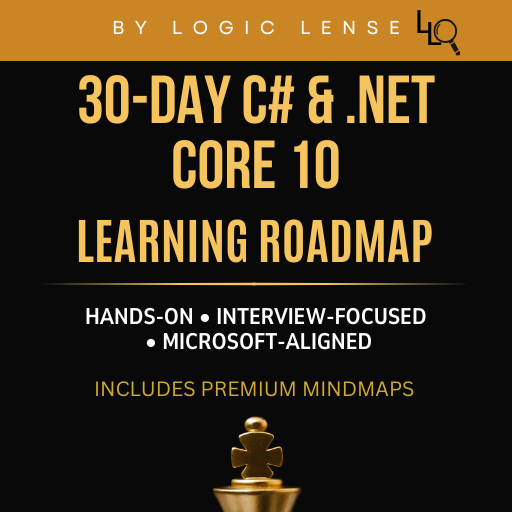
Split it week-wise: Week 1 for C# fundamentals like OOP, collections, LINQ, and exception handling; Week 2 for .NET Core topics like middleware, dependency injection, and routing; Week 3 for Entity Framework, SQL, and unit testing basics; and Week 4 for mock interviews and revision. Following a structured 30-day checklist — like the C# & .NET Core Interview Checklist from Logic Lense — keeps your prep consistent instead of last-minute cramming.
Where can I get 1-on-1 tech doubt support when I'm stuck while learning to code?
Free forums and communities are great first stops, but replies can take hours and threads often get closed as duplicates. When an error blocks your project for days or your interview is tomorrow, a 1-on-1 tech doubt support option — such as priority DM sessions where a mentor answers your exact question quickly — can save days of frustration. Use free resources for everyday doubts and reserve 1-on-1 help for blockers that genuinely stall your progress.