Testimonials
Services
Book 1:1 Mentorship Call on Career Guidance
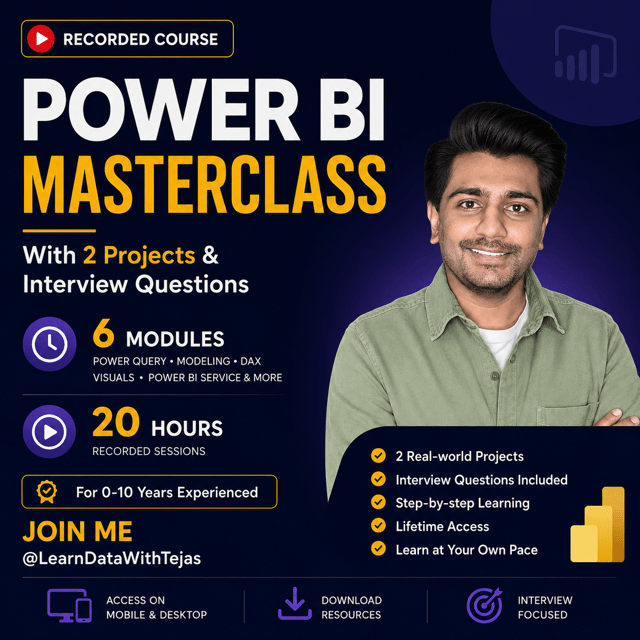
Mock Interview - SQL & Power BI (0-10 yrs exp)
Power BI Project From Scratch For Beginners-VIDEO
SQL LeetCode Solutions PDF
SECRET TOP 105 SQL Interview Questions PDF
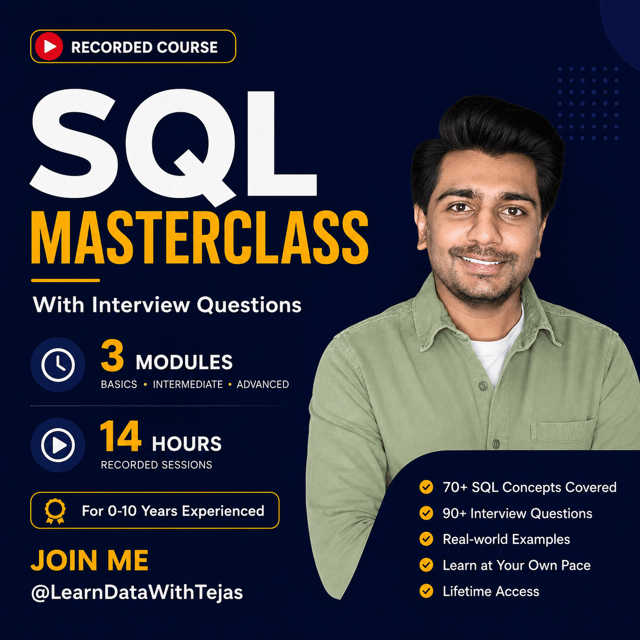
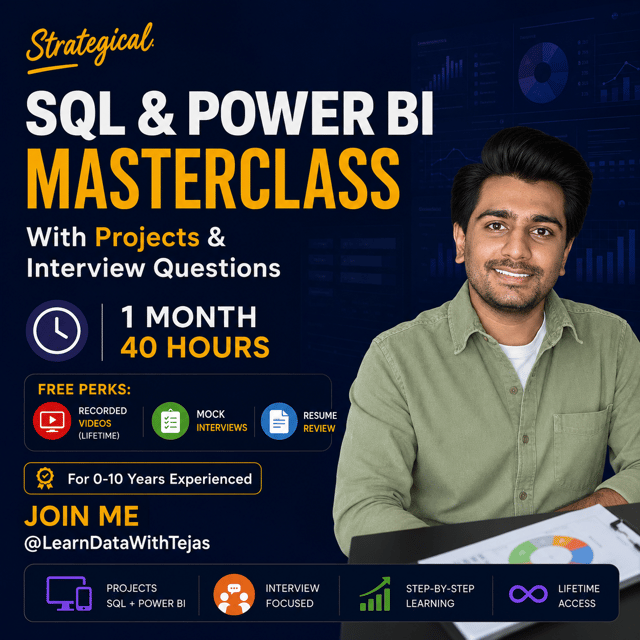
𝐅𝐮𝐥𝐥 𝐃𝐚𝐭𝐚 𝐀𝐧𝐚𝐥𝐲𝐬𝐭 𝐂𝐨𝐮𝐫𝐬𝐞 (𝐈𝐧𝐭𝐞𝐫𝐯𝐢𝐞𝐰 𝐏𝐫𝐞𝐩𝐚𝐫𝐚𝐭𝐢𝐨𝐧)
30-Days Data Analytics Roadmap (2026 Edition)
SECRET Power BI Interview Ques & Ans - Basic PDF
About me
- Follow on INSTAGRAM | LearnDataWithTejashttps://www.instagram.com/learndatawithtejas/

- Subscribe on YOUTUBE | LearnDataWithTejashttps://www.youtube.com/@LearnDataWithTejas

- Power BI End To End Project For Beginners - FULL VIDEOhttps://www.youtube.com/watch?v=YaJRw8uklnw

- LIVE Class of SQL & Power BI + Project + Interviews Preparationhttps://forms.gle/sJ9T75yMgu9rWfvh7

Frequently asked questions
How do I prepare for SQL interview questions as a fresher?
If you are planning how to prepare for SQL interview questions as a fresher, build fundamentals first: SELECT queries, filters, all JOIN types, GROUP BY with HAVING, subqueries, and basic window functions like ROW_NUMBER and RANK. Then solve the standard SQL interview questions for freshers — primary key vs foreign key, DELETE vs TRUNCATE, WHERE vs HAVING, UNION vs UNION ALL — by writing every query yourself instead of just reading answers. Two to three weeks of daily practice, ideally guided by a structured 30-day roadmap like the one Tejas Rane shares on Topmate, is usually enough for fresher-level analyst roles.
What is the right way to answer SQL interview questions when you get stuck?
If you are unsure how to answer SQL interview questions on the spot, think aloud: restate the requirement, identify the tables and join keys, and explain which JOIN, GROUP BY, or window function you would use before writing the syntax. Interviewers in India evaluate structured thinking far more than memorised code, so a logical attempt with clear reasoning usually scores better than silence. Rehearsing this out loud, ideally in a mock interview, makes it second nature.
What are the most frequently asked SQL interview questions and answers?
The most commonly asked SQL interview questions and answers revolve around join types, aggregate functions with GROUP BY and HAVING, subqueries vs CTEs, window functions like RANK and DENSE_RANK, keys and normalisation, indexes, and query optimisation, along with scenario-based queries on employee and sales tables. Revising from one curated set, such as Tejas Rane's top 105 SQL interview questions PDF on Topmate, is more effective than jumping between random websites, because Indian interviewers repeatedly draw from the same core pattern list.
Which SQL and Power BI questions come up in a data analyst interview?
Typical SQL interview questions for data analyst roles focus on joins, aggregations, window functions, data-cleaning queries, and case-study problems built on sales or customer data. Alongside these, expect Power BI interview questions for data analyst positions on DAX measures, Power Query transformations, data modelling, and dashboard design, since most Indian companies expect analysts to handle both tools end to end. Preparing them together also mirrors how the actual technical rounds are structured.
What SQL interview questions are asked for 5 years of experience?
SQL interview questions for 5 years experience move beyond syntax into depth: query performance tuning and execution plans, indexing strategy, recursive CTEs, complex window functions, handling very large tables, and detailed project walkthroughs such as "describe a slow query you fixed." At this level, interviewers judge how you made decisions and what business impact your work delivered, so keep two or three real project stories ready with measurable outcomes.
What are SQL Server interview questions and how are they different from general SQL questions?
SQL is the query language, while SQL Server is Microsoft's database engine used by a large share of Indian IT companies and MNCs. So SQL Server interview questions cover core SQL plus T-SQL specifics: stored procedures, user-defined functions, triggers, temp tables, CTEs, indexes, and working in SSMS. If a job description mentions SQL Server, practise your queries in T-SQL, because built-in functions and syntax differ slightly from MySQL or PostgreSQL.
What are the most common Power BI interview questions and answers?
The most frequently asked Power BI interview questions and answers cover the difference between measures and calculated columns, CALCULATE and filter context, Power Query steps, star schema and relationships, cardinality, row-level security, and dashboard vs report. Interviewers almost always follow theory with "walk me through one of your dashboards," so keep one clean end-to-end project ready covering the data source, transformations, model, and key DAX measures.
Where can I get Power BI interview questions and answers in PDF format?
A Power BI interview questions and answers PDF works best for last-week revision, when you want to quickly scan concepts like DAX context, modelling mistakes, and refresh issues. Pick a curated, topic-wise compilation rather than a long random dump — for example, Tejas Rane shares a dedicated Power BI interview questions and answers PDF on his Topmate for basic-level preparation. Revise from the PDF, but keep practising in Power BI Desktop, since most interviewers test hands-on understanding.
How should experienced professionals prepare for Power BI interview questions?
Power BI interview questions for experienced professionals go deep into advanced DAX such as context transition and iterator functions, performance tuning with aggregations and VertiPaq, incremental refresh, row-level security, and deployment pipelines. Prepare two or three dashboards from your own experience where you can explain requirements, trade-offs, and measurable business outcomes. A mock interview with a senior BI mentor — Tejas Rane conducts SQL and Power BI mock interviews for candidates with 0–10 years of experience — helps you present these decisions the way interviewers expect.
How can I learn SQL as a beginner for free?
If you are wondering how to learn SQL for beginners for free, combine three things: a structured SQL for beginners YouTube playlist for concepts, a free practice platform like SQLBolt or HackerRank for hands-on work, and a free question bank such as Tejas Rane's free top 105 SQL interview questions PDF on Topmate. Follow a simple 30-day sequence — basics first, then joins and aggregation, then window functions and interview questions — and write every single query yourself.
What is the best SQL course for beginners in India?
When learners ask what is the best SQL course for beginners, the honest answer is whichever course makes you write queries daily, covers interview-oriented questions, teaches on a widely used database like SQL Server, and offers genuine doubt support. Compare live weekend batches, which build discipline and allow real-time doubt clearing, with recorded classes, which suit self-paced learners. Tejas Rane, a Microsoft-certified BI lead with 8+ years in the data field, offers both formats for beginners in India, so check recent reviews and pick the format that matches your schedule.
Where can I find good SQL for beginners PDF notes?
You will find no shortage of SQL for beginners PDF files online, but the useful combination is one concise notes file for revision — joins, window functions, string and date functions — plus one solved question bank for practice. Avoid collecting ten PDFs and reading none of them; pick two quality files, then spend most of your time actually writing queries in SSMS or MySQL Workbench, because SQL is learned by typing, not reading.
Can I learn SQL for beginners in Hindi?
Yes. There are many SQL for beginners in Hindi resources, especially on YouTube, where instructors explain joins, GROUP BY, and window functions in simple Hindi while the SQL keywords themselves remain in English. Learning the logic in your comfortable language first and then shifting to English practice questions is a proven approach for interviews. Tejas Rane mentors learners in Hindi, Marathi, and English, so language is rarely a barrier in his sessions.
How long does it take to go from SQL for beginners to advanced?
Moving from SQL for beginners to advanced level typically takes three to six months at one to two hours a day: around four to six weeks for fundamentals like joins and grouping, another six to eight weeks for subqueries, CTEs, and window functions, and the rest for optimisation and real project work. A structured program compresses this timeline — Tejas Rane's recorded SQL MasterClass packs 14 hours of content designed to take learners from basics to interview-level SQL — but daily written practice is what actually builds the skill.
How do I practice SQL interview questions effectively?
If you want to know how to practice SQL interview questions the right way, solve problems on LeetCode's SQL track and HackerRank, rebuild queries on real datasets such as sales and employee data, and time yourself on every problem. Effective SQL practice for beginners means deeply mastering 60–80 patterns — duplicates, running totals, top-N per group, month-on-month growth — rather than rushing 300 random questions. When stuck on a pattern, a solved reference like Tejas Rane's SQL LeetCode Solutions PDF shows how each query is built step by step.