Testimonials
Services
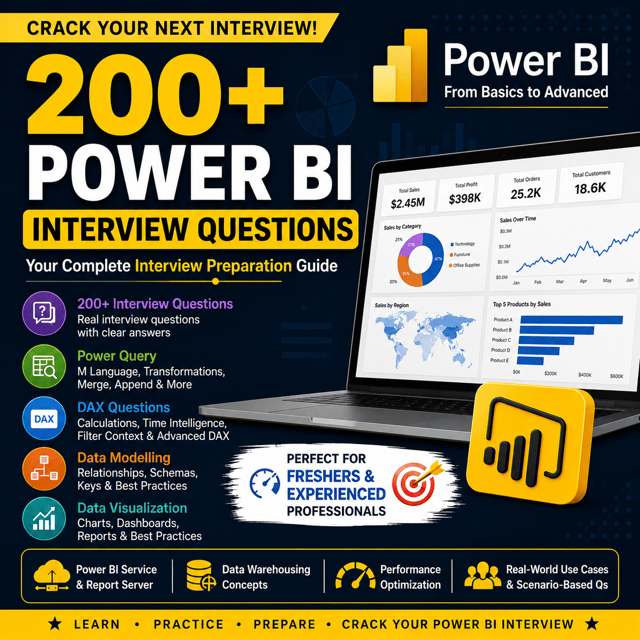
200+ Power BI Questions to Crack Interviews
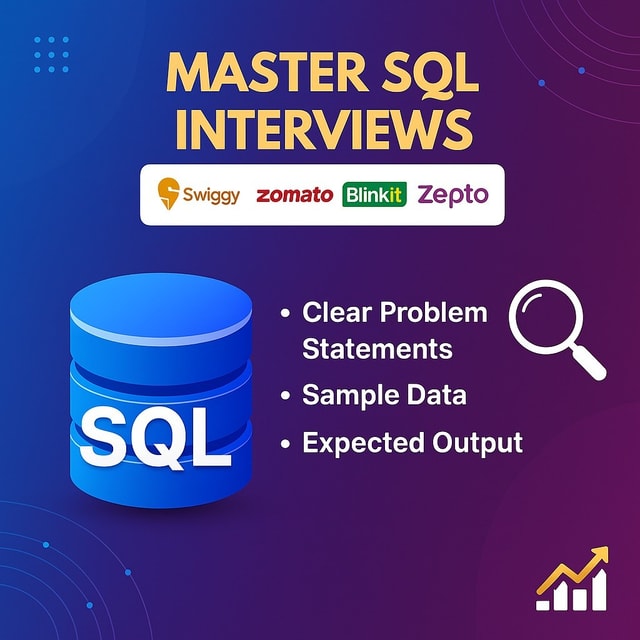
Get Interview-Ready with Real SQL Problems
Best Websites to Learn and Practice SQL
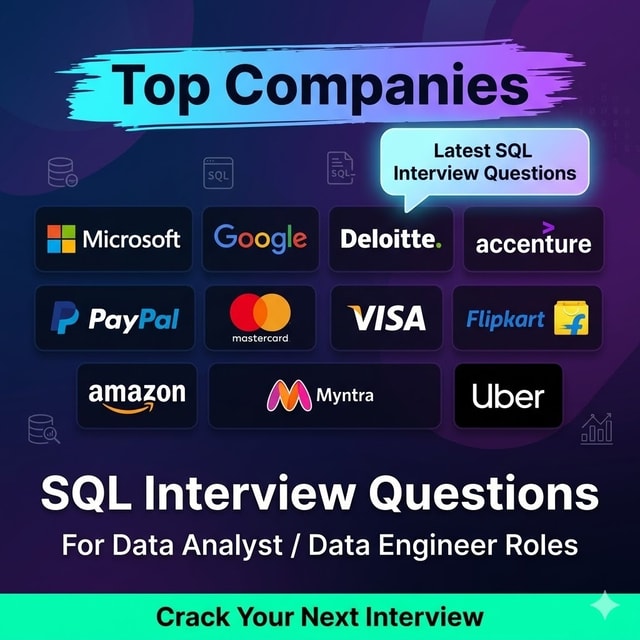
200+ Hands-On SQL Questions to Ace Interviews

SQL Logic Questions PDF for Practice 🚀

Frequently asked questions
How to prepare for SQL interview questions as a fresher?
The best way to prepare for SQL interview questions is to master the fundamentals first — SELECT, WHERE, JOINs, GROUP BY, and subqueries — and then move to window functions and query optimization. Revise the theory, solve hands-on queries daily, and take at least one timed mock. In India, data analyst and product analyst interviews usually test live query writing on sample tables rather than definitions, so practice on real datasets and be ready to explain your logic out loud.
How to practice SQL interview questions every day?
Practice SQL interview questions in a fixed daily slot of 45–60 minutes. Start with joins and aggregations, then progress to window functions, CTEs, and scenario-based business problems. Keep an error log of every query you get wrong, re-attempt those problems after a week, and occasionally write queries without hints to simulate interview pressure. Consistent daily practice beats last-minute cramming.
How to answer SQL interview questions when you get stuck?
When you are stuck, clarify the expected output, state your assumptions, and break the problem into smaller steps before writing the query. Interviewers evaluate your logic-building approach and communication as much as the final answer, so think out loud, handle edge cases such as NULLs and duplicates, and mention how you would optimize the query if the table were very large.
What are the most common SQL interview questions for freshers?
Fresher rounds usually include writing queries for the second-highest salary, removing duplicates, using different JOINs, and explaining GROUP BY vs HAVING, along with basic window functions like ROW_NUMBER and RANK. Many companies in India ask you to write these live on an employee or orders table, so be prepared to type the queries yourself instead of only explaining the approach.
Which SQL interview questions for data analysts are asked most often?
SQL interview questions for data analysts are mostly scenario-driven — calculating month-on-month growth, finding the top N customers per region, handling date ranges, and dealing with NULLs or duplicate records. Hiring teams want to see whether you can convert a business question into a working query, so focus on real business scenarios instead of memorising syntax alone.
How are SQL interview questions and answers for experienced professionals different from fresher-level ones?
SQL interview questions and answers for experienced professionals go deeper into query performance tuning, execution plans, complex window functions, and handling large production tables. Interviewers expect you to justify your approach and discuss trade-offs between different solutions, while fresher interviews focus mostly on syntax and fundamental query writing.
How to crack a Power BI interview?
To crack a Power BI interview, be strong in DAX (especially measures vs calculated columns), data modelling with star schemas, filter and row context, Power Query transformations, and import vs DirectQuery. Prepare two or three portfolio projects and be able to explain the business impact of each dashboard. Most companies now ask scenario-based questions, so practice explaining how you would build a report from a raw dataset.
What are the most common Power BI interview questions and answers?
The most common Power BI interview questions and answers revolve around measures vs calculated columns, filter context, relationships and cardinality, Power Query vs DAX, import vs DirectQuery, and incremental refresh. Prepare short, structured answers with a small example for each, because interviewers in India typically follow up with "why" and "what if" questions to test your depth.
How to explain a Power BI project in an interview?
Structure it in four parts: the business problem, the data sources and cleaning you did in Power Query, the data model and key DAX measures you built, and the insights your dashboard delivered. Keep it to three to five minutes, focus on decisions and business impact rather than button-clicking, and mention one challenge you faced and how you solved it — interviewers value that the most.
Where can I find a good Power BI interview questions and answers PDF for quick revision?
Look for a Power BI interview questions and answers PDF that includes DAX concepts, data modelling, Power Query, and scenario-based questions with model answers, so you can revise everything in the last few days before your interview. Whatever material you use, pair it with hands-on practice in Power BI Desktop, because some interviews include a live task where you build or modify a report.
How to start a data analytics career with no experience?
Start with one focused tool stack — Excel, SQL, and a BI tool like Power BI — and build two or three portfolio projects on real, publicly available datasets. Learn basic statistics, publish your projects on LinkedIn or GitHub, and apply for analyst internships and junior analyst roles. In India, a strong portfolio, solid SQL depth, and referrals usually matter more than a premium degree.
How to switch to a data analytics career from a non-technical background?
Treat your domain knowledge as an advantage rather than a setback. Learn SQL, Excel, and Power BI, then bring analytics into your current role by building dashboards or reports for your team. Rebuild your resume around measurable outcomes, and target hybrid roles that connect your industry with data, since hiring managers value candidates who understand both the business context and the queries.
What does a typical data analytics career path look like?
A typical data analytics career path in India begins as a data analyst or junior analyst, progresses to senior data analyst, and then branches into analytics manager, product analyst, data engineer, or data scientist depending on your strengths. Growth is fastest for professionals who combine strong SQL and BI skills with business understanding, so build both in parallel rather than focusing on tools alone.
How is the data science career path different from the data analytics one?
The data science career path moves toward machine learning, predictive modelling, and experimentation, while analytics roles focus more on dashboards, reporting, and business decision support. Both start with SQL and statistics, which is why many professionals in India begin as data analysts and then add Python and ML fundamentals to transition into data science roles.