Testimonials
Services
RECORDED Session on USD Dominance


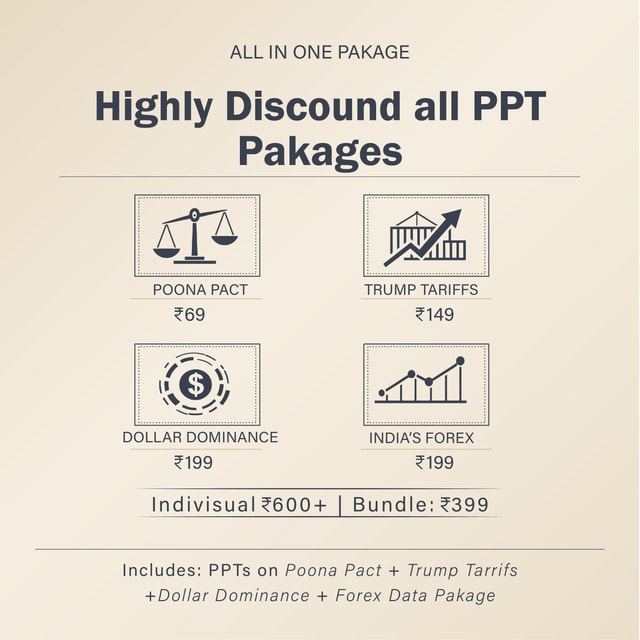
All PPTs and Documents Listed
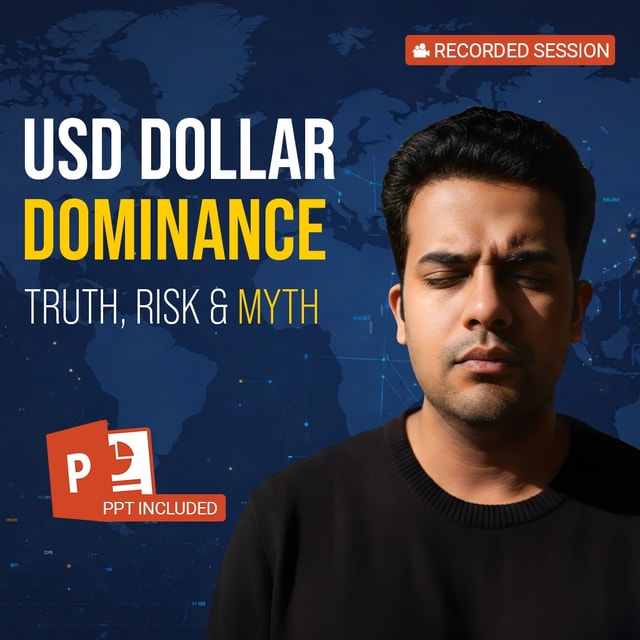
On USD Dominance [Recorded Lecture+PPT]
Frequently asked questions
What is dollar dominance?
Dollar dominance refers to the US dollar's outsized role in the global economy — it is the most-used currency for cross-border trade invoicing, central bank reserves, international debt issuance, and commodity pricing, including oil. The dollar makes up close to 60% of official foreign exchange reserves worldwide, far ahead of the euro, yen, or yuan. This status gives the United States enormous leverage, including the ability to enforce sanctions through the global banking system.
Why is the US dollar used for global trade instead of other currencies?
US dollar dominance in international finance is the product of history and structure. The Bretton Woods system made the dollar the anchor of the post-war monetary order, and America's deep, liquid Treasury market, open capital account, and the petrodollar arrangement for oil pricing reinforced it. Once most trade and debt are priced in dollars, everyone keeps using them for convenience — a self-reinforcing network effect no challenger matches, since the euro has fragmented debt markets and the yuan remains under capital controls.
Is US dollar dominance at risk?
Yes, more than at any time in recent decades, though not imminently. Central banks have been buying record amounts of gold and diversifying reserves after Western sanctions on Russia showed that dollar assets can be frozen; BRICS members openly discuss settling trade in local currencies; and the dollar's reserve share has slid from over 70% in 2000 to under 60% today. Even so, no alternative offers the same depth, liquidity, and legal safety, so most analysts see erosion at the edges rather than an immediate threat to the core.
Is US dollar dominance ending?
Not in the foreseeable future. The dollar's share of global reserves has declined slowly for two decades, but it still exceeds the next several currencies combined. Every challenger carries a handicap — the euro's incomplete structure, China's capital controls, and no deep, open bond market behind any rival currency. The realistic outcome is a gradual shift toward a multipolar system where the euro, yuan, gold, and digital arrangements take a larger share, while the dollar remains the primary global currency for decades.
Is US dollar dominance a blessing or a curse?
It is both, depending on where you stand. For the United States, it is the "exorbitant privilege" — cheaper borrowing, endless global demand for dollars, and sanctions power. For everyone else, it cuts both ways: when the US Federal Reserve raises rates, dollar debts become costlier and capital drains out of emerging markets; when the dollar strengthens, dollar-priced imports like crude oil get more expensive for countries such as India. This tension is exactly why the de-dollarisation debate has intensified since 2022.
How do Trump's tariffs affect India?
They directly hit Indian exports to the US — sectors like textiles, gems and jewellery, shrimp, auto components, and electronics face higher costs and thinner margins, with labour-intensive employment most exposed. But the effects also cut the other way: steep tariffs on China push global buyers to diversify sourcing under the "China plus one" strategy, creating openings for Indian manufacturers and exporters. The net impact depends on how high the tariffs stay and whether India and the US settle on a trade deal.
How are Trump's tariffs legal?
US presidents can impose most tariffs without a fresh vote in Congress because trade powers have been delegated to the executive over decades. Trump has relied on Section 232 (national security, used for steel and aluminium), Section 301 (unfair trade practices, used against China), and, most controversially, the International Emergency Economic Powers Act (IEEPA) for his broader tariffs. The IEEPA route is being challenged in US courts on the argument that a trade deficit is not a national emergency and that tariff power belongs to Congress, so parts of the tariff regime could still be struck down.
What are Trump's tariffs on China?
Trump has layered tariffs on Chinese goods in two waves — first during the 2018–19 US–China trade war, and again far more steeply in 2025, when rates on many products briefly crossed 100% before a partial truce brought them down. The stated goals are shrinking the trade deficit, pressuring China on intellectual property and fentanyl, and pushing manufacturing back to America. For India, the side effect matters: costlier Chinese goods in the US market create export and manufacturing opportunities for competing economies.
Will Trump tariffs on pharma hurt Indian generic drug exporters?
There is a genuine risk, which is why the sector watches every announcement closely. India supplies nearly half of the generic prescriptions filled in the US, and the industry runs on thin margins, so Trump tariffs on generic drugs would either squeeze Indian manufacturers or raise medicine costs for American patients. So far, sector-wide tariffs have been threatened and investigated more than fully implemented, but any final tariff on pharmaceuticals would directly affect the largest overseas market for Indian drugmakers.
How much forex reserves does India have?
India's foreign exchange reserves have generally stayed in the $600–700 billion range in recent years, touching a record of roughly $705 billion in September 2024, which places India among the top five reserve holders in the world. The exact figure changes every week — the RBI publishes updated numbers every Friday — so for the current level, check the latest weekly release rather than older articles.
What are India's foreign exchange reserves?
They are the foreign assets held by the Reserve Bank of India as a buffer for the economy, built from four components: foreign currency assets (deposits and bonds held mainly in dollars, euros, pounds, and yen), gold, Special Drawing Rights allocated by the IMF, and India's reserve tranche position at the IMF. These reserves help the RBI smooth currency volatility, pay for imports during shocks, and reassure global investors that India can meet its external obligations.
How long will India's forex reserves last?
By the standard measure of import cover, India's reserves currently finance roughly 10–11 months of imports — well above the three months considered adequate, and a world away from the 1991 crisis when cover had shrunk to barely three weeks. Import cover is not the only test, though: reserves also need to absorb short-term external debt repayments and give the RBI enough ammunition to defend the rupee during episodes of capital outflow.
Where can I find India's forex reserves chart with the latest data?
The Reserve Bank of India publishes reserve figures every week in its Weekly Statistical Supplement, and its online data portal lets you build India's forex reserves chart by year going back decades. The RBI's Handbook of Statistics on the Indian Economy is the standard reference if you want to see the full trend at a glance — from under $300 billion in the early 2010s to records near $700 billion.
How much were India's forex reserves in 2014 compared to today?
India's forex reserves in 2014 stood at around $300 billion (about $304 billion at the end of March 2014). Since then they have more than doubled, crossing $600 billion during the pandemic years and peaking near $705 billion in September 2024. The 2014 comparison is often used in political debates, but the more meaningful yardstick is reserve adequacy — how many months of imports and how much external debt the reserves can cover, not just the headline number.
How did the Ukraine war affect India's forex reserves?
The war hit India's reserves through several channels at once: costlier oil and gas widened the import bill, while aggressive US rate hikes to fight war-driven inflation pulled capital out of emerging markets. Together, these pressures dragged reserves down by more than $100 billion from their late-2021 peak to roughly $524 billion in October 2022. The war also pushed India to buy discounted Russian crude through non-dollar payment arrangements. Reserves have since rebuilt to record highs, making the post-war period a useful case study in how external shocks test a country's reserve strength.