Testimonials
Services
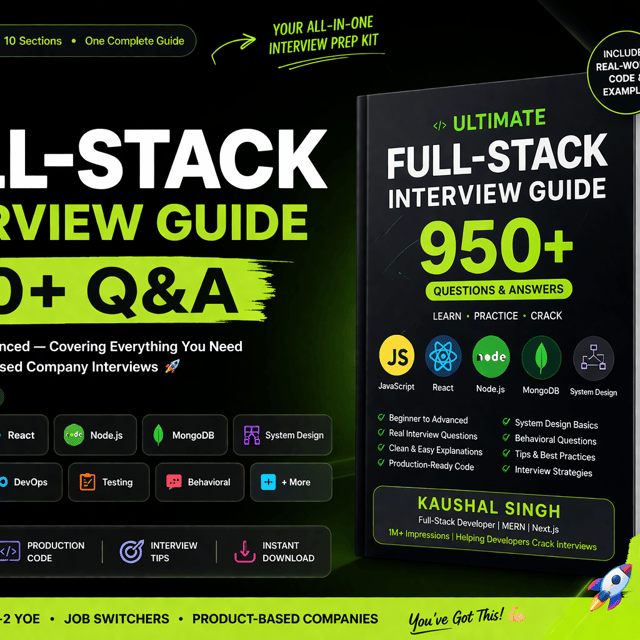
950 MERN +DSA + System Design (Q& A)
SDE SHEET - DSA in 2 Months - By kaushal singh
Personalized mentorship call
Mock Technical Interview + Career Feedback
About me
Frequently asked questions
What topics do full stack developer interview questions usually cover?
In India, full stack developer interview questions typically span the entire stack: JavaScript fundamentals (closures, hoisting, event loop, async/await), React or Next.js on the frontend, Node.js and Express on the backend, MongoDB or SQL for databases, plus authentication, REST APIs, DSA rounds, and system design for product-based companies. Freshers are tested more on fundamentals and projects, while experienced candidates face deeper scenario-based and design questions.
Is memorizing full stack interview questions and answers enough to crack an interview?
No — and this is where most candidates slip. Full stack interview questions and answers are excellent for covering the syllabus quickly and spotting patterns, but interviewers follow up with "why did you do it that way?", live coding, and project deep-dives. Use a question bank to identify weak areas, then revise fundamentals and be ready to explain your own projects end to end.
What do full stack interview questions for freshers usually focus on?
Unlike experienced rounds, full stack interview questions for freshers concentrate on fundamentals over scale: core JavaScript, basic React (components, props, state), simple REST APIs with Node and Express, MongoDB queries, easy-to-medium DSA problems, and questions around your academic or personal projects. If you can explain how data flows from your React frontend through an Express API into MongoDB and back, you are already ahead of most freshers.
Where can I find a good full stack interview questions and answers PDF?
Plenty exist — the real task is filtering for quality. A good full stack interview questions and answers PDF should be organized topic-wise (JavaScript, React, Next.js, Node.js, MongoDB, auth, system design), include actual answers instead of bare question lists, and be based on questions genuinely asked in recent interview cycles. Random blog dumps usually recycle the same 50 basic questions, so always check the coverage list before committing to any PDF.
What do full stack interview questions for MERN stack roles cover?
In practice, full stack interview questions for MERN stack roles combine general screening with stack-specific depth: React (hooks, Redux), Node.js and Express (middleware, REST design), MongoDB (schema design, aggregation), and JWT-based authentication, followed by DSA and system design rounds depending on seniority. Treat any "MERN developer" opening as a signal that all four technologies will be tested together.
Are GitHub repositories a good source for full stack interview preparation?
Searching for full stack interview questions on GitHub throws up hundreds of repositories, but quality varies wildly — many are just question dumps with no verified answers, outdated patterns, or no ordering from basics to advanced. Repos are useful as extra practice material, but pair them with a structured, answer-backed question set and a few mock interviews so you are not revising from stale lists.
Where can I find real full stack interview questions shared by actual candidates?
Threads with full stack interview questions on Reddit are among the best sources of real, recently asked questions — Indian developers regularly post the exact rounds they faced at product and service companies. The downside is that answers are scattered and unverified, so use these threads to understand patterns and difficulty levels, then prepare the underlying topics properly.
What is the best way to prepare JavaScript interview questions and answers?
Layer your preparation instead of jumping around randomly. Work through JavaScript interview questions and answers in this order: core mechanics (closures, hoisting, this, prototypes), asynchronous JavaScript (event loop, promises, async/await), ES6+ features and output-based questions, and finally framework-level usage in React or Node. Most rejections happen not on rare topics but on shaky explanations of the basics.
How are JavaScript interview questions for experienced developers different from fresher-level questions?
Once you have a few years of experience, JavaScript interview questions for experienced developers stop being about definitions — expect event loop internals, memory leaks, performance optimization, design patterns, testing, and "walk me through a real problem you solved" scenarios scaled to your experience. With 3–5+ years, interviewers also probe architectural judgement, so prepare stories from real projects, not just textbook answers.
How many React interview questions and answers should I prepare before applying?
Depth beats volume. A focused set of React interview questions and answers covering components and props, hooks (useState, useEffect, useMemo, useCallback), reconciliation, state management with Redux or Context API, and performance optimization is enough for most rounds. Add one solid React project you can walk through, because interviewers frequently convert theory questions into "how did you use this in your project?"
Which React hooks interview questions are asked most frequently?
In most interviews, React hooks interview questions start with useState and useEffect — dependency arrays, cleanup functions, stale closures, and infinite re-render bugs — before moving to useContext vs useReducer, useMemo and useCallback, custom hooks, and the rules of hooks. Being able to debug a runaway useEffect on a whiteboard is practically expected now.
How different are React Native interview questions from React web questions?
The foundation overlaps — components, state, props, hooks — but React Native interview questions add mobile-specific layers such as navigation, FlatList performance, native modules and bridging, platform-specific styling, offline handling, and app deployment. If you are moving from React web, prepare examples that show you understand mobile constraints like low-end devices and limited memory.
What is a promise in JavaScript and why does it appear in every interview?
A promise is an object representing the eventual completion or failure of an asynchronous operation, and it exists in one of three states: pending, fulfilled, or rejected. Type promise in JavaScript interview questions into Google and you'll notice every list begins with this definition and then drills into .then/.catch chaining, error handling, Promise.all, and how async/await is built on top of promises — which is exactly why interviewers love it.
How should you respond to interview questions about weaknesses?
Knowing how to respond to interview questions about weaknesses comes down to honesty plus visible progress: pick a genuine, non-critical weakness, briefly show how it affected your work, and explain the concrete steps you are taking to improve. Avoid clichés like "I'm a perfectionist" and never name a weakness that is central to the role — a thoughtful answer here often signals more maturity than a perfect technical answer.