Testimonials
Services
Quick turn around for your queries in a Single Day
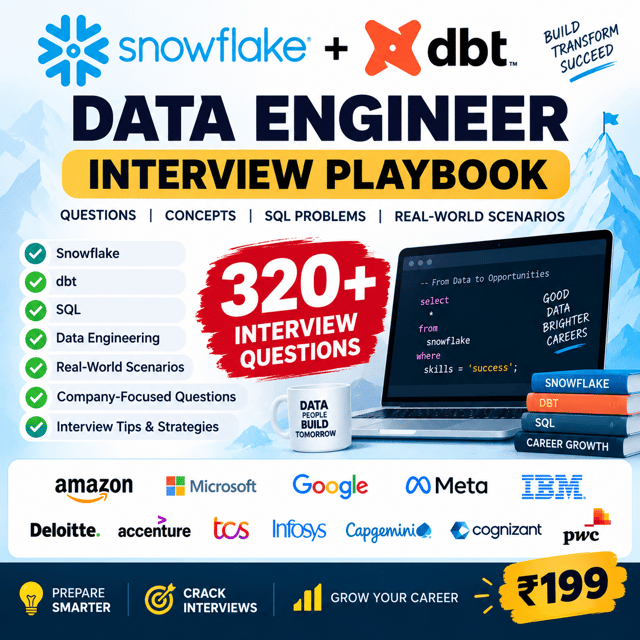
Snowflake Data Engineer Interview Playbook 🚀
DM for queries
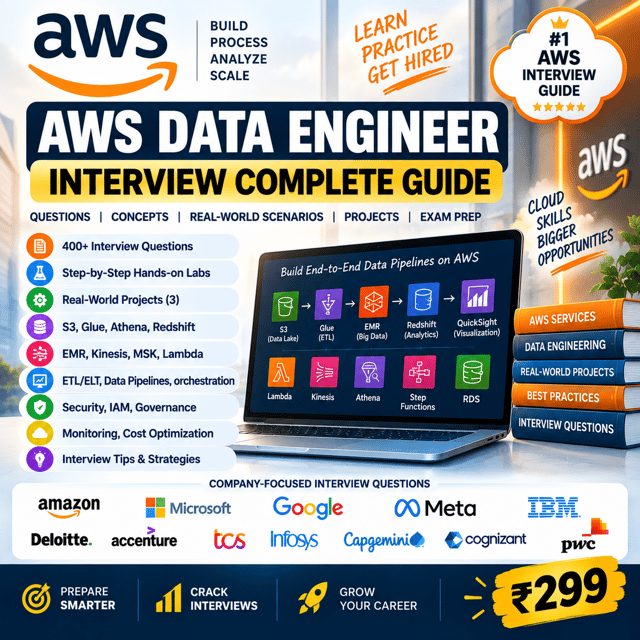
AWS Data Engineer Interview Playbook
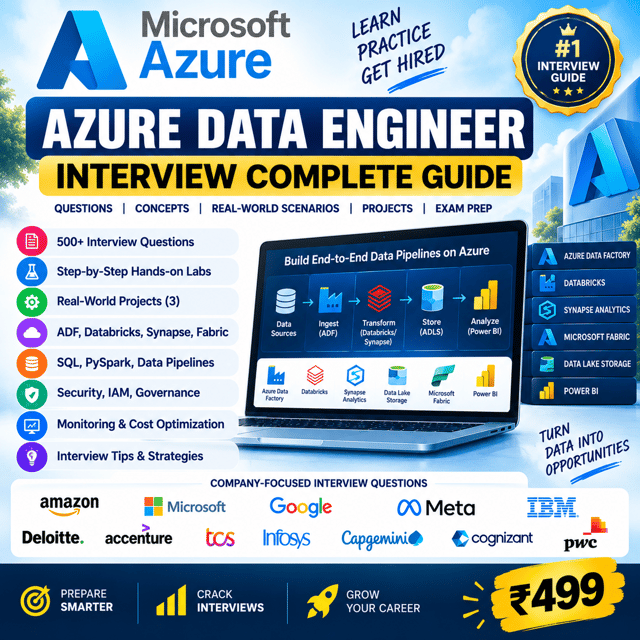
Azure Data Engineer Interview Playbook
About me
- Offer 50%

Frequently asked questions
How to crack a data engineer interview?
Focus your preparation on the four areas almost every data engineer interview in India tests: advanced SQL (joins, window functions, query tuning), Python and PySpark, data modelling and warehouse concepts, and one cloud platform in depth. Build two or three end-to-end pipeline projects you can walk through confidently, practise scenario questions like handling late-arriving data or fixing a failing DAG, and do at least a few mock interviews under time pressure. Researching the target company's stack in the final week makes a noticeable difference.
What are the most common data engineer interview questions?
The most common data engineer interview questions revolve around SQL (WHERE vs HAVING, RANK vs DENSE_RANK, deduplication queries), Python and PySpark internals, star schema and SCD types, Airflow concepts like idempotency and backfills, and cloud services such as S3, Redshift, Glue, Data Factory, or Databricks depending on the role. Mid-senior rounds add design questions like ingesting millions of daily events with exactly-once guarantees. A short behavioural round on production failures and stakeholder communication usually closes the loop.
What are the common data engineer interview questions for 5 years of experience?
Data engineer interview questions for 5 years of experience shift from definitions to architecture and trade-offs: optimising a slow pipeline, controlling cloud warehouse costs, schema evolution, CDC-based ingestion, and moving batch workloads to streaming. Expect deep-dives into your past projects, so keep metrics ready — data volumes, SLAs, cost savings, and the data quality checks you personally implemented. A live design round like "load 2 TB daily with a 6 a.m. SLA" is almost guaranteed at this level.
How do you answer "Why do you want to be a data engineer" in an interview?
Anchor the answer in something specific rather than generic enthusiasm — a project where you turned messy raw data into a decision-ready output, the satisfaction of building reliable systems other teams depend on, or genuine enjoyment of SQL and Python problem-solving at scale. Then connect it to the company's data platform and the problems its team solves. Interviewers use "Why do you want to be a data engineer" to test authenticity, so one concrete story beats five textbook points.
How to become an AWS data engineer?
If you're mapping out how to become an AWS data engineer, follow this sequence: strengthen SQL and Python first, learn data warehousing and ETL fundamentals, then go deep on S3, Glue, EMR, Lambda, Kinesis, and Redshift — the services behind most AWS data roles in India. Build a batch pipeline, a streaming pipeline, and a warehouse modelling project, back them with the AWS Data Engineer Associate certification, and publish everything on GitHub and LinkedIn. Most consistent learners reach interview-ready level in roughly four to six months.
What is the AWS Data Engineer Associate certification?
The AWS Data Engineer Associate certification (exam code DEA-C01) validates your ability to build and maintain data pipelines on AWS. It covers data ingestion and transformation, data store management, data operations, and security and governance, with services like S3, Glue, Redshift, Kinesis, and Lambda at the core. It suits working data engineers and professionals with hands-on AWS exposure, and it has become one of the most in-demand cloud data credentials in Indian hiring.
How to pass the AWS data engineer certification?
To pass the AWS data engineer certification, plan six to eight weeks: begin with the exam domains and core services, spend the middle weeks building hands-on with Glue, Athena, Redshift, and Kinesis, and finish with timed practice exams. The paper leans heavily on scenario questions where you pick the right service based on cost, latency, and scale, so practise those trade-offs instead of memorising limits. Candidates who skip hands-on labs are the ones who usually struggle — if you can design a complete pipeline on the free tier, you're nearly there.
How to become an Azure data engineer?
Becoming an Azure data engineer starts with solid SQL and Python, followed by the Microsoft data stack: Azure Data Factory for pipelines, Databricks and PySpark for transformation, Synapse for warehousing, and Event Hubs for streaming. Structured Azure data engineering courses can speed this up, but pick one that includes real project work, since tutorials alone rarely get people hired. Combine the learning with the Azure certification and two or three end-to-end projects, and you'll be a credible candidate in about four to six months.
What is the Azure data engineer certification?
The Azure data engineer certification validates that you can design and implement data processing solutions on Microsoft Azure. It has traditionally been tied to the DP-203 exam, and Microsoft has been transitioning its data-certification path toward Microsoft Fabric (DP-700), so check the live exam catalog before booking. The skills tested map directly to the day-to-day Azure data engineer role — building pipelines with Data Factory, transforming data with Databricks, and managing lakehouse storage — all heavily demanded across Indian banks, insurers, and consultancies.
What are the most common AWS data engineer interview questions?
The AWS data engineer interview questions asked most often cover S3 data lake design (partitioning, Parquet vs Avro), Glue and EMR processing, Redshift internals like distribution and sort keys, Kinesis versus Kafka, and Lambda-based ingestion patterns. Expect PySpark coding rounds, tough SQL puzzles, and debugging scenarios such as "a nightly job suddenly runs four times slower — where do you start?" Depth on cost optimisation and data governance is usually what separates senior candidates.
What are the most common Azure data engineer interview questions?
The Azure data engineer interview questions you'll typically face revolve around Data Factory (integration runtimes, triggers, mapping data flows), Spark and Databricks optimisation (caching, partitioning, broadcast joins), Delta Lake features like MERGE and time travel, and Synapse dedicated versus serverless pools. Scenario rounds often ask you to design a full source-to-consumption pipeline for reporting or ML use cases. Since ADF plus Databricks dominates Indian enterprise stacks, hands-on comfort with both is essential.
How do I write a strong AWS data engineer resume?
A strong AWS data engineer resume leads with measurable impact — "cut pipeline runtime by 60%" or "reduced Redshift costs by 30%" — rather than a plain list of tools. Quantify the pipelines you've built (volume, latency, uptime), name the services you genuinely know such as S3, Glue, EMR, Redshift, and Airflow, and keep SQL and Python clearly visible since ATS filters and recruiters search for them. If you're also applying to Microsoft-stack roles, an Azure data engineer resume should follow the same structure but lead with Data Factory, Synapse, and Databricks, with keywords tailored to each job description.
What is the data engineer salary in India?
The data engineer salary in India typically ranges from ₹4–8 LPA for freshers to ₹10–20 LPA at the 3–6 year mark, while senior engineers at product companies and global capability centers frequently earn ₹25–40 LPA or more. Depth in AWS or Azure, strong Spark and SQL skills, and streaming experience are the biggest salary levers — often mattering more than years alone. Service-based companies generally sit at the lower end, and product companies and fintechs at the higher end.
What is the Azure data engineer salary in India?
The Azure data engineer salary in India generally falls between ₹5–9 LPA at entry level and ₹12–20 LPA for mid-level engineers, with senior roles at product companies and GCCs often crossing ₹25 LPA. Because many Indian banks, insurance firms, and consultancies run on the Microsoft stack, candidates with Data Factory and Databricks experience plus certification tend to negotiate above-average offers. Adding Synapse or Fabric exposure strengthens your positioning further.
Can an Oracle DBA become a data engineer?
Yes — the move from Oracle DBA to data engineer is one of the smoothest career switches in tech because your SQL depth, data modelling, and performance-tuning instincts transfer directly. The gaps to close are programming in Python, distributed processing with Spark or Hive, orchestration with Airflow, and one cloud platform such as AWS or Azure. Most experienced DBAs can become job-ready in two to three months of focused upskilling, which is significantly faster than a fresher starting from zero.