Testimonials
Services
AI Mentorship [Only for Oru Community]
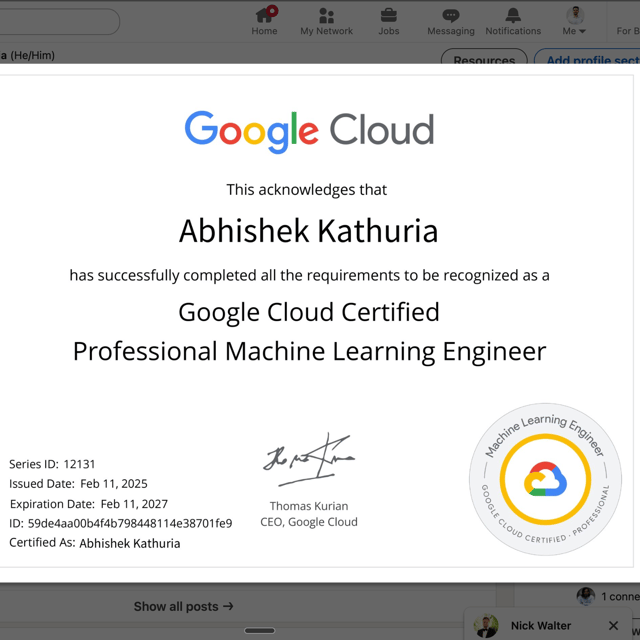
Quick Study Guide: Google Cloud ML Certification
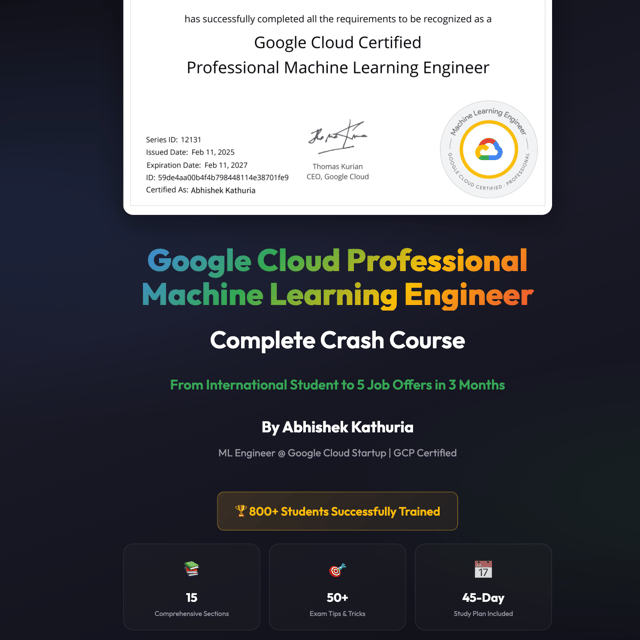
Full Crash Course: GCP ML Engineer Certification
1-on-1 AI Career Advice
Discovery/ Collab Call

LLM Crash Course (With Gemini Capstone Project)
Linkedin Message Template
Resume Review
Linkedin Profile Review with Tips
About me
- Abhishek was a pleasure to work with. He created quality code for an LLM pipeline and described structures and decisions made along the way.Recommended by Michael Pesavento on

- The technical expertise that Abhishek brought to the table was as unique and original as his personality. You get to see the passion he has for Data Science and ML in his creations.Recommended by Sandeep Kumar Gupta on
- Abhishek was instrumental in creating a robust Engineering and Recommendation Platform. I highly recommend him to anyone looking for a talented and detail-oriented Machine Learning Engineer.Recommended by Dillon Mitchell on
Frequently asked questions
What are data scientist jobs, and what do they actually involve?
Data scientist jobs focus on using data to solve business problems: cleaning and exploring data, building and evaluating machine learning models, running experiments, and communicating insights to stakeholders. The day-to-day usually involves Python, SQL, statistics, and ML libraries or cloud platforms, along with presenting findings to non-technical teams. In India, these roles exist across IT services, banking and fintech, e-commerce, and product companies — and they are distinct from data analyst roles, which lean more toward reporting and dashboards.
How to get a data science job with no experience?
Focus on proof of skill instead of experience: get comfortable with Python, SQL, statistics, and core ML, then build two or three end-to-end projects on real datasets and publish them on GitHub. Apply widely, because many data science jobs for freshers are actually posted under titles like Data Analyst, Business Analyst, or Junior Data Scientist. Tailor your resume to each job description, reach out for referrals instead of only applying cold, and prepare for SQL- and case-style interviews. This is the same sequence I've seen work repeatedly for the students I've mentored.
What is the data science jobs salary in India for freshers?
Entry-level data science jobs in India typically pay between ₹4–10 LPA, with service-based companies on the lower end and product companies or well-funded startups on the higher end. Data analyst roles, a common entry point, usually start around ₹3–6 LPA. City, portfolio quality, and interview performance move these ranges significantly, so a fresher with strong projects can often land at the top of the band.
How to get a data analytics job in India as a fresher?
Build the core toolkit first: SQL, Excel, and one BI tool like Power BI or Tableau, plus basic Python and statistics. Create one or two dashboard projects on real datasets so recruiters can actually click through your work, then apply to analyst openings on LinkedIn and Naukri with a headline optimized for the role. A data analytics job is the most realistic first step into a data career, and you can pivot toward data science from there.
How to make a data science resume as a fresher?
Keep it to one page and structure it as: a header with LinkedIn and GitHub links, a two-line summary, a skills section, projects, education, and certifications. For a data science resume for freshers with no experience, your projects section does the work that internships do for others — so lead with two or three substantial projects, each showing the problem, the tools, and a measurable result. Pull keywords directly from the job description you're targeting, and cut filler like generic objective statements.
What should a data science resume look like?
Clean and skimmable: a single-column, ATS-friendly layout with no photos, graphics, or tables; clear section headings; and consistent formatting. Projects and skills should appear above education for freshers, and every bullet should read as an achievement with a number attached — "built a churn model that improved recall by 15%" beats "worked on machine learning models." Save it as a PDF named with your name and the role, and check that it parses correctly in an ATS before applying.
How to put data science projects on your resume?
Treat projects like work experience. The right way to put data science projects on your resume is to give each one a clear title, one line on the business problem, the tools and techniques used, and a quantified outcome, along with a GitHub or live demo link. Pick your two to four strongest projects — quality beats quantity — and drop tutorial clones or basic coursework, since recruiters recognize those instantly.
How to improve your data science resume if it isn't getting shortlisted?
Start with three fixes: add a metric to every bullet, mirror the exact keywords from each job description so you clear ATS filters, and remove anything that doesn't support the role you're targeting. If calls still don't come, the problem is usually positioning — your projects don't match the roles you're applying to. That's where a targeted review from someone working in the same field helps, because they can spot mismatches in minutes that you've been staring past for weeks.
Is the GCP ML Engineer certification worth it for freshers?
Yes, if you're aiming at ML, AI, or cloud-focused roles. The GCP ML Engineer certification validates skills companies actually use — building and deploying models on Vertex AI, designing pipelines, and managing ML systems in production — so it signals applied ability rather than just theory. It won't replace projects or experience, but paired with a hands-on capstone you can showcase, it helps freshers stand out, especially for cloud-heavy teams. If you already know Python and ML basics, it's a logical next step.
How much does the GCP ML certification cost in India?
The GCP ML certification cost for the Professional Machine Learning Engineer exam is $200 USD — roughly ₹16,000–17,000 depending on the exchange rate. Preparation can be nearly free through official documentation and skills labs, while structured courses and practice exams cost extra. Each retake attempt also carries the exam fee, so build that into your budget, and check the official Google Cloud certification page for the latest India-specific pricing.
What is the format of the GCP ML certification exam?
The GCP ML certification exam runs about two hours with roughly 50–60 scenario-based questions in multiple-choice and multiple-select formats. There are no formal prerequisites, and you can take it online with a proctor or at a test center. Expect applied situations — framing ML problems, choosing between modeling approaches, working with Vertex AI, pipelines, monitoring, and responsible AI — so hands-on understanding matters far more than memorizing definitions.
Where can I find a good GCP ML certification practice exam?
Start with the official sample questions on Google Cloud's certification page, then use full-length mocks bundled with structured courses and question discussions shared in exam-prep communities. Aim to score consistently above 80% across at least two different sets before booking your slot, and spend more time reviewing wrong answers than retaking tests. A GCP ML certification practice exam works best when combined with hands-on Vertex AI practice, since the real exam is scenario-driven.
Which GCP ML certification course is best for beginners?
A good GCP ML certification course should cover the full Professional ML Engineer syllabus — ML problem framing, data preparation and feature engineering, Vertex AI including AutoML and custom training, pipelines, model monitoring, MLOps, and responsible AI. Prefer one with hands-on labs and a capstone project you can show recruiters, since the exam tests applied judgment. If you're short on time, a structured crash course that compresses the syllabus into a few weeks with labs and mock tests usually works better than piecing together random free videos.