Testimonials
Services
SEO Audit Skill
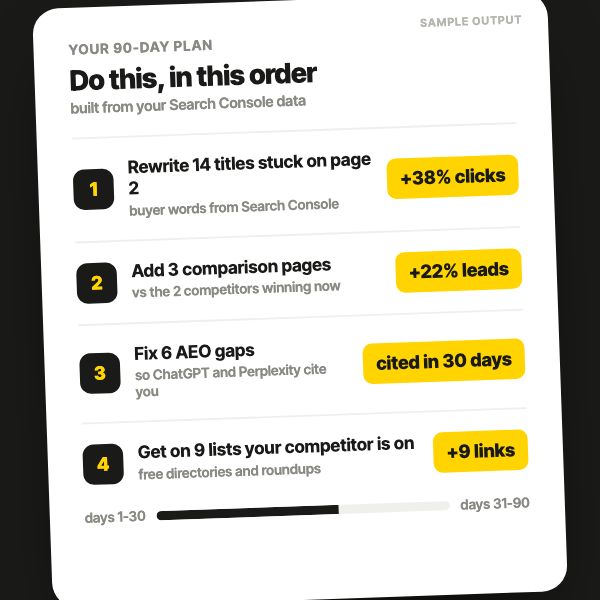
Website Audit + 90-day SEO + AEO Plan
About me
Frequently asked questions
How does programmatic SEO work?
Programmatic SEO works by pairing a database with a page template so you can publish hundreds or thousands of pages targeting one repeating search pattern, like "best time to visit [destination]" for 500 destinations. The workflow is: find a keyword pattern with real search demand, collect structured data for each variation, design a template, generate the pages, and internal-link them through hub pages. The hard part is index management and quality control — every page needs genuinely unique value for its query, or Google treats it as thin content.
What are programmatic SEO pages?
Programmatic SEO pages are pages generated at scale from a template and a dataset, where each page targets a specific long-tail query instead of one broad head term. Common types include location pages, "X vs Y" comparison pages, e-commerce category pages, SaaS integration pages, and exam or syllabus pages. They only work when each page serves distinct, useful data for that specific search — a real page for every city, product variant, or exam people actually look up.
How to implement programmatic SEO?
Implementing programmatic SEO starts with identifying a repeating keyword pattern with enough total search volume, such as "[service] in [city]" or "[product] alternatives". Next, validate that you can build or source a dataset for every variation, then create a template with unique elements on each page — dynamic data, FAQs, filters, or user-generated content. Publish in batches rather than all at once, build hub pages that internal-link to every child page, submit sitemaps, and monitor indexation so you can prune or improve pages Google ignores.
What are some programmatic SEO examples?
Travel websites with "things to do in [city]" pages for thousands of destinations, job portals with "[role] jobs in [city]" pages, and real estate portals with "flats for sale in [locality]" pages are classic examples. In India, edtech sites building exam-specific pages at scale — answer keys, syllabus, cutoffs, counselling dates — is one of the biggest use cases. SaaS companies use the same system for integration pages and competitor comparison pages.
How to get customers with programmatic SEO?
Getting customers with programmatic SEO depends on targeting patterns with buying intent, not just traffic intent. Patterns like "best [tool] for [use case]", "[competitor] alternatives", and "[service] in [city]" attract people already comparing options, so place a clear call to action, lead magnet, or signup link on every template page. Track conversions per page template, not just sessions — the most common failure is ranking thousands of purely informational pages that bring traffic but never convert.
How to do an SEO audit of a website?
Doing an SEO audit of a website begins with a full crawl using a tool like Screaming Frog to surface broken links, redirect chains, duplicate content, and missing titles or meta descriptions. Then check indexability in Google Search Console, review Core Web Vitals and mobile usability, audit headings and internal linking, and compare your content against what currently ranks for your target keywords. Finish by sorting every issue by impact and effort — fix technical blockers that prevent crawling and indexing first, then move to content improvements.
What is an SEO audit report?
An SEO audit report is the documented output of a website audit — a structured file listing every issue found, its severity, the affected pages, and the recommended fix. A useful report covers technical health, on-page optimisation, content quality, and backlink red flags, and ends with a prioritised action plan instead of a raw error dump. The prioritisation is what makes it actionable: it tells you what to fix this week versus what can wait a quarter.
Which free SEO audit tools can I use?
For free SEO audit tools, Google Search Console is the essential starting point — it shows indexing coverage, Core Web Vitals, mobile usability, and the queries you actually rank for. Pair it with Google PageSpeed Insights for page speed, Screaming Frog's free crawler for technical issues on sites up to 500 URLs, and Ahrefs Webmaster Tools for a free site-wide health check. For most small and mid-sized websites, this free stack covers the majority of a standard audit before you ever need a paid tool.
How to do a site audit in SEMrush?
To run a site audit in SEMrush, create a project for your domain, open the Site Audit tool, and configure the crawl scope — crawl limit, schedule, and whether to respect robots.txt — before running the first crawl. Once complete, work through the Issues tab by severity, then review the thematic reports covering crawlability, HTTPS, Core Web Vitals, and internal linking. Fix the highest-severity errors first and recrawl to confirm they are cleared; comparing consecutive crawls is the easiest way to show progress over time.
What is answer engine optimization (AEO)?
Answer engine optimization (AEO) is the practice of structuring content so answer engines — Google's AI Overviews, ChatGPT, Perplexity, and voice assistants — can extract it and present it as a direct answer. Traditional SEO focuses on ranking a clickable link; AEO focuses on being the content that gets quoted inside the answer itself. The core signals are concise, direct answers, question-based headings, structured data, factual accuracy, and strong topical authority.
How to implement answer engine optimization?
To implement answer engine optimization, start by collecting the real questions your audience asks — Google autocomplete, People Also Ask, forums, and your own sales or support conversations. Answer each question in the first 40 to 60 words under a question-style heading, then add supporting depth below, since answer engines prefer self-contained passages they can lift directly. Add relevant schema markup, keep facts and dates current, build consistent brand and entity mentions across the web, and track whether your pages start appearing in AI Overviews and AI chat answers.
How to improve answer engine optimization for existing content?
Improving answer engine optimization on pages you already rank for is usually faster than creating new content. Find pages already sitting on page one, rewrite their openings to lead with a direct, quotable answer, and convert dense paragraphs into scannable question-and-answer blocks, lists, and tables. Refresh outdated statistics, add structured data, consolidate pages that compete with each other for the same query, and monitor which pages get cited in AI Overviews so you can repeat the pattern across the site.
What is the difference between answer engine optimization and generative engine optimization?
Answer engine optimization (AEO) targets systems built to return one direct answer — featured snippets, voice assistants, and knowledge panels — while generative engine optimization (GEO) targets AI systems that compose full written responses, like ChatGPT, Gemini, and Perplexity. In practice the overlap is large: both reward clear structure, extractable answers, up-to-date facts, and a strong, citable brand presence. Most teams now treat them as one combined discipline — optimise your content to be quoted, and you usually win in both.
Is SEO better than Google Ads?
Neither is universally better — they solve different problems. Google Ads buys immediate visibility, which makes it ideal for testing offers or generating leads this month, but traffic stops the moment the budget stops. SEO is slower to produce results but compounds over time, typically delivers a lower cost per visit at scale, and keeps working without ongoing ad spend. Most businesses in competitive markets get the best outcome by using Ads for instant demand while building SEO as the long-term, sustainable channel.