Testimonials
Services
Ask me anything
The full stack Package
THE REACT BUNDLE (REACT + REACT NATIVE)
The Complete Frontend Package
Cracking The JAVA & MERN Interviews
Cracking The JAVA, REACTJS & MERN Interviews
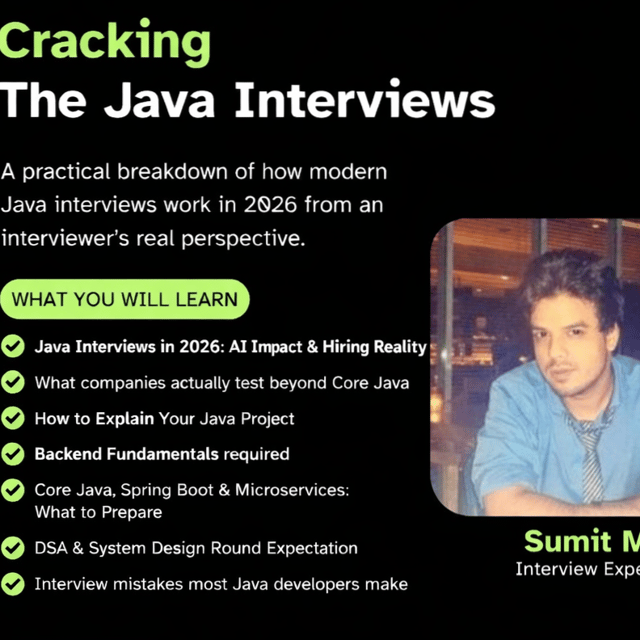
Cracking The JAVA Interviews pdf + Webinar Rec
MERN + Reactjs + React Native
Cracking The REACTJS & MERN Interviews
Cracking The JAVA & REACTJS Interviews
The Complete Java Backend Package
About me
- SQL interview Question of the dayhttps://youtu.be/to25K0T7xj8

Frequently asked questions
What are the most common Java interview questions and answers?
The most common Java interview questions and answers revolve around OOPs concepts, String handling, the Collections framework, exception handling, multithreading and JVM basics. Interviewers usually start with these core areas before moving to live coding and project-based questions. Since answers are judged on structure and clarity, practising them aloud — ideally in a mock interview with someone who has sat on the interviewer's side of the table — helps far more than silent reading.
What Java interview questions for freshers are asked most often?
Java interview questions for freshers mostly test fundamentals: JDK vs JRE vs JVM, data types, access modifiers, String immutability, == vs equals(), ArrayList vs LinkedList, and simple programs like reversing a string or printing patterns. Freshers are not expected to know system design, so interviewers focus on logic, clean coding and how clearly you explain your thought process. Building two or three small Java projects also gives you material for project-related questions.
How are Java interview questions and answers for experienced candidates different from those for freshers?
Java interview questions and answers for experienced candidates go deeper into JVM internals, garbage collection, concurrency, design patterns, Spring Boot, microservices and real scenarios from your past projects. Instead of definitions, interviewers expect you to justify technical decisions and discuss trade-offs. Senior rounds often include system design, so prepare detailed stories around problems you have actually solved at work.
How to respond to interview questions like tell me about yourself?
Keep the answer to roughly 60–90 seconds and follow a present–past–future flow: your current role or studies, the relevant experience or projects behind you, and why this next role fits your direction. Avoid reading your resume line by line; instead, highlight two or three achievements that map to the job description. Rehearsing this opener in a mock interview makes you sound confident rather than memorised.
How to respond to interview questions about weaknesses?
Choose a genuine, non-critical weakness, then explain the concrete steps you are taking to improve and show evidence of progress. For example: "I used to hesitate while delegating, so I now assign smaller tasks and review outcomes every week." Never say "I work too hard" or "I have no weaknesses" — interviewers have heard these hundreds of times. Honesty paired with self-awareness is what they are actually testing.
What are the most common React interview questions and answers?
The most common React interview questions and answers cover components, JSX, props vs state, the virtual DOM, keys in lists, useEffect and lifecycle behaviour, and controlled vs uncontrolled components. Expect small live coding tasks too, such as building a counter, a todo list or a custom hook. What separates prepared candidates is explaining the "why" behind each concept instead of reciting definitions.
How are React interview questions and answers for experienced candidates different?
For experienced profiles, React interview questions and answers shift to reconciliation and Fiber, performance optimisation with memo, useMemo and useCallback, code splitting, state management patterns like Redux or Context, error boundaries and testing. You may be asked to architect a feature end to end or debug an unnecessary re-render live. Come prepared with real production issues you have diagnosed and fixed.
What are the most common React hooks interview questions?
React hooks interview questions usually dig into useState and useEffect, dependency arrays, cleanup functions, useRef, useContext, useMemo vs useCallback and writing custom hooks. A classic tricky question is what happens when the useEffect dependency array is empty or changes on every render. Practise writing hooks in an editor or on a whiteboard without autocomplete, since many rounds make you code them live.
What React Native interview questions should I expect?
React Native interview questions typically cover how React Native differs from React, Core Components versus HTML elements, Flexbox styling, navigation with React Navigation, state management, linking native modules and performance topics like FlatList optimisation. Because many teams hire for the combined React + React Native skill set, expect your plain JavaScript fundamentals — closures, promises and ES6 — to be tested as well.
Where can I find good React interview questions on GitHub?
Searching for React interview questions on GitHub brings up several community-maintained repositories with curated questions, answers and coding exercises. Pick repos with a high star count, recent commits and topics sorted by difficulty, because older repositories often focus only on class components. Use them as a revision checklist, and pair them with mock practice since reading answers alone rarely prepares you to code live.
What are the most common MERN stack interview questions?
MERN stack interview questions usually span every layer: JavaScript and ES6 fundamentals, React on the frontend, Node.js and Express for APIs, and MongoDB for schema and query design. Frequent topics include REST principles, middleware, JWT authentication, CORS handling and MongoDB indexing. Full-stack candidates should also be ready to walk through one complete project from database design to deployment.
How to crack a MERN stack interview?
To crack a MERN stack interview, build up in this order: strengthen JavaScript fundamentals, revise React and Node/Express concepts, practise MongoDB queries, and prepare one full-stack project you can explain in depth. Keep solving DSA problems because most companies still run a coding round. A mock interview with a mentor who regularly evaluates MERN candidates is the quickest way to uncover the gaps you cannot see yourself.
Where can I find a MERN stack interview questions and answers PDF?
A MERN stack interview questions and answers PDF is handy for structured, last-minute revision because it keeps everything topic-wise in one place. Free compilations exist online but tend to be generic, while guides created by working interviewers stay closer to what is actually asked. Structured ebooks and webinar recordings on cracking MERN interviews are usually more reliable than scattered notes from random blogs.
Where can I find MERN stack interview questions on GitHub?
If you want MERN stack interview questions on GitHub, look for well-maintained repositories that split questions into JavaScript, React, Node.js and MongoDB sections, ideally with answers and code snippets. Check the last commit date and star count before relying on a repo, and cross-check answers since community edits can be inconsistent. Treat GitHub lists as a syllabus — real depth comes from building projects and talking through them aloud.