Testimonials
Services
Universities that provide B.A in Japanese

2600 Scholarships after you go to Japan!

Scholarships for Japan: A Comprehensive Guide
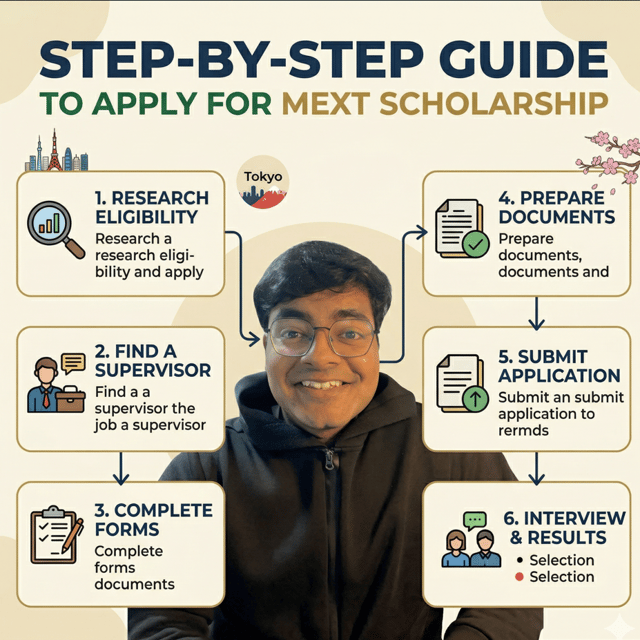
Step-by-step guide for applying to MEXT program

200 recruiting companies for Japan!
1:1 Consultation
About me
- Akash Gautam is friendly, insightful, and genuinely caring, offering valuable, practical guidance that clears doubts and inspires confidence.
 AI-generated based on testimonials
Frequently asked questions
How to study in Japan after 12th from India?
Indian students need 12 years of completed schooling to apply for a bachelor's degree in Japan. There are two main routes: Japanese-taught programs, where you typically need JLPT N3/N2 and the EJU (Examination for Japanese University Admission for International Students, held in multiple countries including India), or English-taught degree programs offered by a growing number of Japanese universities. The process involves shortlisting universities, submitting transcripts, essays, and recommendation letters, clearing the university's exam or interview, and then applying for a student visa with your Certificate of Eligibility. Starting Japanese early, even at N5/N4 level while still in school, gives you a big advantage for both admissions and scholarships.
How to study in Japan from India for free?
Studying in Japan for free almost always means winning a fully funded scholarship, and the MEXT scholarship is the most complete option — it covers full tuition, a monthly stipend, and round-trip airfare. Beyond MEXT, JASSO offers honors scholarships of around ¥48,000 per month, and many universities provide tuition waivers or admission-based scholarships to international students. A practical backup plan is combining a partial tuition waiver with the 28 hours per week of part-time work allowed on a student visa. Free study is competitive, but it becomes realistic if you start preparing your academics and Japanese language skills at least a year in advance.
Is study in Japan for Indian students cheaper than the US or UK?
Yes, in most cases. Tuition at Japanese national universities is fixed at roughly ¥535,800 per year (around ₹3–3.5 lakh), and even private universities usually charge only ¥1–1.5 million per year — far below US or UK programs that often cross ₹25–40 lakh annually. Living costs of ¥80,000–¥150,000 per month are manageable, especially outside central Tokyo, and scholarships like MEXT can bring the total down to nearly zero. Overall, the cost of study in Japan for Indian students usually comes to a fraction of a comparable Western degree.
Do I need a study in Japan consultancy in India to apply?
No, a consultancy is not mandatory. Japanese universities and the MEXT scholarship both accept direct applications, and MEXT applications go through the Embassy of Japan in India, not through agents. What you actually need is accurate information — deadlines, documents, EJU and JLPT requirements — and this is where a mentor or someone who has already completed the journey can help you avoid expensive mistakes. If you do use a study in Japan consultancy in India, verify their claims carefully and stay away from anyone promising "guaranteed" admission or visas.
What is the MEXT scholarship in Japan?
MEXT (Monbukagakusho) is the Japanese government's flagship scholarship, funded by the Ministry of Education, Culture, Sports, Science and Technology. It covers full tuition, a monthly stipend, and round-trip airfare, and it is available at undergraduate, master's, and doctoral levels. There are two main routes to receive it: embassy recommendation, where you apply through the Japanese embassy in your country, and university recommendation, where a Japanese university nominates you. For most applicants from India, the embassy route is the practical starting point.
How to apply for MEXT scholarship 2026?
For the 2026 intake, watch for the embassy recommendation announcement from the Embassy of Japan in India, usually released around April–May. The process runs as follows: fill in the application form, submit documents such as transcripts, recommendation letters from your principal or dean, and a health certificate, and then appear for written exams and an interview if you are shortlisted. The university recommendation route works differently — you apply directly to a Japanese university that holds MEXT slots, and each university sets its own deadlines. Because the 2026 cycle moves quickly once announced, keep your documents scanned and ready well in advance.
What are the MEXT scholarship requirements?
For the undergraduate track, you must have completed 12 years of schooling and fall within the specified age band (roughly 17–24 at the time of application). For the research (postgraduate) track, you need a bachelor's degree — typically 16 years of education — and a strong academic record, since GPA or percentage plays a major role in screening. Indian citizens are eligible, and there is no strict JLPT requirement just to apply, though Japanese ability or a clear willingness to learn it strengthens your file. Exact age limits and document lists are revised every year, so always confirm them in the current application guidelines.
What is the MEXT scholarship exam?
It is the written test conducted as part of the embassy recommendation screening. For the undergraduate track, papers usually include English, Mathematics, and Science subjects (Physics, Chemistry, or Biology depending on your stream), while humanities applicants generally take English, Mathematics, and Japanese. For the postgraduate research track, the test is typically in English, with Japanese added for some fields. The undergraduate-level questions are broadly around 11th–12th standard difficulty, and those who clear the written stage are called for an interview.
How much is the MEXT scholarship?
The MEXT stipend is paid monthly on top of a full tuition waiver: approximately ¥117,000 per month for undergraduates and around ¥144,000–¥148,000 per month for postgraduate research students, with a small regional supplement in some areas. Round-trip airfare between India and Japan is also covered. Figures are revised periodically, but in Indian terms the stipend generally works out to roughly ₹65,000–₹95,000 per month depending on the level and exchange rate — enough for a comfortable student lifestyle, especially outside central Tokyo.
Is the MEXT scholarship worth it?
For anyone serious about Japan, yes. It is one of the few scholarships in the world that covers tuition, living costs, and airfare with no repayment obligation, and it carries strong weight with Japanese employers and graduate schools. The trade-offs are real though — selection is highly competitive, the undergraduate track includes a mandatory year of Japanese-language preparation, and the stipend is comfortable rather than lavish in expensive cities. If your goal is a Japanese degree followed by a career in Japan, the MEXT scholarship is easily worth the preparation it demands.
What kind of jobs in Japan for Indians are in demand?
Japan's aging population has created a genuine labor shortage, and the most in-demand jobs in Japan for Indians are in IT and software development, mechanical, electrical, and manufacturing engineering, caregiving and nursing, hospitality and food service, and bilingual office roles where English plus Japanese is valued. IT is the most accessible sector since many companies hire English-speaking engineers, while sectors like caregiving and manufacturing run on the Specified Skilled Worker (SSW) visa. Adding Japanese at N3 or better level multiplies your options across every one of these fields.
Are there jobs in Japan for Indian freshers?
Yes, there are genuine jobs in Japan for Indian freshers, and the clearest path is graduating from a Japanese university or language school first, since switching from a student visa to a work visa is the easiest route for newcomers. Direct hiring from India also happens — IT companies recruit fresh graduates with strong coding skills and basic Japanese (N4/N3), and sectors covered by the SSW visa hire newcomers who pass the skill test and JLPT N4. Some companies also run structured training programs where freshers learn the language and work culture on the job. Without Japanese, fresher options shrink sharply, so start language prep alongside your degree.
How do I find jobs in Japan with visa sponsorship?
Start with job portals that specifically list jobs in Japan with visa sponsorship, along with LinkedIn and the career pages of companies known for hiring foreign engineers. Recruiting agencies that specialize in placing Indian and international candidates in Japan are another practical channel, and Indian IT companies that send employees onsite to Japan offer a proven backdoor — join in India, build your skills and Japanese, then take an onsite posting. Focus your applications on shortage areas like IT, mechanical engineering, and caregiving, where employers are far more willing to sponsor a visa. And remember: legitimate employers never ask you to pay for sponsorship.
How to work in Japan as a foreigner?
The standard process is: get a job offer, obtain the Certificate of Eligibility (COE) — usually filed by your employer in Japan — and then apply for your work visa at the Japanese embassy. The most common work visa is the Engineer/Specialist in Humanities/International Services category, which generally requires a relevant degree or equivalent experience plus a job offer. Alternative routes include the Specified Skilled Worker (SSW) visa, which requires passing a skill test and a basic Japanese test, and the student visa, which lets you study first and switch to full-time work after job hunting. Japanese is not always legally mandatory, but N3 or higher is what most employers realistically expect.
Are there jobs in Japan for Indian mechanical engineers?
Yes, jobs in Japan for Indian mechanical engineers exist in large numbers, concentrated in the automotive sector, robotics, precision manufacturing, and the machinery supplier networks around companies like Toyota, Honda, and Suzuki. Most employers look for a relevant engineering degree, CAD/CAE skills, and Japanese at N3 or above, though some companies accept lower language levels with in-house training. Common entry routes are direct recruitment from India, completing a master's in Japan and then job hunting, or moving onsite through an Indian employer. With Japan's manufacturing workforce shrinking, mechanical engineers with some Japanese are in a genuinely strong position.