Testimonials
Services
Priority DM — Ask a Career Query, Get a Plan

Career Fit Check | 15-Min Discovery Call

Career GPS | Direction Decision
Selection Preparation | Interviews & Assignments

Credibility Decision | Win your first 100 days
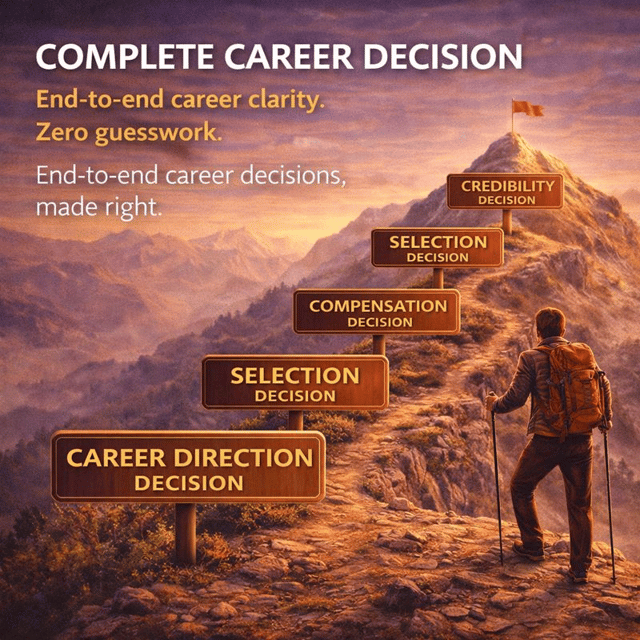
Complete Career Decision Series
Impact Plan | Selection, Negotiation, Credibility
Positioning Decision | Resume & Applications

Compensation Decision | Offer & Pay Negotiation
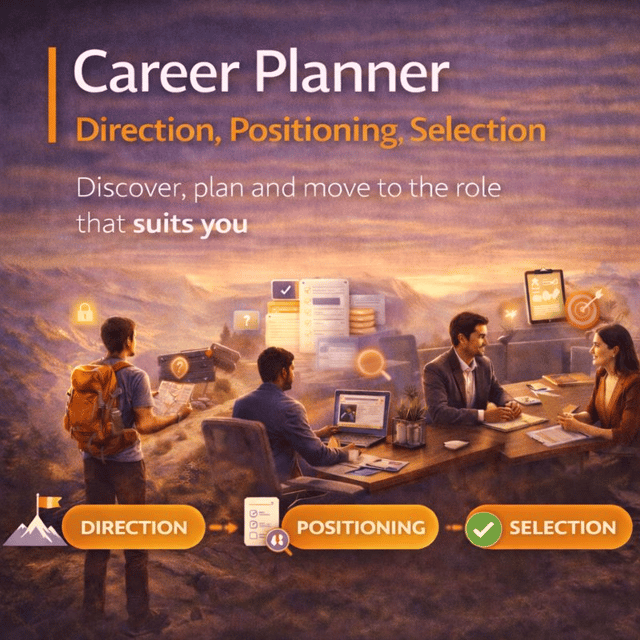
Career Planner | Direction, Positioning, Selection
About me
- Hullas is a thorough professional with immense passion for People practice. He has driven continuous improvements by revamping the PMS process, leading a people manager training curriculum, and introducing Org Network Analysis. His energy and dedication make him a huge asset to any organization.AI-generated from recommendations on

Frequently asked questions
What are career coaching services, and what happens in a career coaching session?
Career coaching services are structured engagements where a coach helps you make and execute career decisions — choosing a direction, positioning your profile, planning applications, preparing for interviews, and negotiating offers. In a typical career coaching session, you bring a specific stuck point ("should I switch industries?" or "why am I not getting shortlisted?"), the coach assesses your situation, and you leave with a concrete, prioritised action plan instead of generic advice. Good coaches diagnose the real problem first, then give frameworks, templates, and honest feedback you can apply immediately, so progress is measurable between sessions.
Is career coaching online as effective as in-person coaching?
Yes — for working professionals, career coaching online is usually just as effective and far more practical. Coaching is conversation-and-document driven: your resume, job-search plan, interview answers, and offer strategy can all be reviewed on a call or screen-share, so nothing is lost by not sitting in the same room. It also lets you choose a coach with the right hiring or industry background instead of limiting yourself to whoever is nearby. Just confirm the coach offers structured sessions, clear outcomes, and real feedback rather than only motivation.
How do I find career coaching near me?
Start by searching for career coaching near me, then vet what you find: check the coach's actual corporate, HR, or hiring background, read client testimonials, confirm they work with your career stage (fresher, early-career, mid-level switch), and verify what a session covers and costs. The same checklist applies when deciding how to find a career coach online — credibility, relevant experience, and a clear process matter more than location. For most professionals, a coach who has worked inside real hiring and performance systems gives sharper guidance than a general motivator, so always do a short discovery call before committing to a package.
Are career coaching classes worth it for students and working professionals?
It depends on your need. Group career coaching classes work well for foundational skills — resume basics, interview fundamentals, exploring career options — and are budget-friendly for students. Working professionals with specific stuck points (wrong role, stalled growth, low offers, failed interviews) usually get more value from 1:1 coaching, because the guidance is personalised to their profile, industry, and target roles. A simple rule: if your problem is lack of knowledge, a class is enough; if your problem is your individual situation, choose one-on-one coaching. Either way, pick providers who can show real outcomes and testimonials, not just promises.
How to become a career coach in India?
Most career coaches in India build on a base of HR, L&D, recruiting, or senior corporate experience, because clients trust coaches who have seen hiring from the inside. A practical path: gain solid exposure to hiring, talent, or people development; add a recognised coaching or HR certification; start by mentoring juniors and colleagues; collect testimonials; and then formalise your practice with clearly defined offerings. Coaches who understand actual hiring and performance systems — not just theory — stand out quickly. If you already work in HR or L&D, your internal mentoring experience is the strongest possible starting point.
What is job interview preparation, and what does it actually include?
Job interview preparation is the process of getting ready to perform at your best in interviews — not just memorising answers. It includes researching the company and role, decoding the job description, preparing structured stories for common and role-specific questions, practising out loud or via mock interviews, preparing questions to ask the interviewer, and planning logistics like documents and format. Strong preparation also means anticipating assignments or case rounds and knowing how your experience maps to what the hiring manager is actually evaluating. Candidates who prepare this way consistently outperform equally qualified people who wing it.
What does interview preparation for freshers include?
Interview preparation for freshers should focus on four things: knowing your resume inside out, mastering a small set of high-frequency questions (introduction, strengths, projects, "why this role"), building structure into answers with simple frameworks like STAR, and researching the company well enough to ask intelligent questions. Interviewers expect potential, learning ability, and clarity from freshers — not corporate war stories. Practising out loud, ideally in a mock interview with feedback, matters far more than reading answer scripts. Also prepare for practical rounds like group discussions, aptitude tests, or assignments, which are common in Indian fresher hiring.
Is an interview preparation AI tool enough, or should I also do mock interviews with a real person?
An interview preparation AI tool is genuinely useful for repetition: generating likely questions, refining drafts of your answers, and practising unlimited rounds without judgement. Where AI alone falls short is realism and context — a human with hiring experience picks up on rambling, low confidence, and role-specific gaps that generic tools miss, and can push back the way a real panel does. The best combo for most candidates is AI for volume practice and drafting, plus at least one or two live mock interviews with a mentor or coach before the real interview. That way you build fluency and then pressure-test it.
Why do I keep failing interviews even though I have the right skills and experience?
Usually the problem isn't your skills — it's how you're packaging and delivering them. Common causes: answers are long and unstructured, stories lack measurable outcomes, you describe responsibilities instead of impact, or you haven't studied what this specific role needs. Learning how to answer interview questions with a clear structure (situation → action → result), tailoring examples to the job description, and rehearsing out loud fixes most avoidable rejections. If you keep reaching final rounds but not converting, get honest feedback through a mock interview — the gap is almost always visible to an outside observer before it's visible to you.
Is an interview preparation course worth paying for?
It can be, if it fixes your actual bottleneck. An interview preparation course is worth it when you need structure, accountability, and expert feedback — especially if you get shortlisted but keep failing at the interview stage, or you're switching into a tougher or newer domain. It's less useful if it only recycles generic question banks available free online. Before paying, check three things: does it include live mock interviews with feedback, is the faculty experienced in actual hiring, and does it cover your target role and industry? If you mainly need personal feedback, 1:1 coaching often beats a recorded course; if you need fundamentals and drill volume, a structured course works well.
How to negotiate salary with HR?
Negotiating with HR works best when you're prepared, polite, and specific. Research the market rate for your role first so you anchor with a number, not a hope. When the offer arrives, express genuine enthusiasm, state your target with brief justification (skills, market data, competing offers if any), and then pause and let them respond — recruiters expect negotiation and usually have some room. Proven salary negotiation tips: avoid revealing your expected number first when possible, negotiate the full package (fixed, bonus, joining bonus, stock) rather than just headline CTC, get everything in writing, and keep the tone collaborative — you're solving a problem with HR, not fighting them. Rehearse the conversation once beforehand; even a single practice round dramatically improves outcomes.
What does a realistic salary negotiation with HR conversation example look like?
Here's a realistic salary negotiation with HR conversation example for India: HR: "We're happy to offer ₹12 LPA." You: "Thank you — I'm genuinely excited about this role. Based on market benchmarks for this position and my experience, I was targeting ₹14 LPA. Is there flexibility on the fixed component?" HR: "Fixed is capped, but I can check on a joining bonus." You: "That would help. If ₹14 isn't possible, could we look at a six-month review instead of twelve?" The pattern to copy: appreciation → market-anchored number → one clear ask → flexible alternatives like bonus or earlier review. Keep it short and warm; recruiters respond far better to confident, reasoned asks than to pressure.
How do I handle salary negotiation in an interview when HR asks for my expected salary?
When the expected-salary question comes up, don't anchor too low and don't dodge completely — recruiters will push. For salary negotiation in an interview, the best approach is to give a researched range rather than a single number: "Based on the market for this role, I'm looking at ₹X–Y, though I'm flexible on structure for the right opportunity." Then ask what budget has been allocated for the position. If you're early in the process, it's fair to say you'd prefer discussing pay once you understand the full role — but still have your range ready, because in India you will almost always be asked. Never quote below your walk-away point just to stay in the process; it's very hard to raise later.
How much salary can you negotiate when switching jobs in India?
In India, job switchers typically target a 30–50% hike, though it varies widely with industry, function, and how underpaid your current role is — so treat your current CTC as a floor, not your benchmark. The stronger your alternatives (competing offers, niche skills, measurable impact), the more room you have, and sometimes you can push well beyond the usual band. Anchor on market data for the target role, quote slightly above your real target so there's room to converge, and prioritise the fixed component over inflated variable pay. If your current salary is far below market, a bigger jump is realistic — but justify it with role fit and market rates, not your old salary.
What is the meaning of salary negotiation?
The meaning of salary negotiation is the back-and-forth discussion between you and the employer — usually HR or the hiring manager — to agree on your compensation before you accept an offer, covering fixed pay, bonus, benefits, and sometimes title or joining date. In Hindi, salary negotiation is commonly understood as वेतन वार्ता (vetan vaarta) — discussing and bargaining your pay package instead of simply accepting the first number. It's a normal, expected part of hiring in India: recruiters build negotiation room into offers, and candidates who negotiate respectfully rarely lose offers over it. What you're really negotiating is your perceived value, backed by market data and your specific skills.