Testimonials
Services
Project Guidance
Stochastic Calculus Roadmap for Quants
Quant Finance Project Ideas Reference Book
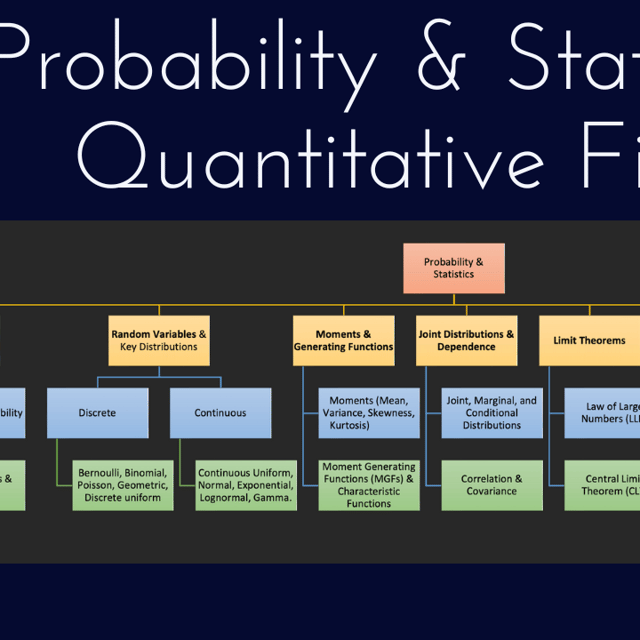
Probability & Statistics Learning Roadmap
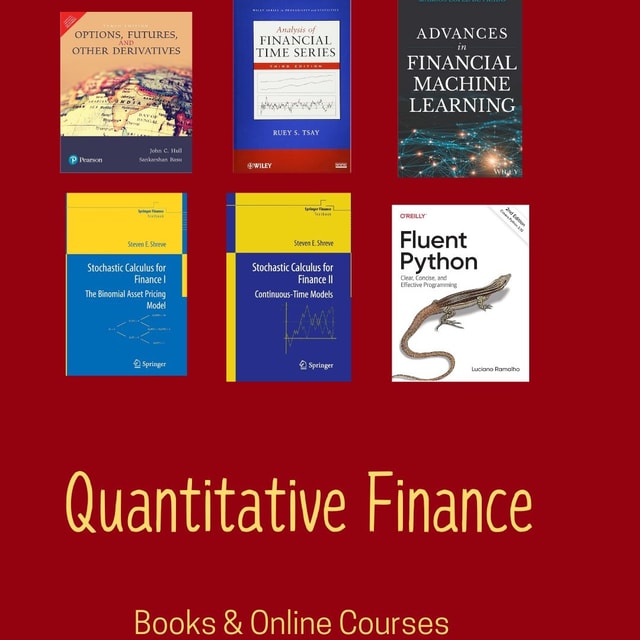
Books and Courses for Quantitative Finance
About me
- ‘Quant’ify Your Career - YouTubehttps://www.youtube.com/@QuantifyYourCareer
- Hiteeksha is an insightful mentor, offering structured guidance and valuable resources in quantitative finance, helping aspiring professionals with clarity and confidence.
 AI-generated based on testimonials

Frequently asked questions
What is quantitative finance all about?
Quantitative finance is the application of mathematics, statistics, and programming to problems in financial markets — pricing derivatives, measuring and managing risk, and building systematic trading and investment strategies. It sits at the intersection of markets, data, and technology, powering everything from option pricing models at investment banks to multi-asset portfolio strategies at asset managers. If you enjoy probability, coding, and thinking about how markets behave, it is one of the most intellectually rewarding and well-paid corners of finance.
How to learn quantitative finance as a beginner?
Build the foundations in the right order: calculus and linear algebra first, then probability and statistics, then programming (Python is the standard entry point), and only after that finance-specific topics like derivatives and stochastic calculus. The most common beginner mistake is jumping into advanced models without this base and stalling out halfway. Once the foundations are in place, learn by doing — reproduce classic models, build small projects, and practice interview-style problems. A structured roadmap or guidance from a mentor who works in the field helps you skip topics that don't actually matter for the roles you're targeting.
How to become a quant in finance without a quantitative background?
It is very achievable, but you have to close the math and coding gap deliberately: strengthen probability, statistics, and programming, consider a master's in financial engineering or a quantitative field, and use adjacent roles — risk, data science, consulting, product — as stepping stones into pure quant seats. Quant teams value people who understand markets and can communicate, not just theorists, so a non-traditional background is not automatically a disadvantage. My own route went from consulting and risk management into quant research, and that breadth ended up being an asset rather than a handicap. What ultimately decides it is demonstrable skill: coursework, projects, and interview performance.
What is a quantitative finance degree, and is it worth it?
A quantitative finance degree usually means a quantitative finance masters — an MFE (Master of Financial Engineering) or an MS in Quantitative Finance — a 1–2 year graduate program covering stochastic calculus, derivatives pricing, numerical methods, machine learning, and portfolio theory. For career switchers and anyone targeting front-office quant roles in the US, a well-ranked program is generally worth it because of the structured curriculum and direct recruiting pipelines into quant research, trading, and risk. If you already have a strong math, CS, or physics base with real projects, breaking in directly is possible, but the degree remains the most reliable route for most people.
What jobs can you get with a quantitative finance degree?
Typical quantitative finance jobs include quant researcher, quant trader, quant developer, risk quant, model validation analyst, and pricing or structuring roles, plus data science positions inside asset managers and hedge funds. Employers span investment banks, hedge funds, prop trading firms, asset managers, and fintechs. The seats differ meaningfully — research and trading roles are alpha- and markets-driven, while risk and model validation are more model- and regulatory-focused — so align your coursework, projects, and interview preparation with the specific seat you want.
What is the salary in quantitative finance?
Compensation in quantitative finance is among the highest in finance, though it varies widely by firm type, seat, and seniority. Entry-level quant researchers and traders at top hedge funds and prop firms in the US often start in the $150k–$250k total compensation range, and experienced quants at the best-paying firms can earn multiples of that. Bank-side roles such as risk, model validation, and pricing typically pay somewhat less than buy-side research and trading seats, but they are still strong and often serve as a more accessible entry point into the field.
How much math for quant finance do I actually need?
The non-negotiables are multivariable calculus, linear algebra, and probability and statistics — and probability is the single most important area, both for interviews and for daily work. If you are targeting quant research or derivatives pricing, you will eventually need real analysis and stochastic calculus on top of that; for more coding-heavy quant developer roles, algorithms and numerical methods matter more than measure theory. You don't need to be a pure mathematician, but you do need to reason comfortably about random variables, expectation, and conditional probability, and explain your derivations out loud.
How to learn stochastic calculus step by step?
First make sure the standard stochastic calculus prerequisites are solid: probability theory, multivariable calculus, and linear algebra, with some exposure to real analysis if possible. Then learn in this order: discrete-time binomial models, Brownian motion and filtrations, the Itô integral, Itô's lemma, stochastic differential equations, and finally risk-neutral pricing and measure changes. Work through the derivations by hand and immediately apply each concept to a concrete pricing problem so it sticks. Shreve's two-volume "Stochastic Calculus for Finance" is the classic sequence most people follow for exactly this path.
How is stochastic calculus used in finance?
Stochastic calculus is the engine behind modern derivatives pricing: it models asset prices as random processes and lets you derive fair values for options and other contingent claims, starting with the Black–Scholes framework. Beyond option pricing, it underpins interest-rate and term-structure models (Vasicek, CIR, HJM), hedging strategy design, credit risk modeling, and portfolio and risk analytics at asset managers. If you're interviewing for quant research or pricing roles, expect to apply Itô's lemma and risk-neutral valuation fluently rather than just recite formulas.
How to prepare for a quant interview?
Plan for 8–12 weeks and prepare across four pillars: probability puzzles and brainteasers, mental math and estimation, stochastic processes and finance fundamentals (for research and pricing seats), and coding in Python or C++. Practice problems actively every day rather than passively reading solutions, and do at least a few full mock interviews under time pressure — verbalizing your reasoning is a scored skill, not a nice-to-have. Also revisit your own resume projects in depth, since interviewers frequently drill into whatever you claim you've built.
What are quant interview questions like?
Most quant interview questions fall into a handful of recurring buckets: probability puzzles involving coins, dice, and expected value; logic brainteasers; mental math and Fermi estimation; statistics and linear algebra; and, for research and pricing roles, stochastic calculus and derivatives questions. Trading firms add market-making games and rapid decision-making exercises, while banks lean more on technical finance and risk concepts. How you answer matters as much as what you answer — you're being evaluated on how you structure an unfamiliar problem, so practice explaining your reasoning out loud instead of memorizing solutions.
What are the best books and courses for quantitative finance?
For foundations, the standard core is Shreve's two-volume "Stochastic Calculus for Finance," Hull's "Options, Futures, and Other Derivatives," and a rigorous probability text, supplemented with Python programming and machine learning courses. For interviews, a dedicated quant interview questions book — Zhou's "A Practical Guide to Quantitative Finance Interviews" or Joshi's "Quant Job Interview Questions and Answers" — will do more for you than any general textbook. The bigger differentiator is depth: work through a small number of books completely, with written solutions and code, instead of stockpiling resources you never finish.
How do I prepare for quant interview questions at Jane Street?
Firms like Jane Street test raw probabilistic reasoning more than finance formulas: expect probability puzzles, expected value and estimation problems, mental math under time pressure, and interactive market-making or guessing games where the interviewer keeps extending the problem. Prepare by drilling arithmetic speed and accuracy, internalizing classic probability problems until the reasoning is automatic, and practicing thinking out loud and updating quickly when the interviewer pushes back. Depth beats breadth in these interviews — they will keep extending a single problem until they find the edge of your understanding, so master the fundamentals rather than skimming many topics.
What are some good quant finance project ideas?
Strong quant finance project ideas include building an option pricing engine with binomial trees and Monte Carlo simulation, constructing and interpolating a yield curve using term structure models, backtesting a strategy such as pairs trading or a moving-average crossover, and implementing a factor model or a VaR engine from scratch. Choose projects that match your target seat — pricing-oriented projects for derivatives roles, data-driven backtesting for buy-side research — and document them properly with clean code, stated assumptions, and honest results. One project you can defend in depth is worth more than a repository full of half-finished notebooks.
How important is the statement of purpose for MFE admissions?
Very important — transcripts and test scores get your application considered, but the SOP is where you convince the committee that you have a coherent reason for pursuing quantitative finance and a realistic plan for it. Strong essays connect your coursework, projects, and work experience to what the specific program teaches, and lay out clear, credible career goals. The most common mistakes are essays that simply restate the resume or keep goals vague, which is exactly why many applicants get a detailed MFE essay review from a mentor or program alumnus before submitting — an outside reader spots weak narrative and generic claims immediately.