Testimonials
Services
Learn ABAP New Syntax From Scratch
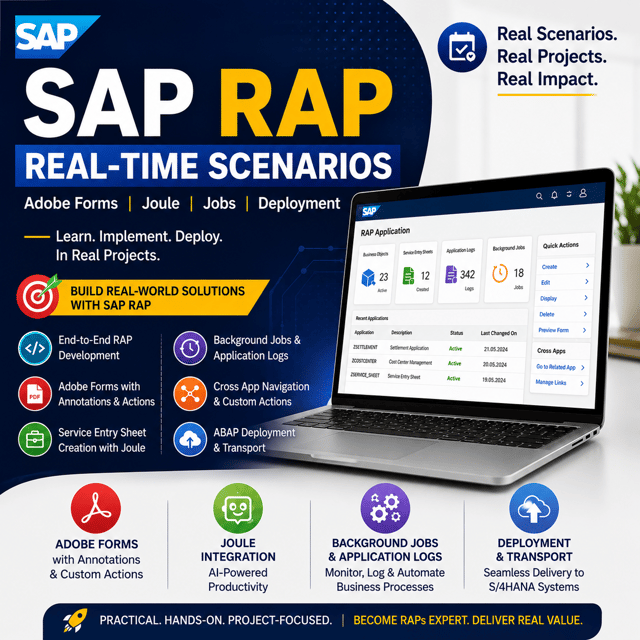
ABAP to RAP: Real Projects
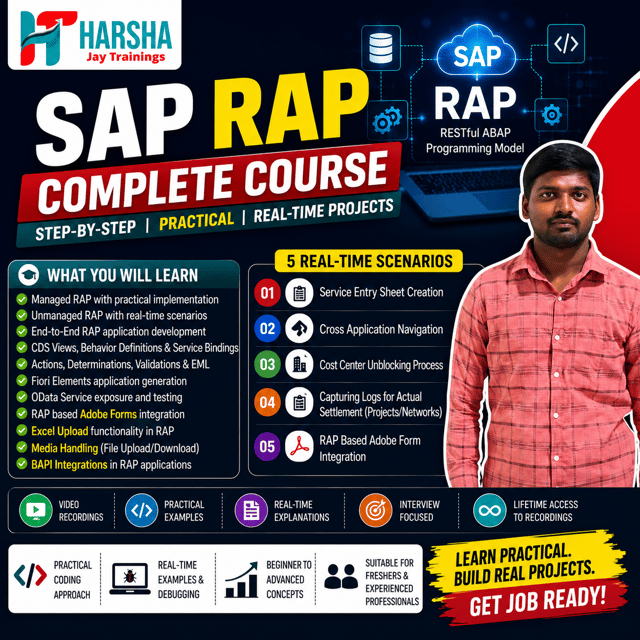
Master OO ABAP
Master Abap New Syntax
QUICK CALL
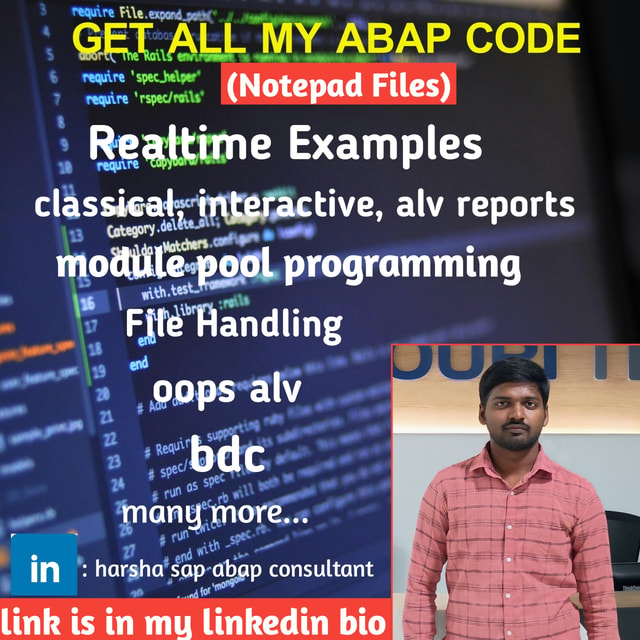
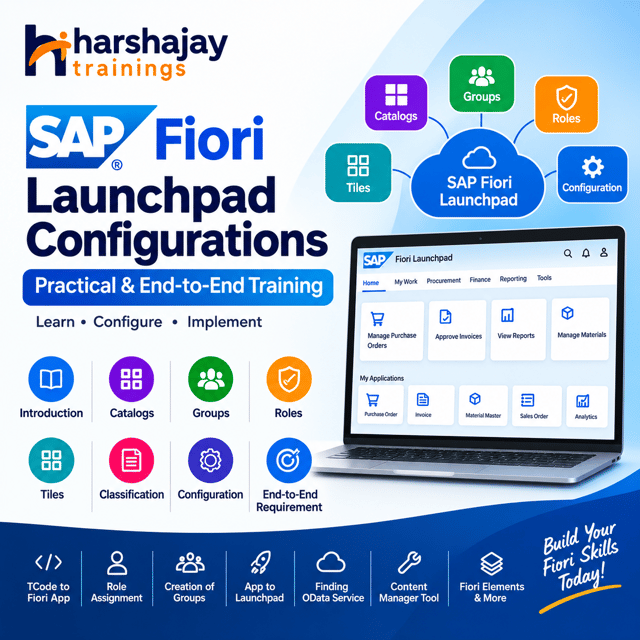
Ebooks
Master Forms
ABAP INTERVIEW PREPARATION
Frequently asked questions
How to learn SAP ABAP from scratch?
Start with core concepts — data types, internal tables, modularization, data dictionary, and SQL joins — and practice them on a sandbox or trial system before moving to OO ABAP and the new 7.4+ syntax. Building small real-time RICEFW objects like reports, interfaces, enhancements, and forms helps you apply what you learn. Following a structured SAP ABAP course with hands-on examples is usually faster than jumping between scattered free videos, and it also prepares you for interviews.
What is an SAP ABAP consultant?
An SAP ABAP consultant is a technical consultant who develops and customizes SAP applications using the ABAP programming language. The role typically involves building RICEFW objects — reports, interfaces, conversions, enhancements, and forms — and converting business requirements shared by functional consultants into technical solutions. In modern S/4HANA projects, skills like OO ABAP, CDS views, OData, and RAP are increasingly expected, which is why consultants who upgrade these skills are in high demand in India.
What is the full form of ABAP and RAP in SAP?
The SAP ABAP full form is Advanced Business Application Programming, SAP's proprietary programming language used to build and customize business applications. The ABAP RAP full form is RESTful Application Programming Model, which is SAP's modern framework for developing OData services and Fiori applications on S/4HANA and SAP BTP.
Are there SAP ABAP jobs for freshers in India?
Yes, freshers are hired for SAP ABAP roles by IT services companies, consulting firms, and in-house SAP teams, though competition is high. Entry-level roles generally expect strong fundamentals in classic ABAP along with growing exposure to OO ABAP, OData, and RAP for S/4HANA projects. Freshers who can show practice projects, handle common interview questions confidently, and explain concepts with real-time examples have a clear advantage.
What SAP ABAP interview questions are most commonly asked?
Frequently asked areas include internal tables vs work areas, JOINS and performance, modularization techniques, BAPIs, enhancement techniques like user exits and BAdIs, and debugging scenarios. For S/4HANA roles, expect questions on OO ABAP, CDS views, OData, and RAP. Interviewers increasingly want candidates to explain concepts with real project examples rather than memorized definitions.
Which ABAP OOPS concepts are most important for real-time projects?
The core ABAP OOPS concepts to master are classes and objects, encapsulation, inheritance, polymorphism, interfaces, events, and narrowing and widening casts. In real projects, these are applied in OO ALV reports, class-based exception handling, and reusable helper or factory classes. Learning each concept through a working scenario, not just theory, is what makes them stick for both projects and interviews.
What is an interface in ABAP OOPS?
An interface in ABAP OOPS is a contract that defines methods and attributes without providing their implementation, and any class that implements the interface must supply the logic for those methods. Interfaces enable polymorphism and loose coupling, and unlike inheritance, a class can implement multiple interfaces. They are commonly used to make components interchangeable and code easier to test and maintain.
How to handle an exception in OOPS ABAP?
In OOPS ABAP, exceptions are handled using class-based exceptions: the risky code is placed inside a TRY...ENDTRY block, and specific exception classes are caught using CATCH, with an optional CLEANUP block. Exceptions are raised using RAISE EXCEPTION or the RAISING addition in a method signature, and you can create custom exception classes inheriting from CX_STATIC_CHECK, CX_DYNAMIC_CHECK, or CX_NO_CHECK depending on the situation.
Which ABAP OOPS interview questions are asked most often?
The most common ABAP OOPS interview questions cover the difference between a class and an interface, singleton class implementation, constructor rules, narrowing vs widening cast, abstract vs final classes, events and event handlers, and inheritance vs composition. Interviewers usually expect you to back each answer with a real-time example, such as using OOPS in ALV reports or exception handling.
What is SAP RAP?
SAP RAP (RESTful Application Programming Model) is SAP's recommended framework for building enterprise applications — Fiori UIs and OData services — on S/4HANA, S/4HANA Cloud, and the BTP ABAP Environment. It combines CDS views for data modeling, behavior definitions and implementations for business logic, and service bindings to expose OData V4 or UI services, supporting both managed and unmanaged scenarios. It is the modern successor to older SEGW-based OData development.
How to learn SAP RAP?
Build the prerequisites first — OO ABAP, CDS views, and basic OData — because RAP is layered on top of them. Then learn the RAP building blocks such as behavior definitions, behavior implementations, draft handling, actions, validations, and determinations, and practice building end-to-end applications in ADT (Eclipse) on a BTP trial or S/4HANA sandbox. A structured ABAP RAP course built around real-time projects shortens the learning curve considerably compared to reading documentation alone.
What is SAP RAP and CAP?
SAP RAP is an ABAP-based programming model for developing applications on S/4HANA and the BTP ABAP Environment, while CAP (Cloud Application Programming Model) is SAP's polyglot framework — mainly Node.js and Java — for building cloud-native applications on SAP BTP. If you come from an ABAP background and work on S/4HANA projects, RAP is the natural path, whereas CAP suits greenfield cloud projects built outside the ABAP stack.
How to deploy a SAP RAP application?
After developing the RAP business object in ADT, create and publish the service binding to expose it as an OData UI (V4) or Web API service. In an on-premise S/4HANA system, the published app is made available through the Fiori Launchpad with the appropriate business catalog and role assignment, while in the BTP ABAP Environment you publish the service binding and test it via the preview or add it to the launchpad. Always test the preview before releasing it to users.
What ABAP RAP interview questions should I prepare for S/4HANA roles?
Prepare on the RAP architecture layers — CDS views, behavior definition, behavior implementation, service definition, and service binding — along with managed vs unmanaged scenarios, draft handling, actions, determinations, validations, EML, OData V4, and how Fiori Elements consume RAP services. Being able to walk through a real-time RAP scenario end to end usually impresses interviewers more than theoretical answers.
How to learn SAP OData from scratch?
Begin with REST fundamentals and HTTP methods (GET, POST, PUT, DELETE), then learn how SAP exposes OData services through the classic SEGW (Gateway) approach and the modern CDS-based approach. Practice implementing CRUD operations and get comfortable with query options like $filter, $expand, and $top by building services around simple business objects. Consistent hands-on practice on a sandbox system matters more than theory, and learners who prefer regional languages can also find Telugu-medium OData courses alongside English ones.