Testimonials
Services
Mentorship - Interview Preparation
Mock Interview - DSA/LLD/HLD/HM Round
Trial - FAANG Mentorship
Salary Negotitations
System Design - All in One Resource
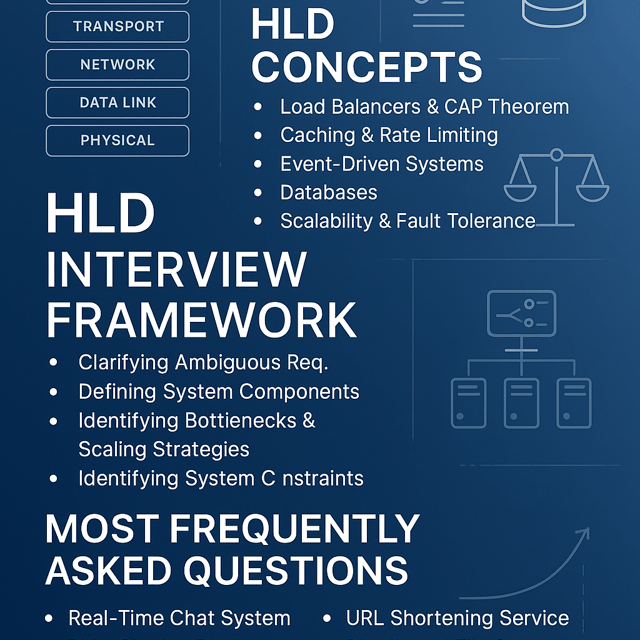
System Design (HLD) Handbook
Ask Me Anything Video Call
Resume Review, Tailoring and Priority Referrals
Career guidance
Low Level Design (LLD) Sheet
About me
- Harsh Singhal offers invaluable feedback and support, helping individuals excel in interviews and build confidence for success.
 AI-generated based on testimonials
Frequently asked questions
How to prepare for a DSA interview?
If you're planning how to prepare for a DSA interview, start by picking one language (C++, Java, or Python) and mastering core patterns — arrays, hashing, two pointers, sliding window, trees, graphs, and dynamic programming — instead of solving random problems. Around 150–250 well-chosen problems with spaced revision, plus 2–3 timed mock interviews before the real thing, is a realistic target for product company roles in India.
How to answer DSA interview questions when you don't know the optimal solution?
Knowing how to answer DSA interview questions is as much about communication as coding. Restate the problem, ask clarifying questions about constraints and edge cases, state the brute-force approach with its complexity, and then optimize step by step while thinking aloud. Interviewers evaluate your problem-solving process heavily, so a structured attempt often scores better than a silent "perfect" answer.
What is a realistic DSA interview preparation roadmap for 2–3 months?
A practical DSA interview preparation roadmap looks like this: weeks 1–4 for arrays, strings, hashing, stacks, and linked lists; weeks 5–8 for trees, heaps, graphs, and recursion; weeks 9–12 for dynamic programming, greedy, and company-specific practice, ending with mock interviews. Working professionals often stretch this to 4–5 months at 1–2 hours a day, which is completely fine.
Is a DSA interview preparation course worth it, or is self-study enough?
Self-study works well if you're disciplined, but a DSA interview preparation course or 1:1 mentorship is worth it when you keep getting stuck, don't know what to revise, or are short on time before interviews. The biggest value is personalized feedback — a mentor who has cracked product company interviews can spot gaps in your approach that recorded playlists and PDFs cannot.
What is a system design interview?
A system design interview is a round — usually for mid-level and senior engineering roles — where you're asked to design a large-scale system such as a URL shortener, chat app, or food delivery platform and justify trade-offs around scalability, latency, reliability, and cost. In India, most product companies introduce this round from SDE-2 onwards, though freshers increasingly face basic HLD/LLD rounds too.
How to prepare for a system design interview?
If you're figuring out how to prepare for a system design interview, build fundamentals first — load balancing, caching, sharding, replication, CAP theorem, message queues, and databases — and then study one real system (WhatsApp, Netflix, Uber) deeply every week. Practice 10–15 complete designs out loud, because explaining trade-offs clearly matters as much as knowing the concepts.
How to approach a system design interview in the 45–60 minutes you get?
The most reliable way to think about how to approach a system design interview is as a fixed framework: clarify functional and non-functional requirements, estimate scale (QPS, storage), define the API and data model, draw the high-level design, and then deep-dive into bottlenecks like caching or partitioning. Managing time — roughly 5 minutes for requirements and the rest for design and trade-offs — separates strong candidates from average ones.
What kind of system design interview questions are asked in product companies?
The most common system design interview questions ask you to design a URL shortener, Twitter/X feed, chat application, notification system, rate limiter, or parking lot (for LLD-focused rounds). Product companies in India also probe follow-up "what if" scenarios — 10x users, region failures, consistency vs availability — so prepare for depth, not just the first diagram.
Is Grokking the System Design Interview enough to crack system design rounds?
Grokking the System Design Interview is a solid starting point because it teaches reusable patterns for common problems, but on its own it is rarely enough for SDE-2 and senior rounds. Pair it with fundamentals (databases, caching, queues), practice designing unfamiliar systems, and get feedback through mocks — interviewers increasingly ask twisted versions that the book doesn't cover.
How to write a software engineer resume that gets shortlisted?
The core of how to write a software engineer resume is impact over responsibilities: every bullet should follow an "action + tech + measurable result" format, e.g., "Reduced API latency by 40% using Redis caching." Keep it to one page for 0–8 years of experience, mirror keywords from the job description, and highlight 2–3 strong projects instead of listing every technology you've touched.
How to format a software engineer resume so it passes ATS filters?
If you're deciding how to format a software engineer resume for ATS, use a single-column layout, standard section headings (Summary, Skills, Experience, Projects, Education), a readable font, and clean bullet points — avoid tables, text boxes, photos, graphics, and two-column designs that parsers break on. Save and send it as a PDF unless the application portal specifically asks for .docx.
How do I create a software engineer resume for freshers with no work experience?
A software engineer resume for freshers should lead with projects, internships, and achievements instead of experience: include 2–3 substantial projects with tech stack and measurable outcomes, competitive programming ratings (LeetCode/Codeforces), DSA problem counts, and open-source contributions. Indian recruiters for fresher roles also look at CGPA (usually 7+ for many product companies), so place education prominently.
Should I use a software engineer resume template or design my own?
Using a simple software engineer resume template is fine — and often safer than an over-designed one. Choose a clean, single-column, ATS-friendly template and customize the content for every application; what gets you shortlisted is the impact in your bullets, not the design. Avoid heavy Canva-style graphics for tech roles.
How do I switch from a service-based company to a product-based company in India?
The switch usually takes 4–6 months of focused preparation: product companies test DSA rigorously even for experienced engineers, so rebuild that first, then add HLD/LLD for SDE-2+ roles, rewrite your resume around impact metrics, and actively seek referrals from employees — referral-driven applications convert far better than cold portals. Also plan for notice-period and CTC-structure questions that are common in Indian hiring.
What are some practical salary negotiation tips for software engineers in India?
Effective salary negotiation starts before the offer call: never disclose your expected CTC first, let the company share a number, and try to have at least one competing offer to anchor against. Evaluate total compensation (base, bonus, stocks/ESOPs, joining bonus) rather than fixed pay alone, and remember that most Indian product companies have some negotiation room even at the SDE-2 level — a polite, data-backed counter almost never costs you an offer.