Testimonials
Services
Electrical engineering CV

Goal & Habit Tracker (Excel)
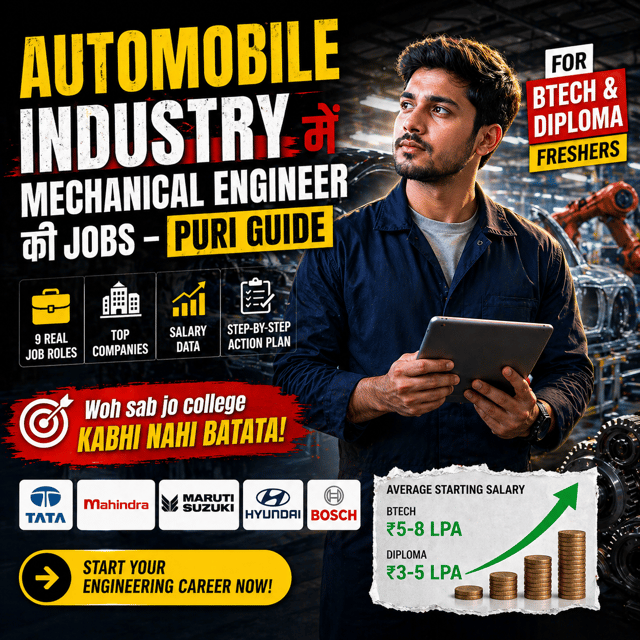
Mechanical Engineer Jobs Guide - Automobile Inds.
30 mins video call

Start your Content creation journey from scratch
Mechanical engineer ATS resume templates
DM Your Doubts – Get Quick Career Advice

Electrical / ECE Engineer First Jobs Guide
Career Guidance Call for Engineers
About me
Frequently asked questions
How to get a job in the automobile industry in India?
Target the right entry points: campus placements, off-campus drives, and portals like Naukri and LinkedIn where OEMs and tier-1 suppliers post openings. Automobile industry jobs in India are concentrated in hubs such as Pune, Chennai, Gurgaon–Manesar, Bangalore and Nashik, so apply to companies with plants or R&D centres there. Build job-ready skills first — AutoCAD or CATIA, GD&T, Lean and basic EV concepts — keep your resume ATS-friendly, and consider a Graduate Engineer Trainee role or NATS/NAPS apprenticeship if you're a fresher. Referrals and a keyword-rich LinkedIn profile significantly improve shortlisting.
What are the best automobile industry jobs for freshers?
Freshers usually enter through Graduate Engineer Trainee (GET) programmes or as design, production, quality, maintenance and supply chain engineers. Aftermarket roles in service, spares and technical sales are also easier entry points, and EV startups are creating new openings in battery, testing and electronics roles. If core offers are limited, a one-year apprenticeship at an auto plant is a proven way in — many companies convert well-performing apprentices into permanent employees.
Are there good automobile industry jobs in Chennai?
Yes — Chennai is often called the "Detroit of India" because of its dense cluster of vehicle and component makers. Companies like Hyundai, Renault-Nissan, Ashok Leyland, TVS, Royal Enfield and several global tier-1 suppliers run large plants and R&D centres around Oragadam, Sriperumbudur and the city outskirts. Roles span production, quality, design, maintenance and testing, and openings are regularly posted on major job portals and company career pages.
How to get mechanical engineering jobs?
Combine three things: skills, visibility and targeted applications. Learn the tools the industry expects — AutoCAD, CATIA or SolidWorks, plus Lean or Six Sigma basics — then build a one-page, ATS-friendly resume that mirrors keywords from each job description. Apply through job portals, LinkedIn and company career pages, ask for referrals, and don't ignore government options such as SSC JE, RRB JE and GATE-based PSU recruitment. Freshers can also start as trainees or apprentices in manufacturing firms to gain core experience.
How is the mechanical engineering job market in India?
It is steady and gradually improving, driven by automobile production, general manufacturing, defence and the EV push, but competition at the fresher level is high. Most core openings are concentrated in industrial belts around Pune, Chennai, Bangalore, NCR and Gujarat, and companies prefer candidates with practical software and shop-floor skills. Mechanical engineers who add skills like CAD/CAE, EV technology, TPM or Lean consistently get better roles and salaries than those relying on the degree alone.
What is the average mechanical engineering jobs salary in India?
Mechanical engineering jobs salary in India typically ranges from ₹3–4.5 LPA for freshers in core manufacturing roles, rising to ₹6–12 LPA with 4–8 years of experience in design, quality or production. Engineers with in-demand skills such as EV systems, Lean/TPM and advanced CAD, or those selected for PSUs through GATE, can earn noticeably more. City, company size and whether the role is in R&D, plant or field service all affect the final package.
How can I find mechanical engineering jobs in Pune?
Pune and the Pimpri-Chinchwad–Chakan belt are among India's biggest mechanical and automobile job markets, with OEMs, tier-1 suppliers and engineering services firms hiring round the year. Set location alerts on job portals, apply on company career pages, attend walk-in drives, and connect with recruiters in the PCMC industrial area. Nearby cities like Nashik, Nagpur and Mumbai draw from the same talent pool, and experienced engineers get the best response by highlighting specific machine, process or product experience in their resumes.
How to get electrical engineering jobs in India?
Decide your direction first — core electrical (power, manufacturing, EPC), automation, or emerging areas like EV and solar — because each expects a different skill set. Learn AutoCAD Electrical, PLC/SCADA or power-systems basics, keep an ATS-ready resume, and apply consistently through job portals, company websites and referrals. For government and PSU roles, GATE, ESE, SSC JE and RRB JE are the main gates, while private companies like Siemens, ABB, Schneider and L&T hire through campuses and portals.
How is the electrical engineering job market in India?
It is growing on the back of electric vehicles, renewable energy, data centres, infrastructure and factory automation, with strong demand for design, maintenance and automation engineers. PSU recruitment through GATE continues at scale, and state electricity boards and discoms hire regularly. Candidates who pair their degree with hands-on skills — AutoCAD Electrical, PLC programming, solar design or EV systems — find the market far more rewarding than those with theory alone.
What is the average electrical engineering jobs salary in India?
Electrical engineering jobs salary in India starts around ₹3–4.5 LPA for freshers in private companies, while PSUs such as NTPC or PowerGrid, which recruit through GATE, offer much higher packages. With 4–8 years of experience in automation, power systems or EV-related work, ₹6–12 LPA is common, and site roles often add allowances. Specialised skills like PLC/SCADA, solar design and AutoCAD Electrical typically push offers toward the higher end.
What are the best electronic engineering jobs for ECE freshers?
Popular entry roles include embedded systems engineer, PCB design engineer, testing engineer, IoT developer trainee, VLSI and telecom (5G) roles, plus electronics roles in the EV sector. IT services and automotive electronics firms hire ECE freshers in large numbers, so target them along with core electronics manufacturers. Build C/C++ or embedded C basics, get comfortable with at least one simulation or PCB tool, and showcase mini-projects — that is what most recruiters screen for.
How can I get electrical engineering govt jobs in India?
The main routes are competitive exams: GATE for PSUs like NTPC, PowerGrid and BHEL, ESE for engineering services, and SSC JE or RRB JE for central government departments. State electricity boards, gencos and transcos — such as MSEDCL in Maharashtra — run their own recruitment, so track their official notifications. Prepare from the GATE syllabus since most exams overlap, practise previous-year papers, and keep documents like your degree and category certificates ready for verification.
How can I restart my engineering career after a gap?
Be upfront about the gap but lead with what you did during it — upskilling, freelancing, certifications or responsibilities you handled. Refresh your technical skills (CAD software, industry-relevant tools, Excel), rebuild your resume and LinkedIn presence, and target companies and startups that are open to career-gap candidates, along with apprenticeships or contract roles as re-entry points. Referrals and practice interviews dramatically improve callback rates after a break.
How can I improve my chances of getting shortlisted for core engineering jobs?
Two things matter most: an ATS-friendly resume for engineering jobs and a visible LinkedIn presence. Use clean formatting with standard headings, mirror keywords from the job description, and quantify achievements instead of listing duties. At the same time, build a powerful LinkedIn profile with a clear headline, skills and projects, because recruiters in India actively source core engineers there. Referrals and consistent, targeted applications do the rest.
Are AutoCAD free courses enough to get a core engineering job?
Free courses are a good starting point to learn the interface and basic drafting, but recruiters hire for what you can produce, not the certificate alone. After the basics, practise on real-world drawings — mechanical components, GA drawings or electrical panel layouts if you're targeting design roles — and add structured, job-oriented learning for advanced modules like AutoCAD Electrical. A small portfolio of practice projects convinces hiring managers far more than a free course certificate.