Testimonials
Services
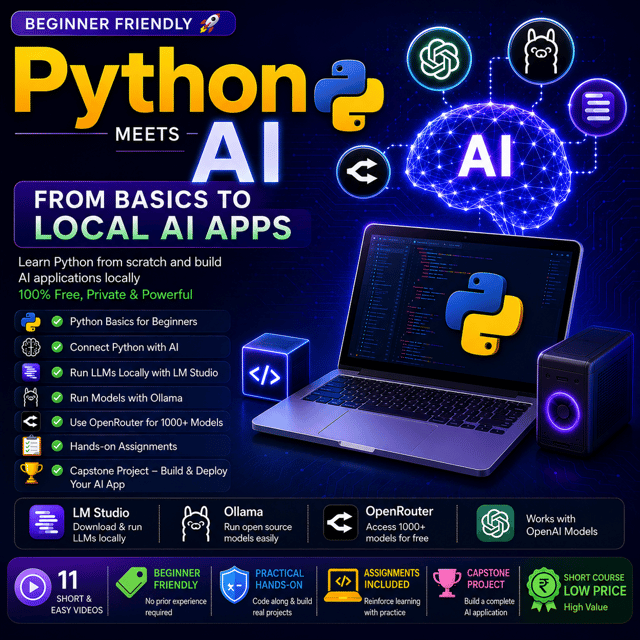
Python + AI for Beginners |Build your Local AI
Testing/Automation Guidance + Resume templates
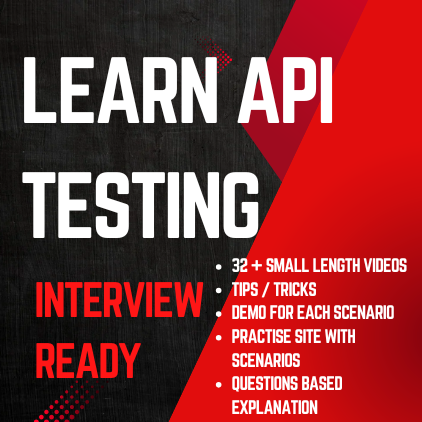
API Testing Crash Course — 30+ Interview Q&As

2 Resume Templates | Tips & tools |Digital Product
Resume review | Video Meeting
Save 25% and get AI / API / WebSiteCourse / Resume

Build Your Personal Website - FREE (yourname.com)
Resume Review + Guidance on Testing/Automation
Guidance in Testing, Automation,AI ,Career-Ask Me
Quick Answer in 24 hrs
About me
- Gaurav is renowned for clarifying doubts, imparting valuable insights, and providing direction to those facing career challenges.
 AI-generated based on testimonials
 - Udzial (By Gaurav Khurana) - YouTubehttps://www.youtube.com/@udzial

Frequently asked questions
What is test automation in software testing?
Test automation in software testing is the practice of using scripts, tools, and frameworks to execute test cases automatically instead of checking every feature manually. Tools like Selenium, Playwright, and Postman verify application behaviour after every change — especially repetitive regression checks — so teams can release faster with fewer human errors. It typically covers UI testing, API testing, database validation, and CI/CD integration, and it is now a core expectation from QA engineers in most product companies and MNCs in India.
Is automation testing worth it?
Yes, for most testers in India it is worth it. Automation and SDET roles consistently pay noticeably more than manual testing roles, while purely manual openings keep shrinking as teams adopt CI/CD and faster release cycles. The trade-off is the learning curve — you need one programming language (Java, Python, or C#) and regular hands-on practice, so plan for roughly 4–6 months of focused effort. Testers who combine automation with API testing and AI skills are currently the most in-demand.
What is a test automation framework?
A test automation framework is the structured foundation — guidelines, libraries, folder structure, utilities, and reporting — on which your automated test scripts are built. A good framework handles test data management, reusable functions, reporting, and CI/CD integration, and is commonly organised using patterns like the Page Object Model. Frameworks are broadly classified as data-driven, keyword-driven, modular, or hybrid, and "explain or design a framework" is one of the most frequently asked automation interview questions.
What is a test automation engineer?
A test automation engineer — often called an SDET in product companies — is a QA professional who writes code to test software instead of testing everything manually. Day-to-day work includes designing automation frameworks, writing and maintaining test scripts, testing APIs, integrating tests into CI/CD pipelines, and reporting quality metrics. The role demands programming skills in Java, Python, or C# along with tools such as Selenium, Playwright, Postman, and Azure DevOps.
What is the average test automation engineer salary in India?
Test automation engineer salary in India typically ranges from around ₹4–7 LPA for freshers, ₹9–18 LPA for engineers with 3–6 years of experience, and ₹20–40 LPA or higher for senior SDETs at product-based companies. The final figure depends heavily on your programming depth, whether you can design frameworks rather than just write scripts, your API automation skills, and the company type — product companies and well-funded startups generally pay more than service-based MNCs.
How long does it take to learn test automation?
If you already know manual testing basics, expect about 3–6 months of consistent effort to become job-ready: 4–8 weeks to get comfortable with one programming language (Java or Python), then another 2–3 months for hands-on work with Selenium or Playwright, API testing, and a small framework of your own. Starting with no coding background can add 1–2 more months. Building a small project and publishing it on GitHub accelerates learning far more than passively watching tutorials.
Which test automation tools should I learn?
Test automation tools are best learned in pairs — one UI tool and one API tool. Selenium and Playwright are the most in-demand for web automation, while Postman and REST Assured dominate API testing. Pick your programming language first (Java or Python have the largest job market in India), then add Git, a CI/CD tool like Azure DevOps or Jenkins, and basic SQL. Appium is worth adding later for mobile testing, and depth in one stack matters more than surface-level knowledge of many tools.
What is API testing in software testing?
API testing in software testing means testing the APIs that connect different systems directly — checking status codes, response payloads, authentication, error handling, and performance — instead of going through the user interface. For example, a POST request to a login API can be validated by asserting the response code, the returned token, and the error message for wrong credentials. Since APIs carry the core business logic, this approach catches defects earlier and runs far faster than UI testing.
How to do API testing using Postman?
Create a new request in Postman, choose the HTTP method (GET, POST, PUT, DELETE), and enter the endpoint URL along with any headers, query parameters, or authentication tokens. Send the request and verify the status code, response time, and JSON body — assertions written in the Scripts/Tests tab make these checks repeatable. Organise related requests into collections and environments; once a collection is stable, that is also how to automate API testing in Postman — run it with the Collection Runner for bulk execution or with the Newman CLI inside a CI/CD pipeline.
Why is API testing important?
API testing is important because APIs are the backbone of every modern application — if an API fails, the feature behind it fails regardless of how polished the UI looks. It catches business-logic defects earlier and more cheaply than UI testing, runs faster and more reliably, and fits neatly into CI/CD pipelines for continuous regression. For testers, it is also one of the highest-ROI skills to build, since nearly every automation and SDET job description now lists API testing as a core requirement.
How long does it take to learn API testing?
API testing fundamentals — HTTP methods, status codes, JSON structure, and sending requests with assertions in Postman — can be learned in about 3–4 weeks of focused practice. Becoming job-ready usually takes 2–3 months, including automating API tests with REST Assured or Pytest and preparing for common interview questions. A structured API testing course with hands-on exercises and interview Q&As generally shortens this timeline compared to stitching together scattered free tutorials on your own.
What are the most common API testing interview questions?
The most common API testing interview questions cover HTTP methods and status codes (200, 201, 400, 401, 403, 404, 500), PUT vs POST vs PATCH, authentication and authorization (Basic Auth, Bearer tokens, OAuth 2.0), validating JSON responses, handling dynamic tokens and request chaining, query vs path parameters, and idempotency. Scenario-based questions are equally common, such as how you would test a payment or login API. Practising around 30–40 questions with real Postman examples is usually enough for most interviews.
What are the most common SDET interview questions and answers?
SDET interview questions and answers typically fall into four buckets: coding (arrays, strings, and basic data structures, usually in Java or Python), automation (Selenium or Playwright framework design, locators, waits, Page Object Model), API and database testing (REST Assured or Postman, SQL validation), and open-ended scenarios like "how would you test this feature" or "design an automation framework from scratch." Product companies often add a code-review or debugging round, so explaining your thought process clearly matters as much as the final answer.
What are common SDET interview questions for product based companies?
SDET interview questions for product based companies such as Microsoft, Amazon, and Adobe go deeper than tool syntax — expect one or two rounds of DSA-based coding, framework design and trade-off discussions, test scenario generation for real features (for example, "test a video player"), API testing with live payloads, and behavioural questions on quality ownership. Preparation should focus on writing clean, production-quality code under time pressure and justifying your design decisions. A few mock interviews with experienced SDETs is one of the fastest ways to get comfortable with this format.
Which are the best test automation practice websites?
The most popular test automation practice websites for UI are SauceDemo, DemoQA, AutomationExercise (full e-commerce flows), ParaBank (banking scenarios), and The Internet (Heroku's practice app) for tricky elements like alerts, frames, and dynamic loading. For APIs, ReqRes, JSONPlaceholder, and Restful Booker are the go-to options. Pick one or two sites and build a small, well-structured framework around them with Git and CI integration — recruiters value one solid GitHub project far more than certificates from many different sources.