Services


Frequently asked questions
What is water resources engineering?
Water resources engineering is a specialised branch of civil engineering that deals with the planning, design, and management of water-related infrastructure — water supply schemes, sewerage and stormwater drainage systems, irrigation networks, dams, canals, and flood-control works. It draws on hydraulics, hydrology, and environmental engineering, and in India it is practised following guiding documents such as the CPHEEO manuals.
Is water resources engineering a good career?
Yes — India's ongoing investments in schemes like Jal Jeevan Mission, AMRUT, and river-cleaning programmes have created steady demand for engineers who can design water supply, sewerage, and storm drainage systems. Water resources engineers are hired by state water and sewerage boards, municipal corporations, PSUs, and private infrastructure consultancies. Entry-level salaries usually start modestly, but they grow quickly once you add skills like hydraulic modelling, GIS, and design-software proficiency.
How to become a water resource engineer in India?
The usual path is a B.E./B.Tech in civil engineering, followed optionally by an M.Tech in water resources or environmental engineering, for which GATE helps with admissions and PSU recruitment. Along the way, build hands-on skills in hydraulics and hydrology, water supply and sewerage design as per CPHEEO manuals, and tools like EPANET, SWMM, GIS, and Excel-based design calculators. Internships or training with water boards or design consultancies make landing your first design role much easier.
What is runoff in water resources engineering?
Runoff is the portion of rainfall that flows over the land surface instead of infiltrating into the soil, eventually reaching streams, drains, or sewers. Estimating the peak runoff from a catchment — commonly using the rational method for small areas — decides the size of storm drains, culverts, and drainage channels, which makes it one of the most frequently applied concepts in drainage design.
How to design a water distribution system?
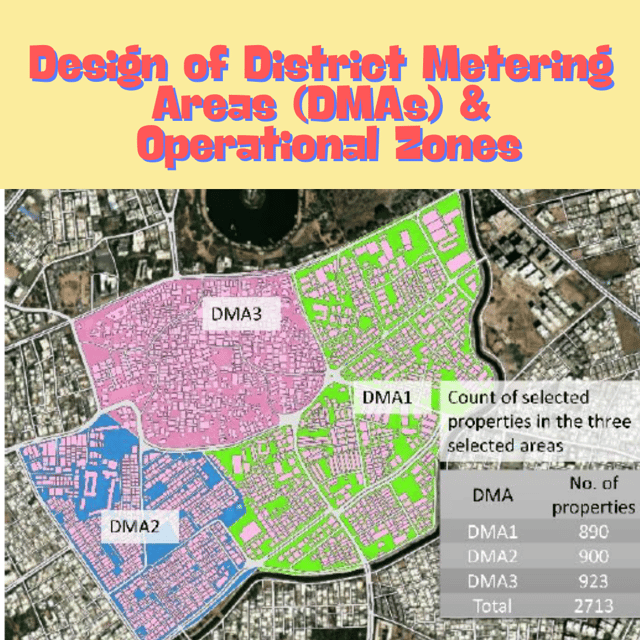
Designing a water distribution system typically starts with demand estimation (population forecasting, per capita supply, and peak factors), followed by dividing the service area into operational zones or DMAs, selecting a layout, and sizing pipes using formulas like Hazen-Williams or Manning. The network is then checked for minimum residual pressures prescribed by CPHEEO and verified with hydraulic modelling software such as EPANET before detailing valves, fire hydrants, and service reservoirs.
What is a water supply system, and how does it work?
A water supply system is the complete chain of infrastructure that carries water from a source to consumers: intake structures, raw-water transmission mains, a treatment plant, clear-water and service reservoirs (ESRs/OHSRs), and a network of distribution mains with valves and meters. It operates either by gravity or pumping, with the distribution network maintaining adequate pressure and quantity at every consumer connection.
What are the different types of water distribution system?
The four classic layouts are the dead-end (tree) system, grid-iron system, ring system, and radial system. Dead-end layouts are cheapest but cause pressure variations and stagnation; grid-iron gives good pressures and suits well-planned towns; ring layouts serve important areas that need supply from two directions; radial layouts feed water from the centre outward, keeping pipe lengths short. Real cities often use a combination of these.
A water distribution system is designed for which demand?
Distribution pipes are sized to meet the maximum hourly demand, since that is the highest flow the network must carry during normal operation. Where fire-fighting requirements are significant, the governing case becomes the maximum daily demand plus fire demand, and the higher of the two cases is adopted for design. Source works and treatment plants, by contrast, are typically checked against the maximum daily demand.
How to design a sewer line?
Sewer line design, as per the CPHEEO Manual on Sewerage and Sewage Treatment, begins with estimating the design discharge using population forecasts, a water-supply return factor, and a peak factor. You then fix the alignment and slope so that a self-cleansing velocity of about 0.6 m/s is achieved at design flow while keeping velocities below roughly 3 m/s to prevent erosion, size the diameter using Manning's formula, check partial-flow behaviour, and finalise depths and manhole locations.
What is the IS code for sewer design?
Gravity sewer design in India is primarily governed by the CPHEEO Manual on Sewerage and Sewage Treatment, supported by IS codes such as IS 4111 for ancillary structures in sewerage works, IS 3370 for liquid-retaining concrete structures, and IS 783 for laying of spun concrete pipes. In actual practice, the CPHEEO manual remains the main reference used by consultants and government departments.
Which sewer design formula is used for gravity sewers in India?
Manning's formula is the standard sewer design formula for gravity sewers in India, with a roughness coefficient generally taken between 0.013 and 0.015 for conventional pipe materials, and a modified Manning's approach permitted under CPHEEO. For pressurised rising mains or force mains, Hazen-Williams or Darcy-Weisbach is used instead.
Which sewer design software is commonly used in India?
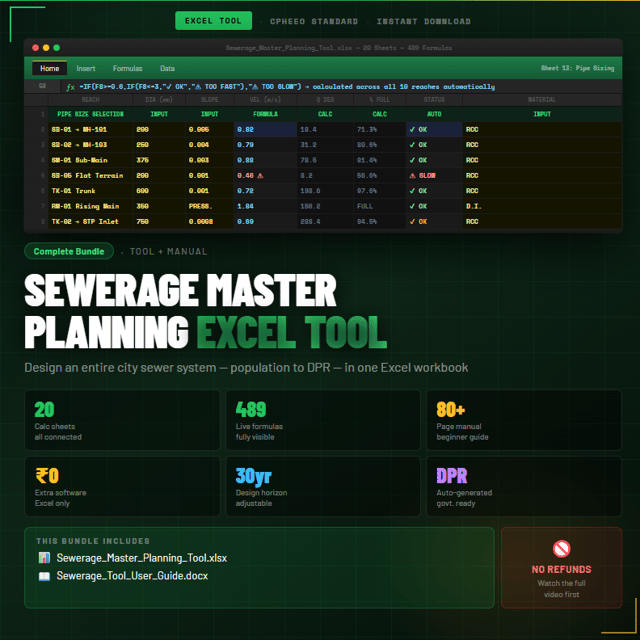
EPA SWMM (which is free), Bentley SewerCAD and SewerGEMS, and OpenFlows/Innovyze products are widely used for detailed sewer network modelling, while EPANET is the go-to tool for water distribution networks rather than sewers. For small and medium schemes, many Indian consultants also rely on transparent Excel-based design calculators with manuals, because they follow CPHEEO steps and are easy to verify and submit to client departments.
Where can I get a sewer design calculations PDF with a worked example?
The CPHEEO Manual on Sewerage and Sewage Treatment, available as a free download from the Ministry of Housing and Urban Affairs website, contains design procedures and worked examples. Standard textbooks by S.K. Garg, Birdie, and B.C. Punmia include step-by-step sewer design calculations, and many colleges publish design-project reports with full calculations. A practical alternative is an Excel-based sewer design tool that comes with a manual and sample data so you can follow every calculation step.
What is water hammer in pipelines?
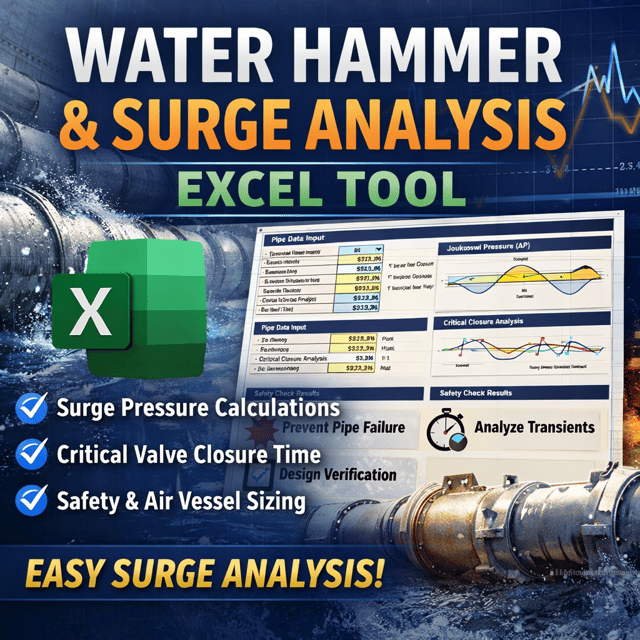
Water hammer — also called surge or transient pressure — is a pressure wave created when flow in a pipeline is suddenly stopped or changed, such as during a pump trip or rapid valve closure. The resulting high-pressure wave can far exceed the normal working pressure and burst pipes, while the low-pressure wave that follows can collapse them. Designers control it with slow-closing valves, surge tanks, air vessels, and surge-anticipating valves, and long rising mains are always checked for transient pressures using relations like the Joukowsky equation.
What is an IDF curve?
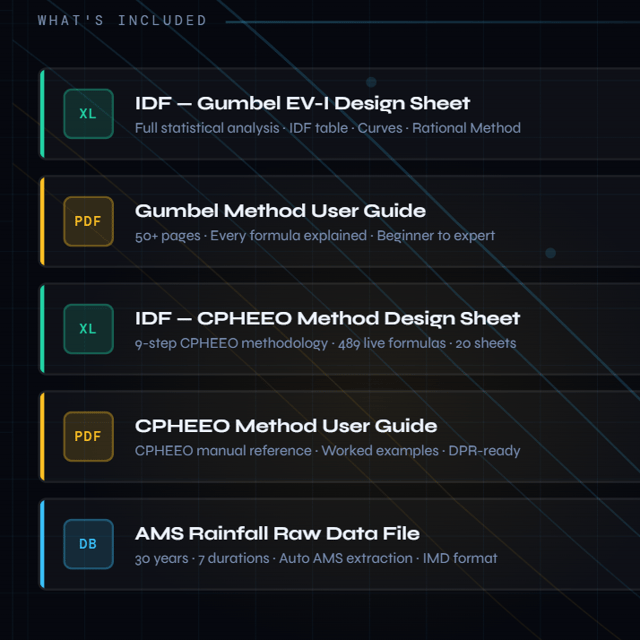
An IDF (Intensity–Duration–Frequency) curve shows how much rainfall intensity (usually in mm/hr) a location receives for different storm durations and return periods — for example, a 5-year, 30-minute storm. Storm-water drains, culverts, and drainage pumping stations are sized using the design intensity picked from the IDF curve for the chosen return period. In India, these curves are developed from IMD rainfall data or local rain-gauge records using frequency analysis such as Gumbel's method.