Testimonials
Services
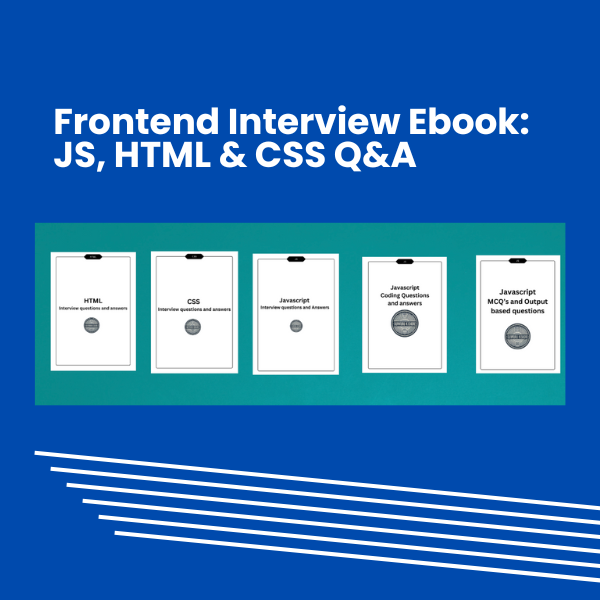
Frontend Interview Mastery: JS, HTML & CSS Q&A
About me
Frequently asked questions
What topics do front end developer interview questions usually cover?
Front end developer interview questions usually cover HTML semantics, CSS layouts like flexbox and grid, responsive design, JavaScript fundamentals, DOM manipulation, browser rendering and performance optimisation. If the role needs a framework, expect component-based questions from React and, increasingly, Next.js topics like routing and server-side rendering. Most interviewers begin with fundamentals and then move to coding or output-based problems.
Which frontend interview questions for freshers should I prepare first?
Start with HTML basics, CSS concepts like the box model, flexbox, grid and media queries, and core JavaScript — data types, loops, functions, arrays, hoisting, closures and events. Frontend interview questions for freshers stay close to fundamentals, so explaining simple concepts clearly and solving small output-based problems matters more than knowing advanced frameworks. Build one or two simple projects so you can back your answers with real examples.
How are frontend interview questions for 3 years of experience different from fresher interviews?
At around three years, interviewers test depth rather than definitions. Frontend interview questions for 3 years of experience usually include JavaScript internals such as closures, prototypes and the event loop, tricky output-based questions, React patterns like hooks and state management, performance optimisation and scenario questions from your real projects. You will also be asked to justify the technical decisions you made in your current role.
Is preparing from a frontend interview questions PDF enough to crack an interview?
A well-organised frontend interview questions PDF is a strong starting point because it puts the most-asked questions in one place, but reading alone is not enough. Type out the code, run the examples and answer mock questions aloud. Combining a PDF or structured eBook with hands-on practice gives far better results than passive reading.
Are frontend interview questions on GitHub reliable enough for preparation?
GitHub repositories are useful for discovering the range of topics, but quality varies widely — many lists are outdated, unstructured or have incomplete explanations. Use frontend interview questions on GitHub to identify gaps, then verify each answer against trusted documentation or an edited question bank with solved answers and MCQs. This saves hours compared to jumping between scattered repositories.
What are the most commonly asked JavaScript interview questions and answers?
The most common JavaScript interview questions and answers revolve around var, let and const, hoisting, closures, the this keyword, arrow functions, event delegation, promises, async-await and output-based snippets. Interviewers in India frequently ask you to predict the output of short code examples, so practise those alongside theory rather than memorising definitions.
Should I complete JavaScript basic interview questions before learning React?
Yes. React assumes you already understand functions, scope, hoisting, arrays, objects and ES6 features like destructuring and arrow functions, which are exactly what JavaScript basic interview questions test. If your fundamentals are weak, you will keep confusing framework behaviour with JavaScript behaviour while debugging. Spend a few days revising basics and solving small output problems, then start React — the learning curve becomes much smoother.
How do I prepare for promise in JavaScript interview questions?
Make sure you can explain what a promise is, its three states — pending, fulfilled and rejected — chaining with then and catch, error handling, and how async-await relates to promises. Most promise in JavaScript interview questions are output-based, asking you to predict the order of console logs when multiple promises run together. Learning the event loop alongside promises makes these answers much easier.
Which React interview questions and answers should I prioritise?
Prioritise React interview questions and answers on components and props, useState and useEffect with dependency arrays, lists and keys, conditional rendering, controlled forms, lifting state up and performance tools like useMemo and useCallback. For experienced roles, add context API, custom hooks, code splitting and re-render behaviour. Practise writing a small component live, since many companies include a hands-on coding round.
What React hooks interview questions are asked most often?
The most frequent React hooks interview questions check your understanding of useState and useEffect dependency arrays, why hooks cannot be called inside conditions or loops, useEffect versus useLayoutEffect, and when to write custom hooks. Prepare short examples for stale closures and cleanup functions too, because these are common follow-ups in interviews for experienced candidates.
How to respond to interview questions like tell me about yourself?
Keep the answer to roughly 60–90 seconds: your current role or education, your strongest frontend skills, one or two projects with clear outcomes, and why the role interests you. Structure it so it sounds confident rather than memorised. Interviewers use this opener to set the tone of the interview, so a relevant, well-paced answer creates a strong first impression.
How to respond to interview questions about weaknesses?
Choose a genuine but non-critical gap, own it honestly and show the steps you are taking to fix it — for example, "I wanted stronger TypeScript skills, so I have been building a small project in it for the past two months." Avoid clichés like being a perfectionist, and never claim you have no weaknesses. Interviewers are checking self-awareness and willingness to improve, not perfection.