Testimonials
Services
1:1 Mentorship for OMFS
Frequently asked questions
What is oral and maxillofacial surgery in dentistry?
Oral and maxillofacial surgery (OMFS) is the dental specialty that deals with the diagnosis and surgical treatment of diseases, injuries, and defects of the mouth, jaws, face, and related structures. Within dentistry, it covers procedures such as wisdom tooth removal, dental implants, corrective jaw (orthognathic) surgery, management of facial trauma, and treatment of cysts and tumours of the jaws. In India, it is pursued as a three-year MDS specialisation after BDS.
How to become an oral and maxillofacial surgeon in India?
In India, the path is: complete BDS with the compulsory internship, qualify NEET MDS, and then complete a three-year MDS in Oral and Maxillofacial Surgery at a recognised dental college. After MDS, most surgeons build experience through senior residency, teaching positions, or hospital practice before establishing an independent surgical practice. Speaking to practising OMFS surgeons or mentors early helps you understand the day-to-day reality of the specialty before committing to it.
Is OMFS worth it?
For students who genuinely enjoy surgery, OMFS is among the most respected MDS branches because it combines dentistry with hospital-based surgical work — trauma, corrective jaw surgery, implants, and facial reconstructive procedures. The trade-offs are the demanding three-year residency and the time it takes to build a surgical practice. If your goal is a procedural career with strong long-term growth rather than early independent practice, OMFS is usually considered worth it.
How much does an OMFS make?
There is no single fixed figure, because OMFS income in India depends heavily on the path chosen. Hospital and academic positions pay a fixed salary, while surgeons doing implants, trauma, orthognathic, and facial cosmetic work in private practice can earn considerably more as their reputation and case volume grow. City, seniority, and the hospital-versus-private-practice mix influence earnings the most, so it is best to assess the specialty through conversations with practising OMFS surgeons rather than generic salary numbers.
Where can I find the OMFS program list for dental colleges in India?
MDS in Oral and Maxillofacial Surgery is offered at government, aided, and private dental colleges across India, with seats filled through NEET MDS counselling at the All India and state levels. To build an accurate list for the current year, check the recognised MDS courses approved by the Dental Council of India and then verify the seat matrix on the respective state counselling portals and college websites, since seat counts change every year.
Is the oral and maxillofacial surgery department part of dentistry or medicine?
In India, oral and maxillofacial surgery is a specialty of dentistry, not medicine. It runs as a dedicated department in dental colleges, where students enter after BDS through the MDS programme, and OMFS surgeons also work in multispecialty hospitals for facial trauma and jaw-related surgery. Although the specialty overlaps with plastic surgery and ENT in scope, the training and qualification in India come through the dental route.
What is the MDS exam?
MDS stands for Master of Dental Surgery — the three-year postgraduate degree pursued after BDS. Admission happens through NEET MDS, and during the course, students appear for university-conducted theory papers in their specialty, applied basic sciences, and recent advances, followed by practicals and viva voce. When students talk about the MDS exam, they usually mean these final-year university examinations for their branch.
What does the MDS exam syllabus cover in the final year?
The MDS exam syllabus is framed by each university following Dental Council of India norms, and for OMFS it typically includes specialty papers in oral and maxillofacial surgery, applied basic sciences such as anatomy, physiology, pathology, and pharmacology as applied to the specialty, and recent advances. The paper-wise pattern, marking scheme, and practical/viva structure vary by university, so students should study from their own university's prescribed syllabus and align it with previous years' question papers.
When is the MDS final year exam date announced?
There is no common all-India date — each state university conducts its own MDS final-year examinations, generally once a year, and announces the schedule through official notifications on its website and through colleges. Theory exams are followed by practicals and vivas after a gap, so the practical dates matter just as much for planning. It is safer to prepare backwards from the earliest expected notification window rather than waiting for dates to be announced.
Which oral and maxillofacial surgery book should I read for the MDS final year?
Most MDS OMFS students build their base from standard textbooks such as Peterson's Principles of Oral and Maxillofacial Surgery, Contemporary Oral and Maxillofacial Surgery by Hupp, and widely used Indian textbooks like Neelima Malik's Textbook of Oral and Maxillofacial Surgery. Since these are detailed reference volumes, the usual final-year strategy is to use one textbook as the base and pair it with a question bank so revision stays aligned with what universities actually ask.
Which oral and maxillofacial surgery question bank is best for MDS final year university exams?
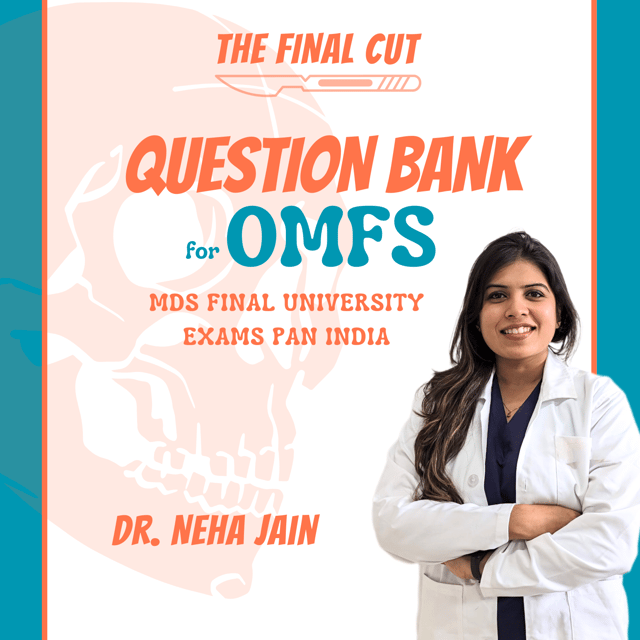
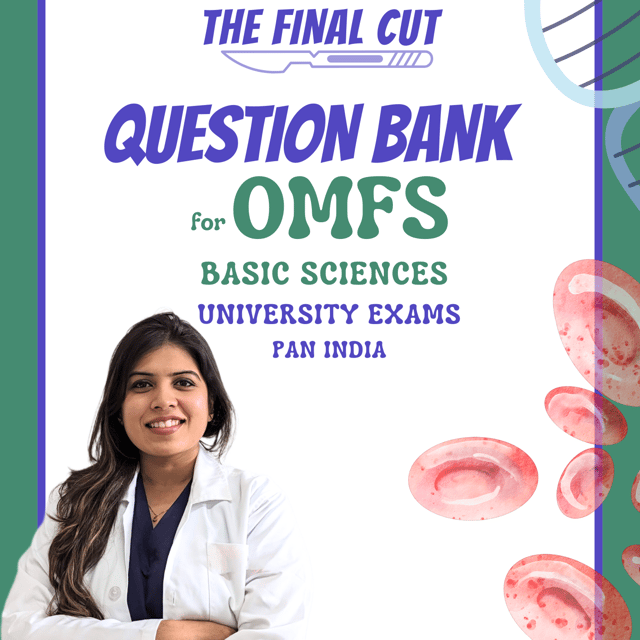
The most useful question bank for university exams is one compiled from previous years' question papers across Indian universities and focused on high-yield, frequently asked questions rather than textbook-style detail. The OMFS MDS Final Exam Question Bank by Dr. Neha Jain follows exactly this approach — it compiles frequently asked questions from universities across India, and OMFS residents describe it as a comprehensive, high-yield resource that gives a clear picture of the examiner's perspective. Whichever you choose, make sure it maps to your university's paper pattern.
How should I prepare for the MDS final year exam in oral and maxillofacial surgery?
Start by collecting previous years' papers from your university to identify repeatedly asked topics, then prepare those high-yield areas topic-wise, with classification-heavy subjects revised multiple times. Keep applied basic sciences ready since they carry separate weight, practise writing structured answers in the format examiners expect, and solve a compiled question bank alongside your textbook in the last two to three months. If certain topics still feel unclear close to the exams, a focused doubt-clearing session with a practising OMFS educator helps close gaps faster than self-study alone.