Testimonials
Services
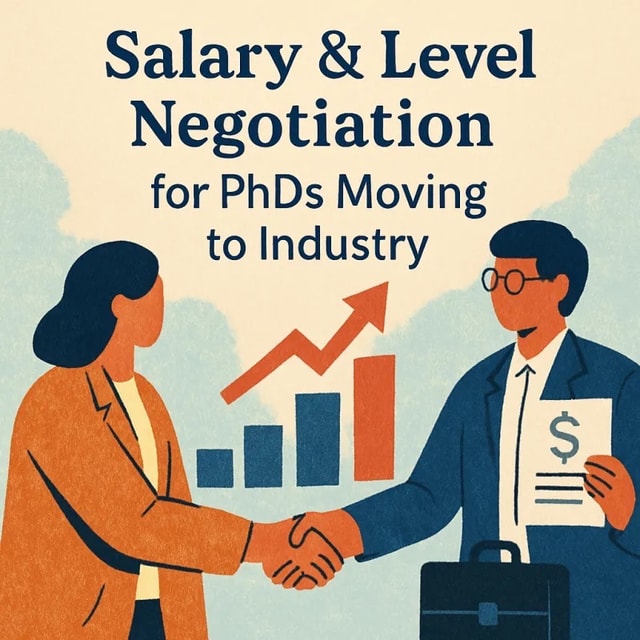
October: Salary & level negotiation for PhDs
PhD Strategy Consultation
PhD application review
Resume and Linkedin optimisation guide
14-Day LinkedIn Optimisation Challenge
About me
- Academia to Industry | Substackhttps://academiatoindustry.substack.com
- After 25 applications and 0 interviews, one CV review with Dr. Aleena changed everything. Got interviews within weeks, and a job offer soon after (everything under 4 weeks). Highly recommend!Recommended by N on

- Dr. Aleena Baby is praised for her detailed guidance on CVs, interviews, and career advice, fostering confidence and clarity in her clients.
 AI-generated based on testimonials
 - Academia to Industryhttps://academiatoindustry.com/

Frequently asked questions
How can I get fully funded PhD positions in Germany?
Treat it as a job search, not an application cycle: most funded doctoral places in Germany are advertised positions at universities, Max Planck, Helmholtz and Fraunhofer institutes, paid through TV-L E13 contracts (usually 50–75%), with DAAD and foundation scholarships as the second main route. Your competitiveness depends heavily on supervisor fit — shortlist professors whose research matches your idea, approach them with a focused research pitch rather than a generic email, and make sure your CV, transcripts and research narrative all point in one coherent direction. Selection committees weight positioning and proposal coherence as much as grades, which is why targeted applications consistently outperform mass applications.
What does a fully funded PhD mean?
A fully funded PhD means your doctoral studies cost you nothing out of pocket: tuition is covered — already the case at German public universities — and you receive a salary or stipend to live on during your research. In practice, funding comes in three forms: an employment contract as a doctoral researcher, a scholarship such as DAAD, or a salaried position tied to a professor's project grant. Genuine full funding means both no fees and a livable monthly income (roughly €1,300–3,500 depending on the model), so a "position" without pay or a stipend below living costs should be examined carefully before you accept.
Where can I find fully funded PhD positions in Europe?
Start with EURAXESS, FindAPhD and the job portals of universities and major research organisations — Max Planck, Helmholtz, Fraunhofer, CNRS, ETH Zurich and the Scandinavian universities that employ doctoral candidates as staff. Also set alerts on LinkedIn and work the hidden market: many positions are created only after a professor secures funding, so a well-matched supervisor email with a concrete research idea can surface openings that were never advertised. Funding models differ by country — Germany, the Netherlands, Switzerland and Scandinavia pay salaries, while the UK leans more on scholarships — so align your search with how your target country actually funds doctoral research.
Can I pursue a PhD in Germany in English?
Yes — a PhD in Germany in English is completely normal, especially in STEM, where research groups operate in English and international doctoral candidates are the norm. English proficiency is usually demonstrated through IELTS, TOEFL or a previous English-medium degree, and German is rarely required for admission or day-to-day research work. German becomes useful for administrative paperwork, teaching duties and life outside the institute, so a basic A1–B1 level makes life easier but is rarely a barrier to getting a position.
Is Germany a good destination for international students who want to pursue a PhD?
A PhD in Germany for international students is one of the strongest options in Europe: no tuition at public universities, doctoral researchers are usually paid employees rather than fee-paying students, and English-speaking research environments are standard in most fields. The main adjustment is structural — German academia is supervisor-driven, so you secure a professor or a specific funded position instead of being admitted to a centralised programme as in the US. Candidates who understand this system and prepare a focused research pitch before applying consistently do better than those who replicate a US-style application.
What should students from India know before applying for a doctoral position in Germany?
A PhD in Germany for Indian students usually hinges on one requirement first: a completed master's degree, since most German universities do not admit candidates directly after a bachelor's. The typical route is shortlisting supervisors whose work matches your interests, emailing them a specific research pitch rather than a generic message, and applying in parallel to advertised funded positions and structured programmes. IELTS or TOEFL is generally sufficient proof of English, German is rarely required in STEM, and funding comes either as an employment contract or through scholarships such as DAAD — so settle the funding question early instead of after admission.
What is the PhD salary in Germany?
There is no single fixed PhD salary in Germany, because most doctoral candidates are salaried employees under the public TV-L E13 scale. A 100% E13 position pays roughly €4,200–4,600 gross per month depending on the federal state, but PhD contracts are commonly funded at 50–75%, which works out to roughly €2,100–3,500 gross. Scholarship holders receive a stipend instead — DAAD's doctoral scholarship, for example, pays around €1,300 or more per month — so always check whether an offer is a contract with social-security benefits or a stipend before comparing numbers.
How much does a PhD cost in Germany?
Doctoral study at German public universities is tuition-free; you pay only a semester contribution of roughly €100–350, which usually includes local transport. That means the real cost is living expenses — about €950–1,300 per month depending on the city, with Munich and Stuttgart at the top of the range. With a salaried doctoral position or a full scholarship, the PhD effectively costs nothing from your own pocket; the financial risk only appears when candidates start without secured funding and try to survive on savings.
How many years is a PhD in Germany?
Officially three to four years of full-time research, though four to five years is common in practice. The spread comes from the system itself: contracts are frequently 50–65%, structured programmes run on fixed timelines while individual doctorates flex with the supervisor, and experimental fields take longer than theoretical ones. Before accepting an offer, ask whether the funding covers the full project duration — a three-year contract attached to a four-year project is a common source of pressure in the final year.
What are the requirements for a PhD in Germany?
The core requirements for a PhD in Germany are a completed master's degree (or a recognised equivalent such as a German Diplom) in a related subject, a supervisor who agrees to take you on or an offered doctoral position, and proof of English proficiency for international programmes. There is no standardised entrance exam like the US GRE — admission is granted at faculty level once supervision is secured. Competitive applicants also bring visible research evidence: a strong thesis, publications or projects, and a research direction that fits the group they are targeting.
How do I start the application process for doctoral study in Germany?
How to apply for a PhD in Germany depends on the route: advertised doctoral positions go through university and institute job portals with a tailored CV, transcripts and a focused cover letter, while the supervisor-led route starts with a targeted email containing a concrete research idea connected to that professor's publications. Structured programmes such as DFG Research Training Groups and International Max Planck Research Schools run formal calls with deadlines and set criteria. Whichever route you take, supervisor agreement is the decisive step — German doctoral admission happens at faculty level, and without a professor's support an application does not move forward.
Is DAAD a good option to fund a PhD in Germany?
Yes — DAAD is the most recognised funding body, and many international researchers complete a PhD in Germany with DAAD doctoral scholarships, which typically pay around €1,300 or more per month plus insurance, travel and research allowances. Competition is stiff and deadlines are annual, so treat DAAD as one track among several: salaried E13 doctoral positions at universities, openings at Max Planck, Helmholtz and Fraunhofer institutes, and project-based funding through a supervisor's grant. Successful candidates usually run both routes in parallel — funded positions for income security, DAAD for independence in choosing a research group.
Where can I find machine learning engineer jobs in Germany?
The main channels are LinkedIn and StepStone, plus the career pages of companies that hire ML talent at scale — Bosch, Siemens, BMW, Mercedes-Benz, Infineon, SAP, Zalando and the startup scenes in Berlin and Munich. German hiring managers look for practical proof: production-level Python, cloud and MLOps skills, and measurable business outcomes from past projects, not just a list of publications. English-only workplaces are common in tech, though German widens your options at established industrial employers, and roles cluster around Berlin, Munich, Stuttgart and Hamburg.
What is a typical machine learning engineer salary in Germany?
A mid-level machine learning engineer salary in Germany generally falls between €60,000 and €85,000 gross per year, with senior and staff roles in Munich, Berlin or Frankfurt often reaching €90,000–110,000. Entry positions after a master's usually start around €50,000–58,000, and doctoral graduates often negotiate above that range because of their research depth. Industry matters too: automotive, semiconductors and finance tend to pay above the average, while early-stage startups compensate partly with equity.
Are deep learning jobs in Germany a realistic target for PhD graduates moving from academia?
Yes — demand for deep learning jobs in Germany keeps growing across autonomous driving, industrial computer vision, healthcare and NLP products, and organisations filling machine learning researcher jobs in Germany — corporate AI labs, Fraunhofer institutes, automotive research groups — actively value doctoral depth. What decides the transition is positioning rather than qualification: translating publications into business outcomes, demonstrating production skills such as cloud and MLOps, and rewriting an academic CV around impact. Candidates who reposition this way typically see interview traction much sooner than those who send the same CV they used for postdoc applications.