Testimonials
Services
Priority DM
Resume Building
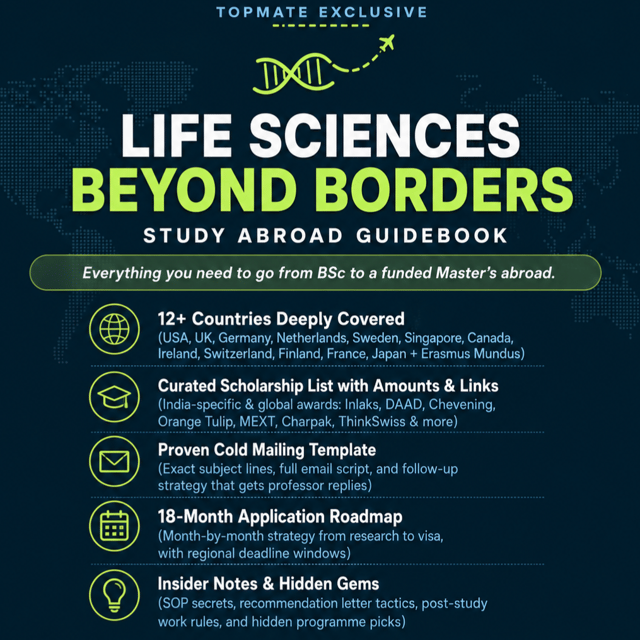
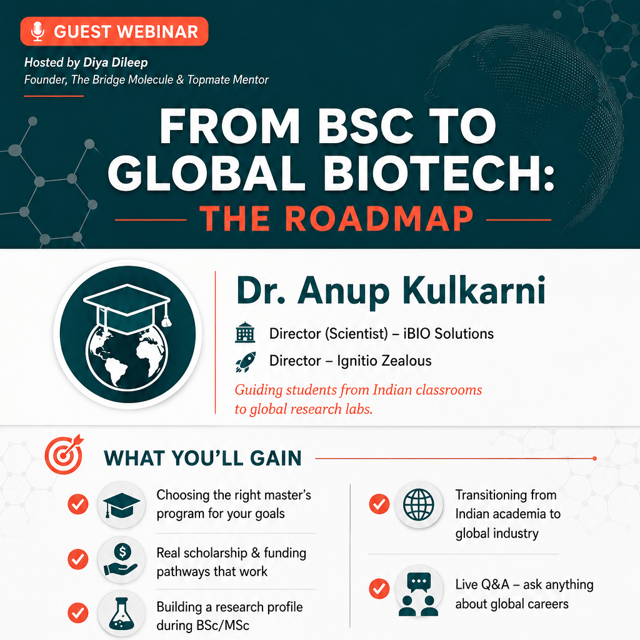
Bridge to the World – Life Sciences Career Talk

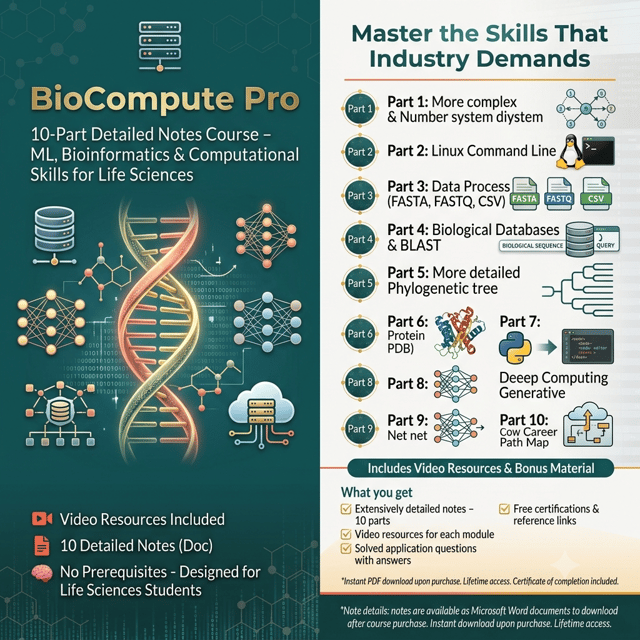

Ireland Scholarship Guidance



Research Launchpad
Quick Enquiry Chat

Ireland Master’s Application
From Data to Draft: Scientific Writing



Ireland Master’s Application 🇮🇪

Ireland Master’s Study Package
About me
- Ireland Master’s Study Package with Diya Dileephttps://topmate.io/diya_dileep09/new/B177THgGPf

- Research Launchpad with Diya Dileephttps://topmate.io/diya_dileep09/new/U96jqW0GnI

- Ultimate Ireland Study Abroad Guidehttps://topmate.io/diya_dileep09/2259276

Frequently asked questions
How to study in Ireland from India?
If you are planning how to study in Ireland from India, the process has five broad steps: shortlist universities and master's programmes that match your academic profile, take an English proficiency test such as IELTS, TOEFL, PTE or Duolingo, apply directly through the university's online portal, accept your offer and pay the confirmation deposit, and then apply for the Irish student visa with proof of funds covering tuition and roughly €10,000 for living expenses. Most Indian students target the September intake, so begin preparing 8–12 months in advance.
What are the eligibility requirements for study in Ireland for Irish universities as an Indian student?
The core requirements for study in Ireland for Indian students at the master's level are a relevant bachelor's degree from a recognised Indian university (most programmes prefer around 60% or a first-class equivalent), proof of English proficiency — usually IELTS 6.5 overall with no band below 6.0, though TOEFL, PTE and Duolingo are widely accepted — plus a statement of purpose, one or two letters of recommendation, an updated resume and academic transcripts. A few programmes may additionally ask for work experience, a portfolio or an interview.
How to study in Ireland for free?
Students searching for how to study in Ireland for free should know that Ireland charges tuition from all non-EU students, so a completely free education is rare. The realistic route is to cut costs through a fully funded study in Ireland scholarship such as the Government of Ireland International Education Scholarship, which covers tuition along with a stipend, combined with partial university merit awards, part-time work of up to 20 hours a week during term, and budgeting by living outside Dublin.
How to study in Ireland as an international student?
How to study in Ireland as an international student comes down to a standard sequence: choose a programme, meet the academic and English language requirements, apply online, receive and accept your offer, pay the deposit, and then apply for a Stamp 2 student visa, which requires proof of funds and private health insurance. Non-EU students can work 20 hours per week during term and full-time during scheduled holidays, and master's graduates can typically stay back for up to two years under Ireland's post-study work scheme to find employment.
What is the study in Ireland cost for Indian students?
The study in Ireland cost for Indian students works out to roughly €12,000–€25,000 per year in tuition for most master's programmes — business and some specialised courses can be higher — plus living expenses of about €10,000–€15,000 a year depending on the city. Dublin is the most expensive, while cities like Limerick and Galway cost noticeably less. Since most Irish master's programmes are one year long, the total investment is often lower than a two-year degree elsewhere, and scholarships plus part-time work reduce it further.
What is higher education in Ireland like for international students?
If you are asking what is higher education in Ireland, it refers to the system of universities, technological universities and colleges that offer bachelor's, master's and PhD degrees under the NFQ framework, where a taught master's sits at Level 9. For international students it is attractive because programmes — especially master's — are usually completed in one year, are taught in English, and institutions such as Trinity College Dublin and University College Dublin are globally ranked, with graduates allowed to remain in Ireland for up to two years after their course to find work.
Do you need study in Ireland consultants to apply for a master's?
No — study in Ireland consultants are not mandatory, because Irish universities accept direct applications through their official portals and publish all entry requirements openly. A consultant or an independent mentor is useful mainly for shortlisting the right programmes, reviewing your SOP and resume, and managing multiple deadlines. If you research carefully and prepare a strong application, you can absolutely apply on your own and save the fee.
How to write a statement of purpose for a master's abroad?
Learning how to write a statement of purpose becomes simple once you treat it as a structured story rather than an essay: open with what motivated your field, summarise your academic background and key projects or internships with specifics, explain why this particular programme and university by naming actual modules or specialisations, and close with clear short-term and long-term career goals. Keep it around 800–1,000 words unless the university specifies otherwise, write in the first person, stay honest, and never copy a sample.
What is the correct statement of purpose format?
A widely accepted statement of purpose format is 800–1,000 words in 5–7 paragraphs, written in the first person with a plain professional font such as Times New Roman or Arial at 11–12 point size and standard margins. Structure it as an introduction with your motivation, two or three body paragraphs covering academics, projects and work experience, one paragraph on why this programme and university, and a conclusion on your goals. Always follow the word limit given by your university, and reviewing a genuine statement of purpose example from your field helps you judge the right tone and level of detail.
What is a statement of purpose for masters?
A statement of purpose for masters is a focused essay — usually 500 to 1,000 words — in which you tell the admissions committee who you are academically, why you want to pursue that specific programme, and where you want your career to go. The statement of purpose meaning is built into the name itself: it states your purpose for applying, which is why it should be tailored to each course instead of reused across universities.
What is a statement of purpose for PhD applications?
A statement of purpose for PhD is far more research-heavy than a master's SOP: instead of only describing your academic journey, it must present your research experience — thesis, projects, publications or lab work — define the specific research area you want to pursue, and show how your interests align with a particular department or potential supervisor. Admissions committees read it as evidence that you can think like a researcher, so being precise about your research questions matters more than polished writing alone.
What are study abroad scholarships for Indian students, and which ones are worth applying for?
If you are wondering what are study abroad scholarships, they are financial awards that cover part or all of your tuition and sometimes living costs, and they broadly fall into merit-based, need-based, university-specific, government-funded and field-specific categories. The strongest study abroad scholarships for Indian students include destination-government awards such as the Government of Ireland International Education Scholarship and the UK GREAT Scholarships, university merit awards offered automatically or on application, and Indian trusts and endowments such as the J.N. Tata Endowment.
How to get study abroad scholarships from India?
Knowing how to get study abroad scholarships starts 10–12 months before your intake: maintain a strong academic record, build relevant projects, internships or publications, and shortlist every university, government and private award that matches your profile. The next step is understanding how to apply for study abroad scholarships in an organised way — most require transcripts, a tailored SOP or essay, recommendation letters and sometimes proof of income — all submitted before individual deadlines. Applying to 8–10 realistic options instead of just one or two dramatically improves your chances.
Can I get a scholarship to study abroad with average grades?
Yes. The worry "can I get a scholarship to study abroad with average marks" is extremely common, and the answer is often positive because not every award is purely merit-based. Many scholarships weigh a compelling essay, leadership, community work, financial need or a specific field of study, and partial awards covering 25–50% of tuition are far more accessible than fully funded ones. Strong recommendation letters, real project work and a sharp SOP can offset an average percentage, so apply broadly instead of ruling yourself out.
Are there study abroad scholarships by the Indian government?
Yes, there are study abroad scholarships by the Indian government, the best known being the National Overseas Scholarship for students from eligible categories, along with occasional state-government schemes. However, the majority of funding for studying abroad actually comes from the destination country's government, its universities and private trusts, so treat Indian government schemes as one option and build your overall plan around university and destination-country scholarships as well.