Testimonials
Services
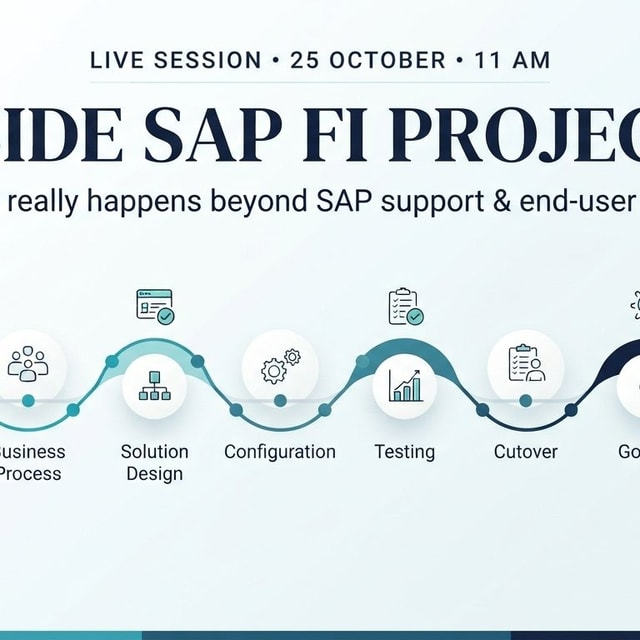
Inside SAP FI Projects
About me
Frequently asked questions
What is the SAP FICO module?
The SAP FICO full form is Financial Accounting (FI) and Controlling (CO). FI handles external reporting such as general ledger, accounts payable, accounts receivable, asset accounting and statutory requirements, while CO covers internal reporting like cost centres, profit centres, internal orders and profitability analysis. It is the most widely implemented SAP module across IT services, manufacturing and consulting companies in India, which is why both freshers and experienced finance professionals pursue it.
How to learn SAP FICO from scratch as a non-IT candidate?
Start with accounting basics and financial statement concepts, then move through the FI and CO submodules one by one, and most importantly practice on a live SAP system instead of only watching videos. Candidates from commerce, finance or MBA backgrounds actually have a domain advantage; the usual gap is hands-on configuration practice and interview readiness, which a structured plan or 1:1 guidance from an experienced consultant helps close. Aim to explain every concept along with its configuration path and one real business scenario.
How to learn SAP FICO for free?
You can build theory using free SAP learning content, YouTube tutorials, SAP Community blogs and official product documentation at zero cost. The practical limitation is that free resources rarely give you live system access, real-time scenarios or feedback on your mistakes, so most learners combine free theory with affordable hands-on system practice or guided sessions before applying for jobs. If your goal is placement, at least budget for system access and mock interviews.
How to become an SAP FICO consultant in India?
Build strong accounting fundamentals, learn FI/CO configuration on a live system, practice end-to-end cycles like procure-to-pay, order-to-cash and record-to-report, and prepare for interviews with real project scenarios. Commerce and finance graduates usually enter through their domain knowledge while IT professionals enter through configuration skills — in both cases, hands-on project practice and a well-positioned resume matter more than certificates alone. Entry-level support roles are a common and smart first step into SAP FICO consulting.
How much are SAP FICO course fees in India?
Most SAP FICO course fees in India range roughly between ₹20,000 and ₹1,00,000 depending on the format — self-paced recordings sit at the lower end, instructor-led programs with live system access sit in the middle, and placement-focused or 1:1 mentorship programs cost more. Before comparing fees, check what is actually included: live system access, real-time scenarios, doubt-clearing, interview preparation and placement support usually justify a higher fee than a cheap recording-only course.
Which is the best SAP FICO course in Pune?
Rather than chasing one "best" institute, judge any SAP FICO course in Pune on the trainer's real implementation experience, live system access, real-time project scenarios, batch size, and interview or placement support. Pune has a strong SAP market due to IT hubs like Hinjewadi, Kharadi and Magarpatta, so both classroom programs in the city and structured online 1:1 mentorship can work well — what matters most is learning from someone who has actually worked on SAP FI projects, not just taught them.
How can freshers get SAP FICO jobs in Pune?
Freshers get shortlisted when they can demonstrate hands-on FI/CO knowledge, real-time scenario understanding and confident interview answers rather than only a course certificate. Search using terms like SAP FICO fresher jobs on portals such as Naukri and LinkedIn, target the IT parks and GCCs around Pune, apply for trainee or support consultant roles, and use referrals, internships and contract roles as practical entry points into your first SAP FICO role.
What are the most common SAP FICO interview questions for freshers?
Freshers are usually asked about the FI and CO submodules, chart of accounts, posting keys, document types, accounts payable and receivable cycles, asset accounting basics, month-end and year-end closing, and integration points with MM and SD. Interviewers also like short scenario questions, such as how a vendor invoice flows into the financial statements or what happens during automatic payment runs. Prepare each answer as concept plus configuration path plus one business example.
How do I prepare for SAP FI interview questions for experienced professionals?
SAP FI interview questions for experienced professionals go beyond definitions into end-to-end implementation or support experience, complex integration issues, New GL and S/4HANA changes like the Universal Journal, data migration and cutover activities, and closing bottlenecks you have actually resolved. Expect follow-up "why" questions on your design decisions, so build your answers around real projects you have worked on instead of bookish theory.
What is APP in SAP FICO?
APP stands for Automatic Payment Program — it is the tool used in accounts payable to process outgoing vendor payments automatically, typically through transaction F110. It is configured using FBZP, where you define paying company codes, payment methods, bank determination and sending methods. It is one of the most frequently asked topics in SAP FICO interviews, so be ready to explain the configuration steps along with the proposal, posting and payment medium steps.
What is SAP S/4HANA Central Finance?
SAP S/4HANA Central Finance (cFIN) is a deployment option of S/4HANA that consolidates financial data from multiple source systems — SAP ECC, other S/4HANA systems and even non-SAP applications — into one central system using real-time replication. It supports initial load plus ongoing replication, central key mapping and central reporting, making it popular for group reporting, finance harmonization, post-merger integration and phased S/4HANA migrations where replacing all source systems at once is not practical.
What SAP Central Finance interview questions should I expect?
Typical SAP Central Finance interview questions cover the overall architecture and data flow from source systems through SLT replication, the difference between initial load and real-time replication, key mapping, ledger and currency considerations, error monitoring and reprocessing, and the business cases where cFIN is chosen. Interviewers also test whether you can explain when Central Finance makes sense compared to a standard consolidation approach or a direct system migration.
Is SAP Central Finance certification worth doing?
A certification adds credibility and helps your resume pass initial screening filters, especially when you are moving from core SAP FICO into the cFIN space. That said, SAP Central Finance is a niche area, and for most SAP Central Finance jobs employers weight hands-on understanding — replication, key mapping, monitoring and real scenarios — far more than the certificate itself. Treat certification as a support and invest seriously in practical, project-style learning alongside it.
Where can I get hands-on SAP Central Finance training?
Because cFIN is a niche topic, most training institutes only cover generic FICO and skip it entirely, so look for SAP Central Finance training delivered by practitioners or solution architects who have worked on live implementations. A good program should cover source system replication, initial load, key mapping, error monitoring and central reporting through real scenarios rather than slides alone. For niche areas like this, 1:1 mentorship with an experienced consultant is usually more effective than pre-recorded courses.