Testimonials
Services
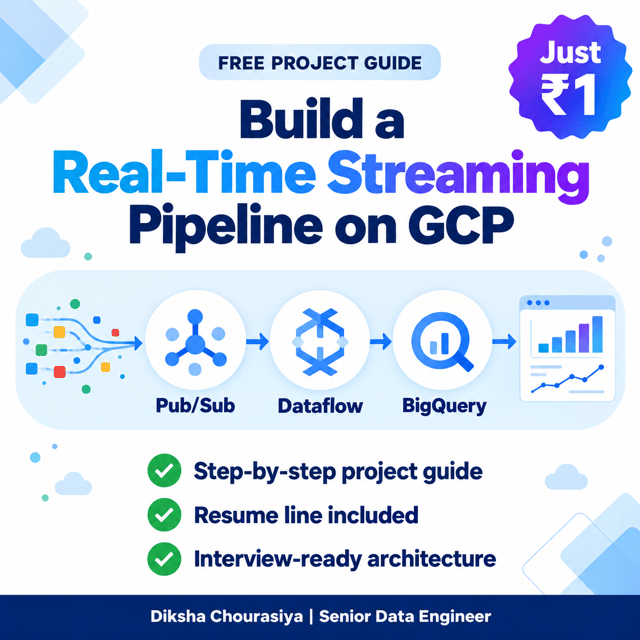
FREE Guide: Real-Time GCP Streaming Pipeline
Have a Question?
Interview Strategy Call: Data | GCP | SQL
GCP Mock Interview: Data Engineering
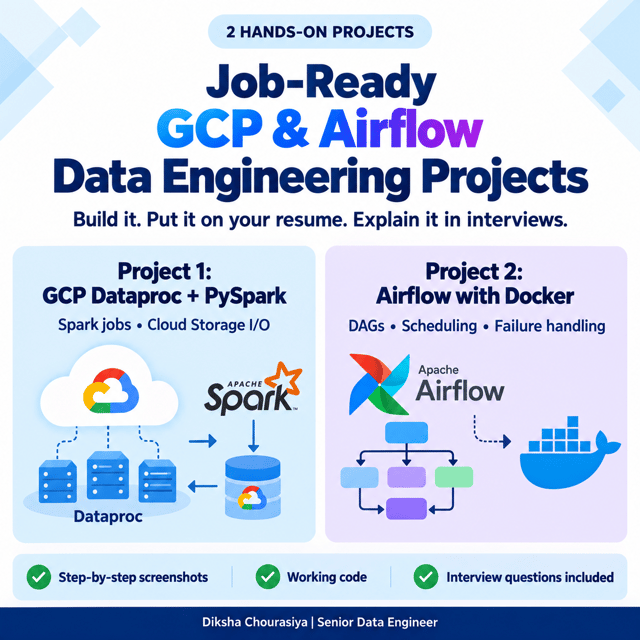
Job-Ready GCP & Airflow Data Engineering Projects
Crack the Cloud: GCP Data Engineering Edition
GCP Certification Prep Pack: Core Concepts
Got a Query? Let’s Solve It in 15 Minutes
GCP Interview Questions for Data Engineers (PDF)
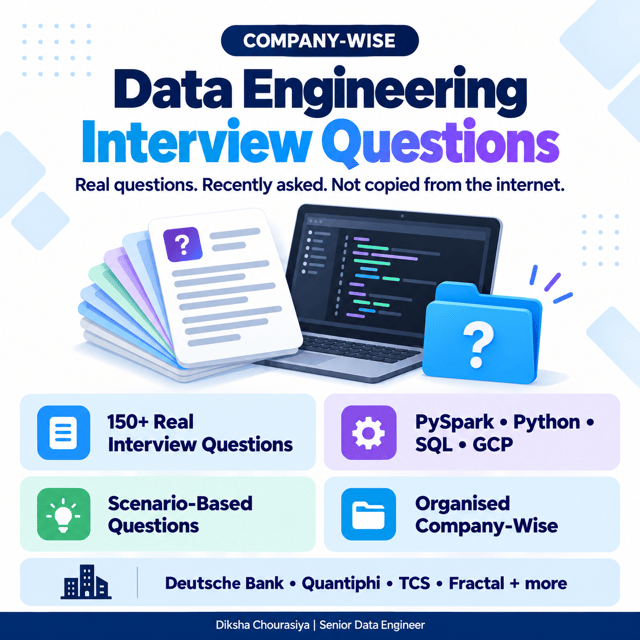
Data Engineering Interview Questions: Company-Wise
About me
- Diksha Chourasiya is an exceptional mentor known for her in-depth knowledge, effective guidance, and supportive approach in career development.
 AI-generated based on testimonials
 - Diksha is a knowledgeable, patient mentor who provides practical guidance and personalized support, helping bookers excel in interviews and data engineering careers.AI-generated based on testimonials
Frequently asked questions
How to become a GCP data engineer?
Start with strong SQL and Python fundamentals, since these are tested in every data engineering interview. Next, learn the core GCP data services — BigQuery for analytics, Cloud Storage for data handling, Dataflow or Data Fusion for ETL, and Cloud Composer for orchestration. Build at least one end-to-end project, such as a pipeline that moves data from Pub/Sub through Dataflow into BigQuery, and put it on GitHub. Finally, the Professional Data Engineer certification adds credibility, especially when you don't yet have cloud work experience.
What does a GCP data engineer do?
A GCP data engineer designs, builds, and maintains data pipelines on Google Cloud Platform. Day to day, this means ingesting data through services like Pub/Sub and Data Fusion, transforming it using Dataflow, Python, or SQL, storing it in BigQuery and Cloud Storage, and scheduling workflows with Cloud Composer. They also tune query performance, manage costs, set up monitoring and alerts, and make sure data is accurate, secure, and available for analysts and downstream teams.
What is the GCP Data Engineer certification?
The GCP Data Engineer certification — officially called the Professional Data Engineer certification — is Google Cloud's professional-level credential for people who design, build, and operate data systems on GCP. The exam tests your ability to design data pipelines, build analytics solutions with BigQuery, choose the right storage and processing options, and ensure security, compliance, and reliability. In India, it is one of the most in-demand cloud certifications for data engineering roles and is recognized by both service-based and product companies.
How to pass the GCP Data Engineer certification?
Prepare for scenario-based questions rather than memorizing definitions. Get hands-on with BigQuery, Cloud Storage, Dataflow, Pub/Sub, and Composer, because most exam questions describe a business situation and ask you to pick the right architecture. Follow the official exam guide topic by topic, take full-length practice tests to identify weak areas, and revise cost optimization and security patterns, since these come up repeatedly. Candidates who combine structured study with real hands-on practice on GCP clear it far more comfortably.
How to crack a data engineer interview?
Focus on the three areas almost every data engineering interview tests: SQL (joins, window functions, query optimization), Python, and core concepts like data modeling, ETL vs ELT, and batch vs streaming. Be ready to walk interviewers through your projects end to end — the architecture, the tools, and the problems you solved. Practice scenario questions like "How would you design a pipeline for this use case?" and do a few mock interviews to get comfortable thinking aloud. Reviewing commonly asked questions for your target companies in the final week helps a lot.
What are the most common GCP data engineering interview questions?
The most common GCP data engineering interview questions revolve around BigQuery (partitioning, clustering, performance and cost optimization), Dataflow and Apache Beam, Pub/Sub, Cloud Storage, and orchestration with Cloud Composer or Airflow. You will also face SQL-heavy problems, scenario-based design questions such as building a real-time pipeline from Pub/Sub to BigQuery, and questions on error handling, data validation, and idempotency. Companies hiring in India often ask you to explain a GCP project you have personally worked on in depth.
What are the common data engineering interview questions for freshers?
Freshers are usually tested on SQL fundamentals — joins, GROUP BY, subqueries, and window functions — along with Python basics and core theory like OLTP vs OLAP, structured vs unstructured data, and batch vs streaming processing. Interviewers also probe your projects, so have at least one end-to-end data pipeline you can explain clearly, including why you chose each tool. Basic awareness of a cloud platform like GCP or AWS and tools like Airflow immediately sets you apart from other freshers.
What are the most common data engineering interview questions for experienced professionals?
For experienced candidates, questions move from definitions to depth: designing scalable architectures, optimizing BigQuery performance and cost, handling late-arriving and duplicate data, schema evolution, orchestration with Composer or Airflow, and trade-offs between Dataflow, Data Fusion, and other ETL options. Expect deep dives into projects you have owned — failures, debugging stories, and decisions you made — plus system design rounds where you architect a complete pipeline. Researching the company's data stack and preparing company-specific questions makes a noticeable difference in later rounds.
How should I answer "Why do you want to be a data engineer?" in an interview?
Use a specific, genuine reason instead of a generic line about loving data. A strong answer connects a real experience — a project where you built a pipeline, cleaned messy data, or worked with SQL, Python, or a cloud platform like GCP — to what data engineers actually do daily. Then add the career angle: data engineering sits at the foundation of every data-driven decision, which means strong demand and clear growth. Interviewers ask this to judge motivation, so one concrete story is worth more than three rehearsed sentences.
What are some good GCP data engineering projects for beginners?
Begin with an end-to-end pipeline that mirrors real industry workloads — ingest data with Pub/Sub, process it with Dataflow, load it into BigQuery, and orchestrate the entire workflow with Cloud Composer. Other strong options are a batch ETL pipeline using Data Fusion, a BigQuery analytics project with dashboards, or a data-quality alerting setup. Push everything to GitHub with a clear README explaining the architecture, because recruiters and interviewers increasingly shortlist candidates based on hands-on GCP projects.
Is a GCP data engineering course worth it?
Yes — if it is hands-on and aligned with what companies actually use. A worthwhile GCP data engineering course covers BigQuery, Cloud Storage, Dataflow, Data Fusion, and Composer with real projects, and ideally prepares you for the Professional Data Engineer certification. Since most employers in India expect practical pipeline-building skills rather than only theory, choose a course that makes you build and deploy complete pipelines you can showcase in interviews. A course shortens the learning curve, but pair it with projects and interview preparation to actually convert it into a job.
How do I get GCP data engineering jobs in India?
Build three things: skills, proof, and interview readiness. Learn the core GCP data stack — BigQuery, Dataflow, Composer, Pub/Sub, and Cloud Storage — add the Professional Data Engineer certification if possible, and showcase two or three pipelines on GitHub. IT services companies and global capability centers in India hire continuously for GCP data engineering roles, so tailor your resume with GCP-specific keywords and prepare for SQL and scenario-based interview rounds. Referrals and LinkedIn outreach to engineers already working in these roles significantly improve response rates.
What is the best BigQuery tutorial for beginners?
Look for a BigQuery tutorial for beginners that starts with plain SQL — SELECT, JOIN, GROUP BY — and then introduces BigQuery-specific concepts like datasets, tables, partitioning, clustering, and how pricing works. Google Cloud's own quickstarts, combined with the free tier or sandbox, are a good place to practice on real datasets, and video walkthroughs help if you learn better by watching. Once the basics are comfortable, practice on a public dataset and focus on optimization, because partitioning, clustering, and cost control are what make BigQuery different from ordinary SQL.