Testimonials
Services
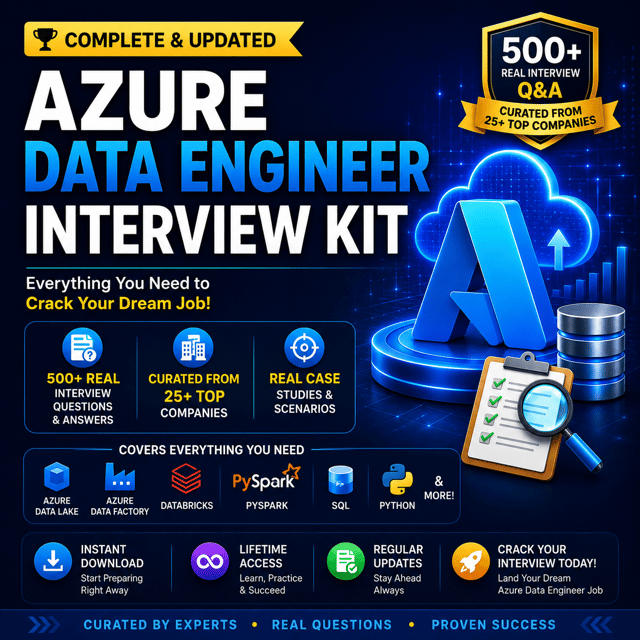
Complete Azure Data Engineer Interview Kit 2026
Resume Review & Optimization
1:1 DE Mentorship
Priority DM – 1:1 Career & Tech Guidance
Azure Data Engineer Mock Interview
About me
Frequently asked questions
How to prepare for the Azure Data Engineer interview?
Build a structured plan covering SQL, Python, PySpark, Azure Data Factory, Azure Databricks, Synapse and ADLS Gen2, since most interviews test these core areas. Move quickly from theory to scenario practice — designing incremental loads, optimizing slow Spark jobs, debugging failed pipeline runs — because interviewers increasingly prefer real-time scenarios over definitions. Prepare a deep walkthrough of every project on your resume, write answers to frequently asked questions in your own words, and test your readiness with at least one or two mock interviews before the actual attempt.
How to crack the Azure Data Engineer interview?
Cracking the interview is less about memorizing answers and more about demonstrating applied thinking. Know your projects end to end, keep two or three architecture stories ready (the problem, your design, the trade-offs), revise integration runtimes, triggers, Spark architecture and optimization techniques in the final week, and practise speaking your answers aloud. Candidates who simulate the interview through mock rounds handle pressure and follow-up questions far better than those who only read question banks.
What are the most common Azure Data Engineer interview questions?
The most common Azure Data Engineer interview questions fall into a few buckets: SQL (joins, window functions, duplicate handling), Python and PySpark coding (deduplication, top-N per group, joins), Azure Data Factory (pipeline vs activity, triggers, integration runtime, incremental loading, error handling), Azure Databricks (Spark architecture, lazy evaluation, caching, Delta Lake), plus scenario questions such as designing an end-to-end pipeline from source to reporting. Expect at least one deep dive into a project you have built in almost every round.
What are the common Azure Data Engineer interview questions for 3 years of experience?
At the 3-year mark, interviewers expect hands-on depth rather than basics: incremental loading patterns in Azure Data Factory, performance tuning in Databricks, complex SQL and PySpark scenarios, debugging production failures, and the architecture of a project you personally owned. For 5–6 years of experience, the balance shifts toward design decisions — choosing between Synapse, Databricks and Fabric, cost optimization, building reusable frameworks and mentoring juniors. Tailor your preparation to the experience band you are interviewing for.
Where can I find reliable Azure Data Engineer interview questions and answers?
Look for question banks built from recent, real interview experiences rather than generic dumps — many people download an Azure Data Engineer interview questions and answers PDF only to find textbook definitions that do not match what interviewers actually ask. A better approach is a subject-wise collection covering Azure Data Factory, Databricks, SQL and PySpark with interview-style answers, combined with first-hand interview experiences shared by candidates on LinkedIn and forums. Rewrite every answer in your own words and practise saying it aloud.
What does a typical Azure Data Engineer interview experience look like?
A typical Azure Data Engineer interview experience in India runs two to four rounds: a screening round, one or two technical rounds covering SQL, Python, PySpark, Azure Data Factory and Databricks, sometimes an architecture or design round for senior roles, and finally an HR discussion. Service-based companies tend to probe tool-specific questions and project details, while product companies add data modelling and system design. Interviewers often pull scenarios directly from their own production environments, so be ready for follow-up "what if" questions.
What is Azure Data Factory and how does it work?
Azure Data Factory is Microsoft's cloud-based data integration and orchestration service. It works through pipelines that contain activities such as copy and data flows; linked services and datasets define connections to sources and sinks; integration runtimes supply the compute; and triggers schedule or event-drive execution. In practice, teams use it to ingest and orchestrate data movement across Azure and external systems, then hand off heavy transformations to tools like Databricks.
How to learn Azure Data Factory?
The fastest way is hands-on: start with the core concepts — pipelines, activities, triggers, linked services and integration runtimes — then build in a free Azure sandbox, beginning with a simple copy pipeline and progressing to incremental loads and data flows. Follow one structured Azure Data Factory tutorial end to end instead of jumping between random videos, and finish with a small end-to-end project you can discuss in interviews. Practical building always beats passive watching.
Which Azure Data Factory interview questions are asked most often?
Frequently asked Azure Data Factory interview questions include: the difference between a pipeline, activity and data flow; types of integration runtimes; schedule versus tumbling window versus event-based triggers; linked services and datasets; achieving incremental loading using watermark columns; copy activity performance tuning; error handling and retries; and securing credentials with Key Vault and managed identities. Scenario questions, like designing an incremental pipeline from ADLS to Azure SQL, are almost guaranteed.
Azure Data Factory vs Databricks: which one should you learn first?
The Azure Data Factory vs Databricks question comes up constantly because the two services do different jobs. Azure Data Factory is primarily an orchestration and ETL tool — moving and scheduling data through mostly low-code pipelines — while Azure Databricks is an Apache Spark-based platform for large-scale processing, advanced transformations and machine learning. Real projects use them together, with Data Factory triggering Databricks jobs, so learn Data Factory basics first and then go deep on Databricks.
Is there a dedicated Azure Data Factory certification?
No — Microsoft does not offer a standalone Azure Data Factory certification. ADF skills are tested as part of broader role-based data engineering certifications on the Microsoft path, while Databricks runs its own separate certification track. Since interviews weigh hands-on project work heavily, treat certification as a supporting credential and build real pipelines alongside your preparation.
What is Azure Databricks used for?
Azure Databricks is a cloud analytics platform built on Apache Spark, used for large-scale ETL, batch and streaming data processing, Delta Lake–based storage, collaborative notebook development, and data science and machine learning workloads. Data engineers rely on it when datasets grow too large for traditional tools, because Spark distributes processing across a cluster. It integrates natively with ADLS Gen2, Azure Data Factory and Microsoft Entra ID, which is why it appears in most modern Azure data architectures.
What Azure Databricks interview questions are commonly asked?
Common Azure Databricks interview questions cover Spark architecture (driver, executors, cluster manager), transformations versus actions and lazy evaluation, narrow versus wide transformations, shuffle and join strategies including broadcast joins, handling data skew, caching and persistence, Delta Lake features such as MERGE and time travel, cluster sizing, and PySpark coding tasks like removing duplicates or finding top-N records per group. Structured streaming basics are increasingly asked for real-time roles.
Is an Azure Databricks certification worth it for data engineers?
Yes — an Azure Databricks certification is worth it, particularly for freshers and career switchers trying to get shortlisted, because it validates the Spark and Databricks skills that recruiters actively screen for. The Azure Databricks Data Engineer Associate certification is the most relevant credential for data engineering roles. It does not replace hands-on project experience, but pairing it with a couple of practical pipelines makes your profile noticeably stronger.
Azure Databricks vs Databricks: is there any real difference?
Databricks is the original platform, while Azure Databricks is its version deployed on Microsoft Azure with native integration into Azure services such as ADLS Gen2, Microsoft Entra ID and Azure Data Factory. The core Spark and notebook experience is identical, so your skills transfer completely — but if you are targeting Azure-based data engineering jobs, the Azure-integrated version is the one you will actually use day to day.