Testimonials
Services
Personalized 1:1 Mentorship & Career Guidance
Data Engineering - basic to advanced
Optimize your linkedin profile
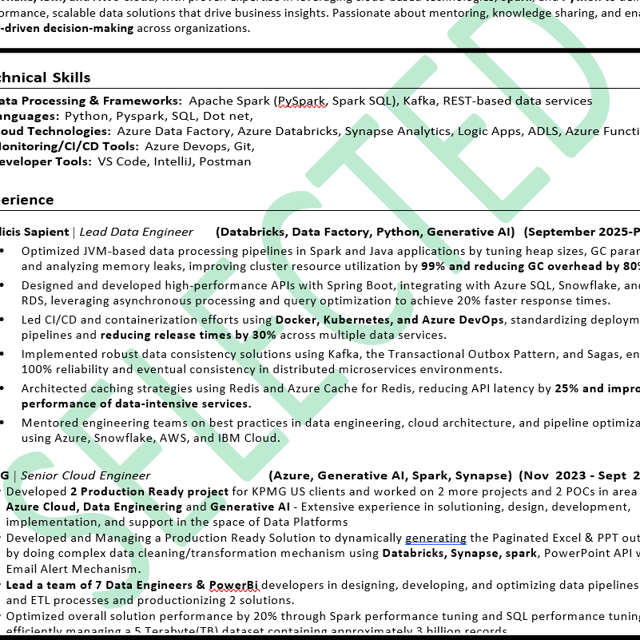
Resume Review
Ask me anything
Interview Preparation
Career Guidance for Data Engineers & Data Analyst
Resume to Offer: Interview Preparation Tips
Only for Referrals | Publicis Sapient
Personal Branding
Discuss any Topic - Understanding/Q&A
2+1 month Data Engineering Mentorship
About me
- Hear out from my Menteeshttps://topmate.io/riya_khandelwal/

- Connect with me on LinkedInhttps://www.linkedin.com/in/riyakhandelwal

Frequently asked questions
How to start data engineering as a fresher in India?
Start by building a strong base in SQL and Python, since most entry-level data engineering interviews in India begin with these two. Next, pick one cloud platform (Azure is widely used by Indian employers), learn ETL concepts, and build small end-to-end pipelines. A CS degree helps but is not mandatory — freshers from any stream get hired when they can demonstrate practical projects.
Data engineering vs data science — which career should a fresher choose?
Data engineering focuses on building and maintaining the pipelines and platforms that move and store data, while data science focuses on analysing that data and building models. In India, data engineering usually has more entry-level openings because every analytics and AI team needs reliable data infrastructure first. If you enjoy SQL, coding, and systems design, data engineering is typically the easier door to enter; if you love statistics and machine learning, aim for data science but expect a higher entry bar.
What is a practical data engineering roadmap for beginners?
A realistic data engineering roadmap looks like this: master SQL first (joins, window functions, query optimisation), then Python, then data modelling and warehousing concepts, then one cloud ecosystem such as Azure, followed by Spark/Databricks and orchestration tools. Finish with two or three portfolio projects. Freshers usually need 4–6 months of consistent effort, while working professionals switching roles may need 6–9 months alongside their job.
Which data engineering projects should I build to get hired as a fresher?
Recruiters prefer depth over quantity, so build two or three well-documented pipelines rather than ten half-finished ones. Good options include ingesting a public API into a cloud data warehouse, a batch ETL workflow using Azure Data Factory, and a processing pipeline with Spark or Databricks. Aim to build your Azure data engineering projects end to end — from ingestion and transformation to loading and reporting — and document your architecture decisions on GitHub, since that is exactly what interviewers probe.
What are the most common data engineering interview questions for freshers?
Expect SQL-heavy rounds covering joins, window functions, and query optimisation, along with Python coding, data modelling (normalisation, star schema), and core ETL concepts. Product companies and GCCs in India increasingly ask scenario questions like "design a pipeline for this use case," so practise explaining trade-offs and architecture instead of memorising definitions.
Which Azure data engineering interview questions are asked most often?
Common Azure data engineering interview questions revolve around Azure Data Factory (integration runtimes, triggers, linked services), Spark and Databricks (partitioning, caching, transformations), Delta Lake (ACID, time travel), storage choices like ADLS Gen2, and cost optimisation. Scenario-based questions such as "how would you migrate on-prem data to Azure" are also frequent, so hands-on experience with at least one real pipeline matters more than recalling service names.
How to learn Azure data engineering from scratch?
Begin with Azure fundamentals, then go deep into the core data stack: ADLS Gen2 for storage, Azure Data Factory for orchestration, Databricks/Spark for processing, and Synapse or Fabric for warehousing. Microsoft Learn offers free structured paths, and a free or student Azure subscription lets you practise hands-on. Consolidate everything with one project, then validate your skills with a certification.
How to become an Azure data engineer without prior experience?
Follow a stepwise path: strengthen SQL and Python, learn the Azure data stack, build two or three end-to-end projects, earn a certification, and then target junior data engineer, ETL developer, or analytics engineer roles. Many people in India also transition internally from support, testing, or BI roles by showcasing projects — referrals and an optimised LinkedIn profile significantly speed this up.
Is the Azure data engineering certification worth it in India?
For freshers and career switchers, yes — it helps your resume stand out in a crowded market, and many Indian service companies and MNCs shortlist certified candidates faster. It will not replace projects or interview skills, but when combined with hands-on practice, an Azure data engineering certification clearly strengthens your profile and credibility.
How to get an Azure data engineer certification as a complete beginner?
Check the current Azure data engineer certification path on Microsoft Learn, complete the free learning modules, get hands-on practice in a free or pay-as-you-go subscription, and finish with practice tests before booking the exam. Beginners who already know SQL basics typically need around 6–8 weeks of focused preparation.
What is Snowflake and how does it work?
Snowflake is a cloud data platform — essentially data warehousing as a service — that runs on AWS, Azure, and Google Cloud. Its core design separates storage from compute, so virtual warehouses can be scaled up or down independently and you pay only for what you use. It handles both structured and semi-structured data, which is why so many enterprises run their analytics on it.
What is Snowflake software used for?
Companies use Snowflake for cloud data warehousing, ELT pipelines, secure data sharing across teams and partners, and powering BI dashboards without managing any infrastructure. A large number of Indian enterprises and startups run their data platforms on Snowflake, which is why Snowflake skills appear in so many data engineer job descriptions today.
Is a Snowflake tutorial for beginners enough to get a data engineering job?
A Snowflake tutorial for beginners is a good starting point for concepts like warehouses, tables, and SnowSQL, but tutorials alone rarely get you shortlisted. Indian interviewers test applied SQL, data modelling, and pipeline design, so pair the tutorial with a small hands-on project — for example, loading and modelling a real dataset in Snowflake — before applying for roles.
Do I need paid data engineering courses to become a data engineer?
No — a large part of the syllabus is available free through Microsoft Learn, official documentation, and YouTube. Paid data engineering courses are useful mainly when you want structure, guided projects, and mentor feedback; if you are self-disciplined, free learning combined with projects and occasional expert guidance can get you job-ready at almost zero cost.
Are there enough data engineering jobs in India for freshers?
Yes — demand for data engineering jobs in India keeps growing as companies migrate to cloud platforms like Azure, Databricks, and Snowflake and invest in AI-ready data infrastructure. Freshers face competition, so projects and a certification are what separate shortlisted candidates. Beyond "data engineer," also explore adjacent titles like ETL developer, analytics engineer, and big data engineer, which are hired by service firms, GCCs, and startups alike.