Testimonials
Services
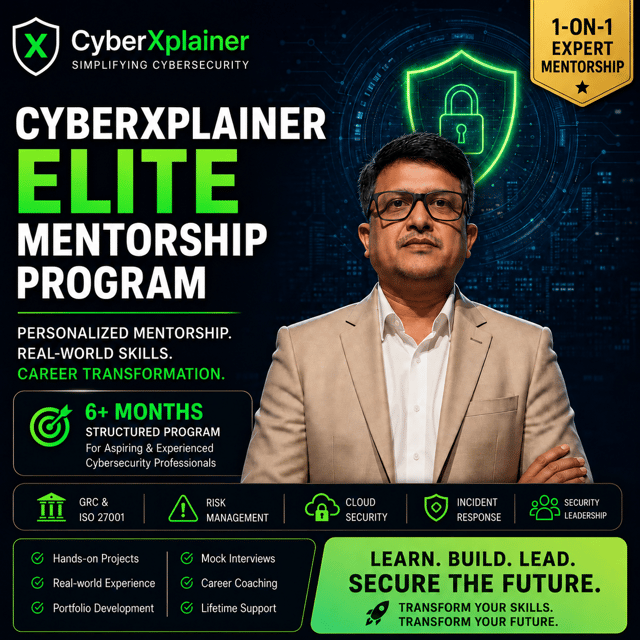
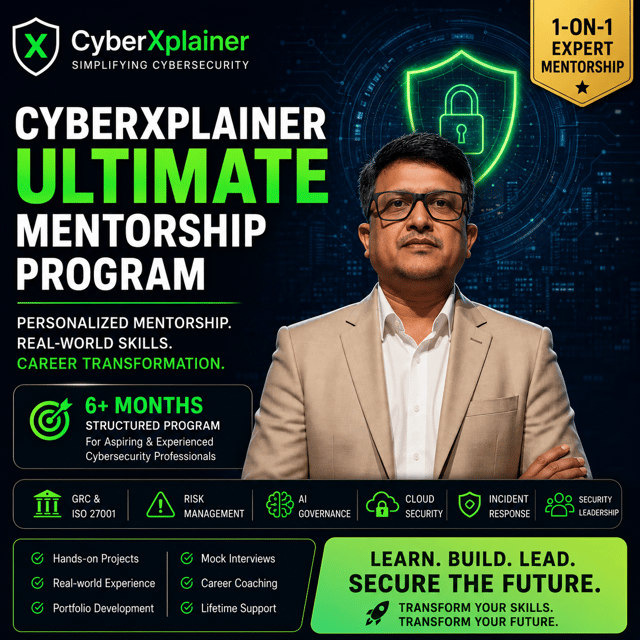
CyberXplainer Ultimate Mentorship Program
Discovery Call
Mock Interview
Cyber Career Accelerator
About me
- CyberXplainer Mentorship Program – Zero to Job-Ready in 6 Monthshttps://cyberxplainer.com/mentorship_landing.html

Frequently asked questions
How to start a cybersecurity career with no IT background?
The sequence for how to start a cybersecurity career with no IT background is fairly standard: first build fundamentals — networking basics, Linux and Windows, and core security concepts like the CIA triad; then get hands-on through a home lab and beginner practice platforms; then pick an entry-friendly role such as SOC analyst, GRC associate, or IT support with a security tilt. Most people need 6–9 months of consistent effort (8–10 hours a week) to become application-ready. The biggest mistake is collecting random certificates without touching a lab — employers in India consistently shortlist candidates who can show practical work.
What is a typical cybersecurity career path in India?
A typical cybersecurity career path in India starts in roles like SOC analyst, IT support, network admin, or audit, then branches into specialisation: SOC Analyst (0–2 years) → Security Engineer or Incident Responder (2–5 years) → specialist tracks such as penetration testing, cloud security, GRC, or threat intelligence (5–8 years) → Security Architect, Security Manager, or CISO-level roles. A CS/IT degree helps but isn't mandatory — certifications like CompTIA Security+, CEH, and cloud security certs are widely accepted by Indian employers. Hiring is strongest in BFSI, IT services, GCCs, and consulting across hubs like Bengaluru, Hyderabad, Pune, and NCR.
What is a realistic cybersecurity career roadmap for beginners?
A realistic cybersecurity career roadmap for beginners fits into roughly 6–9 months: months 1–2 for networking, Linux, and security fundamentals; months 3–4 for hands-on lab work and SIEM basics; months 5–6 for one entry-level certification plus two or three documented projects; and the final stretch for a tailored resume, LinkedIn optimisation, mock interviews, and applications to SOC, GRC, and analyst openings. Don't try to learn everything at once — pick one track (defensive/blue team is the most fresher-friendly), follow a single sequence, and build proof of skills at every stage.
What are the most in-demand cybersecurity careers in India?
The most in-demand cybersecurity careers in India right now are SOC analysts, cloud security engineers, application security engineers, GRC and audit specialists, penetration testers, and incident response analysts. Demand is concentrated in BFSI, IT services, global capability centres, Big 4 consulting, and product companies. Cloud security and GRC are especially strong for people switching from IT, admin, or audit backgrounds, while SOC roles remain the most fresher-friendly entry point. India still has a large cybersecurity talent shortage, so candidates who pair fundamentals with hands-on lab work and clear communication stand out quickly.
Which cybersecurity careers for freshers are realistic without prior experience?
The most realistic cybersecurity careers for freshers are SOC Analyst (L1), Cyber Security Analyst, IT Security Associate, Vulnerability Assessment Analyst, and GRC or compliance associate roles, including openings at MSSPs (managed security service providers). These roles hire candidates who can show fundamentals plus hands-on practice, even without a prior job. A home lab, two or three small documented projects, and Security+-level knowledge usually make a fresher competitive. IT support and NOC roles are also a proven backdoor — you gain exposure first, then move into security internally within 12–18 months.
What is the right cybersecurity career path after 12th in India?
The cleanest cybersecurity career path after 12th is a BTech or BCA in computer science with security-focused self-learning starting from year one. If you choose a non-CS degree, you can still enter through certifications and hands-on practice. A sensible sequence: networking and Linux basics → security fundamentals → an entry certification such as CompTIA Security+ → internships or self-built projects → SOC analyst or IT-security trainee roles by your final year. Students who start labs and projects during college, rather than after graduation, usually reach job-readiness by the time they finish their degree.
What is the best way to learn cybersecurity for beginners?
The best approach to cybersecurity for beginners is learning by doing, not only watching videos. A beginner-friendly order: networking basics (how data moves, IP, DNS, firewalls), then Linux and Windows fundamentals, then core security concepts like encryption, authentication, and the OWASP Top 10, then a home lab where you can safely break and fix things, then guided practice on platforms like TryHackMe or Let's Defend. Free resources can cover most of the theory; paid courses and mentorship mainly add structure, feedback, and accountability. Keep a weekly schedule and document everything you build — that documentation becomes your interview portfolio.
What is a cyber security course for beginners, and what should it include?
A good cyber security course for beginners teaches foundations before tools: networking, operating systems, and security concepts first, then guided hands-on labs, then a small capstone project. Be cautious of courses that are only recorded videos with no practice — labs and feedback are what actually build job-ready skill. Before enrolling, check that the syllabus covers SIEM basics and common attacks like phishing, malware, and web attacks, and that you end up with something to show, such as a working lab setup or a project report. Free content can start you off; structured programs are worth it when you need sequencing and accountability.
Which cyber security jobs for beginners should I target first?
Target cyber security jobs for beginners that explicitly accept 0–1 years of experience: SOC Analyst (L1), Cyber Security Analyst, IT Security Associate, Vulnerability Management Analyst, and GRC Associate. In India, MSSPs, IT services firms, and BFSI companies hire at these levels in volume. Avoid starting with penetration testing or architect roles — they demand prior depth. Match your resume keywords to each posting (SOC roles want SIEM, alert triage, incident response; GRC roles want ISO 27001, risk assessment, audits). If interviews aren't coming, take an IT helpdesk role for 6–12 months and transition internally — a very common and effective route in India.
How much does it cost to learn cyber security in India?
You can begin almost free — networking, Linux, and security fundamentals are covered well on free platforms, and beginner lab subscriptions cost roughly ₹1,000–₹2,000 per month. The real costs are certifications: CompTIA Security+ runs around ₹30,000–₹35,000, CEH roughly ₹60,000–₹75,000, and starter options like Google's Cybersecurity Certificate cost around ₹3,000–₹4,000 per month on subscription. So the honest answer to "how much does it cost to learn cyber security" in India is: under ₹5,000 to start, ₹30,000–₹80,000 if you add one solid certification, and more only if you opt for structured mentorship. Learn fundamentals cheaply first, then spend deliberately.
What are the most common cybersecurity interview questions and answers to prepare?
Most cybersecurity interview questions and answers for fresher-level roles fall into five buckets: fundamentals (CIA triad, encryption vs hashing, TCP vs UDP, firewall types), attacks (phishing, SQL injection, XSS, DDoS and how each is prevented), tools and processes (SIEM, incident response steps, log analysis), scenario questions ("a user clicked a phishing link — what do you do?"), and motivation questions like why security. Prepare short, structured answers: a simple definition, how it works in practice, and one example from your lab or project. Practice saying answers aloud — interviewers judge clarity as much as knowledge at the fresher stage.
Are cybersecurity interview questions for freshers different from those for experienced candidates?
Yes. Cybersecurity interview questions for freshers focus on fundamentals, learning attitude, and home lab or project work — interviewers check whether you genuinely understand networking and security basics and can explain them simply. Interviews for experienced candidates go deeper into real incidents handled, tools used at scale, architecture decisions, and compliance ownership. So as a fresher, your biggest differentiators are a working lab, two or three documented mini-projects, and clear communication. Prepare one detailed walkthrough of something you built — that single answer often decides the outcome of a fresher interview.
How to answer cyber security interview questions when you have no work experience?
The best way to answer cyber security interview questions without work experience is a three-part structure: define the concept simply, explain how it works in practice, and attach a lab or project example. Instead of saying "I have no experience," say "I haven't used this in a job yet, but here's how I set it up in my home lab." Junior hiring expects training, so interviewers are really testing logic, fundamentals, and honesty — never bluff about tools you haven't used. Mock interviews with someone from the industry help a lot, because most fresher rejections at this stage come from weak delivery, not missing knowledge.
Is it worth building a home cyber security lab as a beginner?
Yes — a home lab is the highest-ROI step for beginners because it converts theory into demonstrable skill. A free setup with VirtualBox or VMware, a Kali Linux VM, a deliberately vulnerable target like Metasploitable, and a Windows VM lets you practise scanning, exploitation basics, log analysis, and even SIEM setup safely and legally. Every lab you build becomes a resume project and an interview story. You don't need expensive hardware — a machine with 8–16 GB RAM is enough to start — and you can extend it later with free cloud tiers.
How do I make my cyber security resume stand out with no experience?
Lead with skills and projects, not a career objective. Structure it as: certifications at the top, then a "Projects & Labs" section with two or three concrete entries (what you built, tools used, result — for example, "built a home SIEM lab and analysed 100+ simulated alerts"), then education and skills. Mirror the keywords in each job description — SOC postings search for SIEM, incident response, and log analysis; GRC postings for ISO 27001, risk assessment, and audits. Cut generic lines like "passionate about cyber security", keep it to one page, and get it reviewed by someone already working in security before you start applying — small wording fixes often significantly increase interview callbacks.