Testimonials
Services

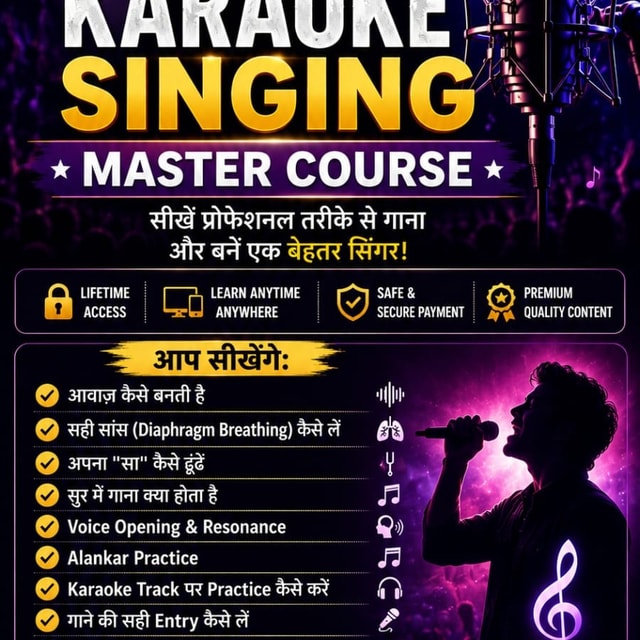
499/- Karaoke Singing Master Course (Hindi)
About me
Frequently asked questions
How to start singing as a beginner with no experience?
To start singing as a beginner, build the basics one at a time: sit or stand with straight posture, practise diaphragmatic breathing, and match simple scales on "sa" or humming before attempting full songs. If you are wondering how to sing for beginners in a structured way, follow a short daily routine — 5 minutes of breathing exercises, 5 minutes of humming and pitch-matching, then one easy song sung slowly. Fifteen to twenty minutes daily works better than one long weekly session, and recording yourself helps you track real progress.
What is breath support in singing?
Breath support in singing means using your diaphragm and abdominal muscles to push a steady, controlled flow of air to your vocal cords, instead of shallow chest breathing. When done correctly, your belly expands as you inhale and stays engaged as you sing, giving your voice consistent pressure. This keeps notes stable, reduces throat strain, and lets you sustain phrases without your voice cracking or fading.
Why is breath control important in singing?
Breath control decides how long you can hold a note, whether you can reach high notes without straining, and how steady your pitch stays through a line. Weak breath control is the reason most beginners run out of air mid-line, go flat on long notes, or feel tension in the throat. Whether you sing karaoke for fun or train for performance, breath control is the foundation everything else sits on.
How to improve breath control in singing?
Practise breath control exercises for singing daily: lie down and breathe so your stomach rises (diaphragmatic breathing), hiss out a slow breath for 20–30 seconds, do lip trills up and down a comfortable scale, and inhale for 4 counts, hold for 4, exhale for 8. Also try sustaining a single comfortable note on one breath and gradually extend the count. Ten minutes a day usually shows noticeable improvement within two to three weeks.
How to control breath while singing long lines and high notes?
Plan your breaths at natural pauses in the lyrics — take a quick, low breath just before a long phrase instead of mid-word. Don't empty your lungs completely on each line; keep a small reserve of air. For high notes, use slightly less air with firmer support rather than pushing more air, which causes strain. Marking breath points on lyrics and rehearsing them the same way every time builds consistency quickly.
How do I find good karaoke singing classes near me?
Check reviews and ratings, and ask specifically whether they teach fundamentals — breathing, pitch matching, and voice modulation — or only make students sing along to songs. Ask about batch size (smaller means more attention), whether a trial class is offered, and if the training language suits you, such as Hindi. Also compare with karaoke singing classes online, since structured online options are not limited by location and often cost less.
Are karaoke singing classes online effective for beginners?
Yes, they work well for karaoke because you ultimately perform with recorded tracks anyway. A good online programme gives you a step-by-step path — fundamentals first, then breath control, pitch matching, and song performance — with practical exercises you can repeat at your own pace. Look for beginner-friendly structure, lifetime access to lessons so you can revise, and training in the language you actually want to sing in.
What do karaoke singing lessons usually cover for beginners?
Quality karaoke singing lessons start from zero and typically cover singing fundamentals like posture and breathing, pitch matching with scales, breath control for sustaining lines, timing with the backing track, microphone technique, and finally expression and stage presence. A beginner-focused course adds practical exercises after every concept so you apply it to real songs instead of only learning theory.
Is a singing for beginners course worth paying for?
It is worth it if the course is structured and reasonably priced. Free content is scattered and gives you tips without a sequence, while a proper singing for beginners course arranges fundamentals, breath training, and pitch work in the right order with exercises to follow. Fees vary widely — offline classes in Indian cities can run into thousands of rupees per month, while some structured online Hindi karaoke master courses are available for a one-time payment of around ₹499 with lifetime access. Check that the curriculum is beginner-friendly before enrolling.
Is singing for beginners on YouTube enough to learn properly?
Most people start with singing for beginners on YouTube, and it is genuinely useful for understanding concepts like breathing and pitch for free. The limitation is that videos cannot hear you, so wrong habits — throat strain, shallow breathing, off-pitch placement — often go uncorrected. A practical approach is to use free videos for exploration and then join a structured course or class for sequenced training and feedback on your actual voice.
How can I get free karaoke songs for a singing machine?
Search for the song name followed by "karaoke" on YouTube — most popular Hindi and English songs have free karaoke versions you can play through a singing machine via Bluetooth or an aux connection. Free-tier karaoke apps also offer large song libraries, and several websites provide free karaoke MP3 and MIDI tracks for classic songs. For practice, use tracks with the melody guide on first, then switch to the backing-only version as you improve.
What to sing for beginners: how do I choose the right songs?
The answer to what to sing for beginners comes down to fit, not difficulty — pick songs that sit within your comfortable vocal range, have a slow to moderate tempo, and a simple, repetitive melody. If you want to sing in Hindi, start with slow melodic numbers rather than fast or very high-pitched songs, and practise with a karaoke track at low volume or with the guide vocal before going fully live. Once 3–4 easy songs feel stable, gradually move to more demanding ones.