Testimonials
Services
Accenture Assessment Test — Preparation Package
Alpha Δ – Complete Java + DSA Placement Course
GFG — DSA Masterclass (Videos, Notes, Problems)
Placement Preparation Booklet (DSA+Core Subjects)
TCS NQT Preparation Kit | Aptitude + Coding + PYQs
Resume for Amazon, Google & 30+ Top Companies
Complete Aptitude Placement Preparation Course
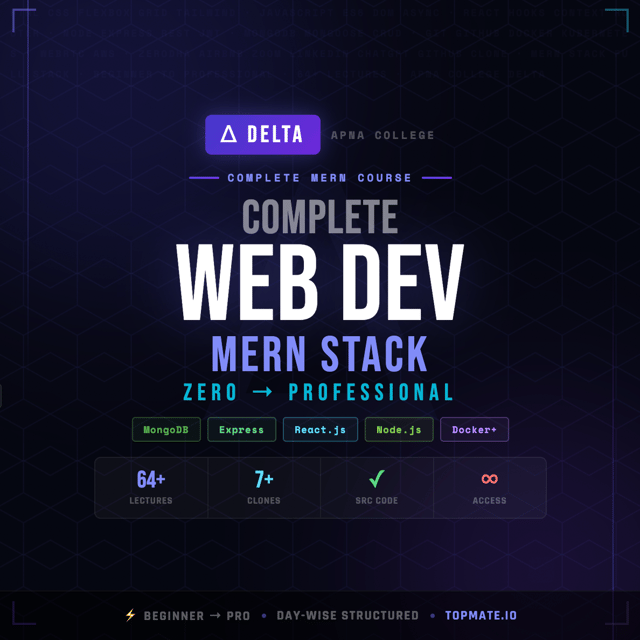
Delta Δ – Complete Web Development (MERN Stack)
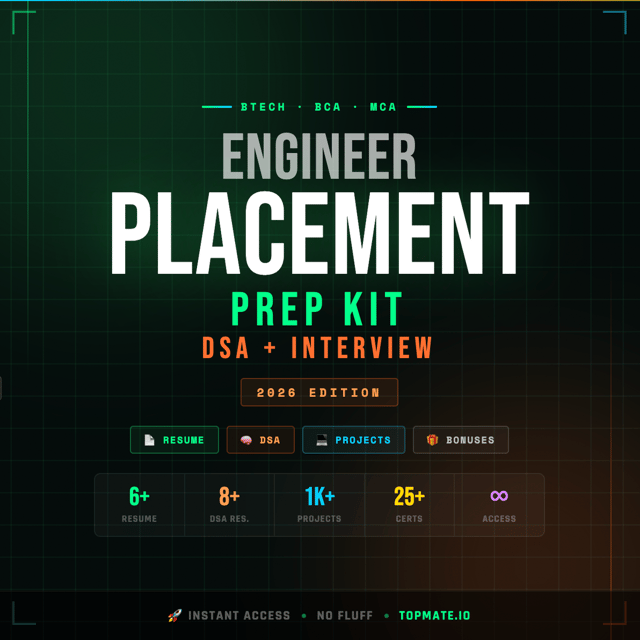
Engineer Placement Prep Kit 2026 (DSA + Interview)
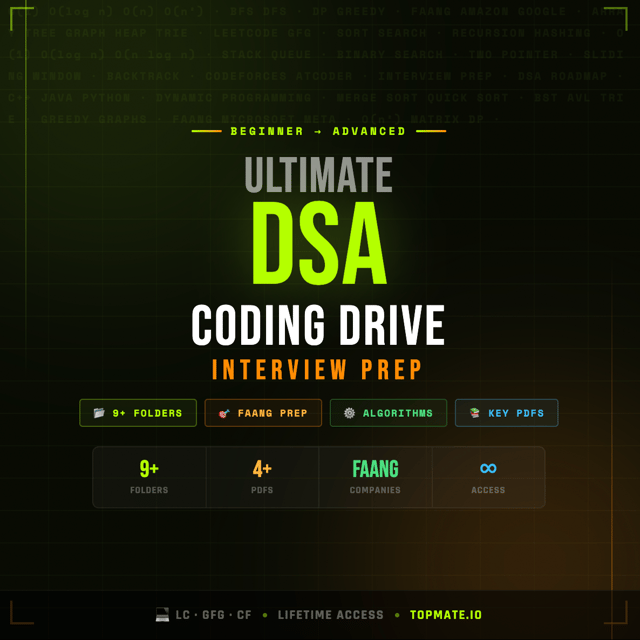
Ultimate DSA & Coding Interview Preparation Drive
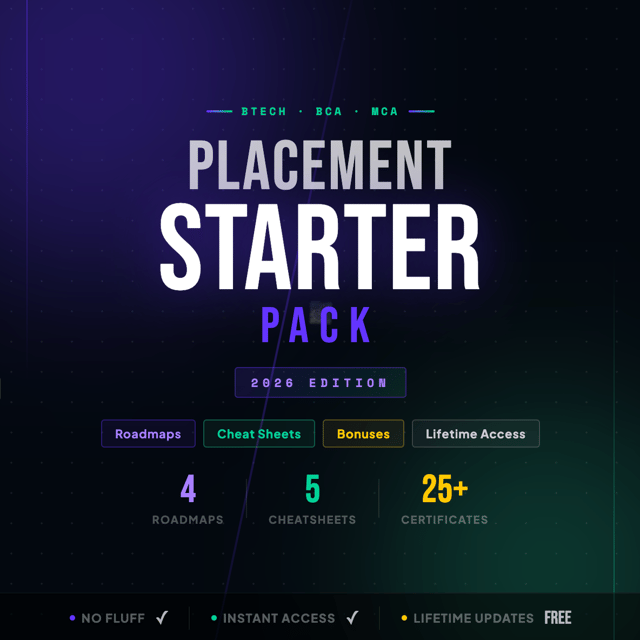
Placement Starter Pack 2026 (Roadmaps+Cheatsheets)
All resources in One (Lifetime)
About me
- CODE20 20% Discount

- Engineer Premium Content Vaulthttps://cosmofeed.com/vig/686f9aa61f8ef80013f08e66

Frequently asked questions
How to start DSA preparation for beginners?
Start with one language — C++, Java, or Python — and get comfortable with arrays, strings, and basic logic before touching advanced topics. Then follow this order: linked lists, stacks, queues, recursion, sorting and searching, trees, graphs, and finally dynamic programming. Solve 2–3 easy problems daily, maintain a mistake log, and revise weekly — beginners struggle with DSA mostly because of inconsistency, not difficulty.
What is an ideal DSA preparation roadmap for placement season?
A practical DSA preparation roadmap runs 3–4 months: Month 1 for arrays, strings, hashing, and two pointers; Month 2 for recursion, linked lists, stacks, queues, and binary search; Month 3 for trees, heaps, graphs, and greedy; and Month 4 for dynamic programming, mixed revision, and timed mock tests. Pair every topic with 15–20 curated problems and keep short cheat sheets for last-minute revision before company tests.
How much DSA preparation for placement is actually enough?
For mass recruiters like TCS, Infosys, and Wipro, around 150–250 well-understood problems covering arrays, strings, linked lists, trees, and basic graphs is usually sufficient, since their tests mostly stick to easy and medium questions. For product-based companies, push towards 400+ problems with stronger graphs and dynamic programming. Keep in mind that DSA preparation for placement and DSA preparation for interview rounds overlap heavily — the same problem bank works for both, but interviews additionally require you to explain your approach out loud while coding.
How do I plan DSA preparation for Google and other product-based companies?
Google-style interviews test problem-solving depth, so go beyond common patterns into graph traversal, dynamic programming, tries, union-find, and tight complexity analysis. Practice medium and hard problems in timed 45-minute sessions and narrate your thinking as you solve, exactly like a real interview. Shortlisting also depends on your resume, so pair your DSA work with one strong project and a crisp one-page resume.
Which DSA preparation course is best for college students?
Judge any DSA preparation course on four things: structured video lectures, concise revision notes, topic-wise curated problem lists, and coverage of interview favourites like trees, graphs, and dynamic programming. Bundled DSA masterclasses that combine videos, notes, and handpicked problems are usually far more affordable than long-form paid programs, and a self-planned roadmap with consistent daily solving works just as well if you stay disciplined.
How to start placement preparation in college?
Start with aptitude (quantitative, logical, verbal) alongside one programming language in the first two years, build DSA and two solid projects by third year, and reserve the final year for company-specific previous papers, core subjects (OS, DBMS, CN, SQL), and mock interviews. Most students lose time collecting scattered free resources, so following one structured placement preparation course or bundle that covers aptitude, coding, and PYQs together keeps the prep tight. Track application deadlines in a simple sheet so nothing slips during final-year chaos.
What does placement preparation for CSE students involve?
Placement preparation for CSE students carries higher coding expectations because recruiters assume CS branches are stronger at DSA and fundamentals. Weight your time towards coding rounds, DBMS and SQL, operating systems, and computer networks, and be ready to defend at least one project in depth. Don't ignore aptitude though — service companies still filter a large chunk of CSE applicants at the written-test stage itself.
How important is placement preparation for aptitude tests?
Extremely important — for mass recruiters like TCS, Infosys, Wipro, and Accenture, the aptitude round (quantitative ability, logical reasoning, verbal) eliminates the majority of candidates before anyone sees your coding round. Give it 30–45 minutes daily for 4–6 weeks: speed maths, percentages, ratios, probability, puzzles, and seating arrangement, followed by company-specific previous papers under timed conditions. Practicing real PYQs is the single biggest edge in clearing aptitude cuts.
What are placement papers and how should I use them?
Placement papers are previous years' question papers from company hiring exams — like TCS NQT, Infosys, Wipro, and Accenture tests — showing the real pattern, difficulty level, and frequently repeated question types. Use them in the last 2–3 weeks before your exam: attempt one full paper in a timed, exam-like setting, analyze which section dragged your score, and re-attempt after fixing weak areas. Question patterns repeat far more often than students expect, so 8–10 solved placement papers of your target company can decide the outcome.
What is the TCS NQT exam?
The TCS NQT (National Qualifier Test) is TCS's national-level recruitment exam for fresher hiring in India, used for roles like TCS Ninja and Digital. It generally tests numerical, verbal, and logical aptitude along with a coding/programming section, and clearing it leads to TCS interviews. Since the pattern leans heavily on aptitude plus coding, preparing with aptitude drills, coding practice, and previous year questions is the standard route to clear it.
What is the TCS NQT 2026 registration last date?
TCS opens TCS NQT 2026 registration on its official TCS iON NQT portal, and applications for each drive typically close a few days before the exam window — but the exact deadline differs by cycle and by batch year. Register as soon as the drive for your graduation year opens, keep your resume, photograph, and ID handy, and confirm the deadline only on the official portal rather than relying on forwarded dates.
When is the TCS NQT exam date 2026?
TCS conducts NQT across multiple exam windows through the year instead of one fixed day, and the confirmed TCS NQT exam date 2026 for each cycle is announced on the official portal along with its registration window. After registering, your hall ticket mentions your specific exam date and slot. Since dates are usually revealed close to the exam, finish your aptitude and coding preparation before the admit card arrives rather than waiting for it.
How to check TCS NQT results?
TCS NQT results are published on the official TCS iON NQT portal — log in with your registered credentials to check your qualification status, and shortlisted candidates also receive interview details on their registered email. Results usually take a few weeks after the test, so keep checking periodically instead of panicking. If you don't clear this attempt, use the result to identify weak sections and start next-cycle preparation immediately, since repeat attempts with stronger coding practice often convert into offers.
How should a fresher create a resume for Amazon, Google, and other top companies?
Keep it to one page: a sharp summary, two or three impactful projects with tech stack and measurable results, internships, competitive programming achievements, and neatly grouped skills. Write bullet points with action verbs and numbers ("reduced load time by 40%") instead of listing responsibilities, and mirror keywords from the job description since resumes are usually ATS-screened before a human ever sees them. Get it reviewed by a mentor or a placement-focused resume service before applying — small formatting and wording mistakes cost freshers more shortlists than anything else.
Do final year projects really help in placements?
Yes — for freshers without work experience, final year projects are the strongest proof of practical skill, and interviewers routinely spend a large part of technical interviews digging into whatever project is on your resume. Projects that solve a real problem, use in-demand stacks like MERN or Python, and are deployed live with clean GitHub code stand out far more than generic clone tutorials. Pick one project you can fully explain — architecture, trade-offs, challenges, and what you'd improve — instead of stacking five half-understood ones.