Testimonials
Services
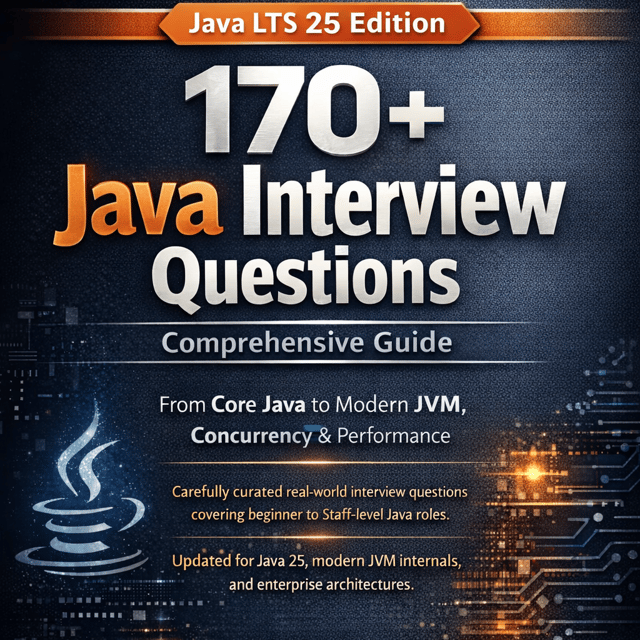
Java Interview Questions - Comprehensive Guide
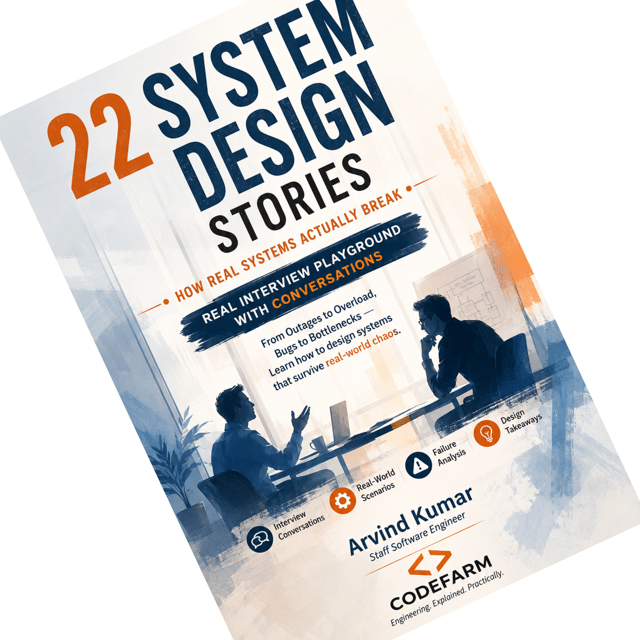
22 System Design Stories- How Real Systems Break
1:1 Mentorship
E Books Package - Microservices & Spring Boot
[Videos]Master Complete Kafka with Springboot
Enquiry | Lets see if I can help you
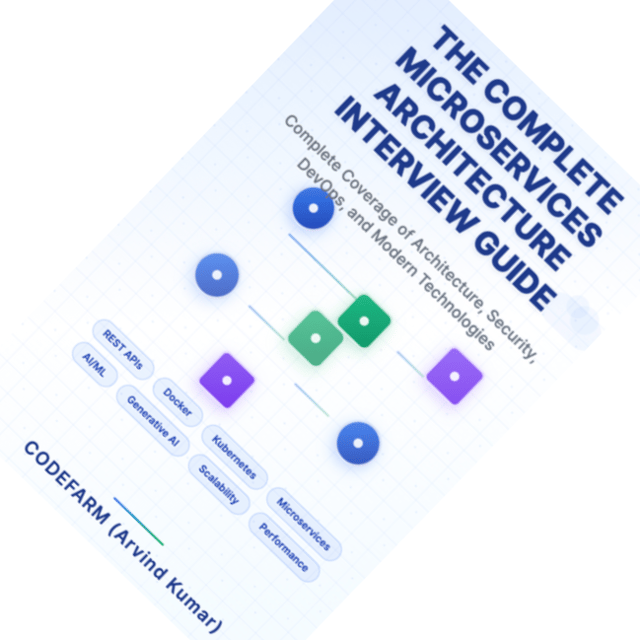
Microservices Architecture Interview Guide
Debugging and Architecture Review
Mock Interview for Job Readiness
About me
- Codefarm - YouTubehttps://www.youtube.com/@codefarm0

Frequently asked questions
What is Spring Boot microservices architecture?
Spring Boot microservices architecture is a way of building an application as a collection of small, independently deployable services instead of one large monolith. Each service owns a specific business capability — such as payments, orders, or user management — runs in its own process, has its own database, and communicates with other services through REST APIs or messaging. Spring Boot simplifies this with embedded servers and Spring Cloud tools like Eureka for service discovery, Spring Cloud Gateway, and Config Server. This design lets teams build, deploy, and scale each service independently, which is why most modern banking and e-commerce systems use it — and why it dominates backend interviews.
How to create a Spring Boot microservices project from scratch?
Start small: use Spring Initializr to generate two or three simple services (for example, order, payment, and inventory), give each its own database, and expose REST APIs. Then add Spring Cloud components one at a time — Eureka for service discovery, Spring Cloud Gateway as a single entry point, and a Config Server for central configuration. Use OpenFeign for inter-service calls and introduce Kafka or RabbitMQ later for async communication. Once things work, containerize with Docker. The biggest mistake beginners make is trying to build the full setup on day one; evolve the project gradually instead.
How to scale Spring Boot microservices?
Keep services stateless so multiple instances can run behind a load balancer, then scale horizontally by adding instances (Kubernetes HPA or cloud auto-scaling handles this automatically). Add caching with Redis for frequently read data, use read replicas or sharding at the database level, and push heavy workloads to async processing through Kafka or RabbitMQ. Also add circuit breakers with Resilience4j so one slow service doesn't drag the others down. In interviews, the expected answer is usually this combination: stateless design, load balancing, caching, database scaling, and async decoupling.
How to deploy Spring Boot microservices in AWS?
The most common path is to containerize each service with Docker, push images to Amazon ECR, and run them on ECS or EKS, with an Application Load Balancer or API Gateway in front, RDS for databases, and CloudWatch for monitoring and logging. For simpler setups, Elastic Beanstalk can deploy Spring Boot services without managing containers directly. If you're new to cloud deployment, start with a single service on Elastic Beanstalk or EC2, then move to ECS or EKS as your number of services grows.
What is an API gateway in Spring Boot microservices?
An API gateway is a single entry point that sits in front of all your microservices. Instead of clients calling each service directly, they call the gateway, which routes requests to the correct service and can also handle authentication, rate limiting, logging, and response transformation. In the Spring ecosystem, this is implemented using Spring Cloud Gateway. Interviewers love this topic because the natural follow-up is "why not let clients call services directly?" — the answer being centralized cross-cutting concerns, hiding internal service structure, and controlled exposure of APIs.
What are the common patterns of Spring Boot microservices communication?
There are two broad styles. Synchronous communication uses REST calls via OpenFeign or WebClient — simple, but it creates temporary coupling between services. Asynchronous communication uses event brokers like Kafka or RabbitMQ, where services publish and subscribe to events, decoupling them and handling traffic spikes better. Real systems use a mix: REST for queries needing immediate responses, messaging for workflows like order processing or notifications. Be ready for related questions on eventual consistency, the saga pattern for distributed transactions, and idempotency.
What Spring Boot microservices interview questions are most frequently asked?
Expect a mix of concept and scenario questions: monolith vs microservices and when NOT to use microservices; how services communicate; what API gateway and service discovery do; database-per-service design; handling distributed transactions with saga or two-phase commit; circuit breakers and fault tolerance; securing services with JWT or OAuth2; and debugging a failing inter-service call in production. At product companies, you'll likely also get "walk me through a system you designed" — so prepare one project story end to end rather than memorizing definitions alone.
Is it better to learn from a Spring Boot microservices tutorial or join a Spring Boot microservices course?
A good free Spring Boot microservices tutorial is enough to grasp individual concepts, but most tutorials stop at basic demo services and skip what interviews and real projects demand — distributed transactions, resilience, security, deployment, and trade-off decisions. A structured Spring Boot microservices course, curated e-book, or 1:1 mentorship is worth paying for if it includes a realistic project, architecture diagrams, and someone to review your design and clear doubts. If you're self-disciplined, combine free tutorials with building your own project; if you're short on time or preparing for interviews, structured guidance usually saves weeks. Arvind's Spring Boot & Microservices Mastery Guide and 1:1 mentorship calls are built for this exact gap.
What are the most frequently asked Java interview questions and answers?
From freshers to senior levels, the core set stays surprisingly consistent: OOP concepts with real examples, String immutability and the String pool, Collections (especially HashMap internals and ArrayList vs LinkedList), exception handling, multithreading and the Java Memory Model, Java 8 features like Streams and lambdas, and JVM basics like garbage collection. The difference is depth — at senior levels you must explain why, not just what. Practicing answers aloud or in a mock interview works far better than only reading lists of Java interview questions and answers; Arvind's comprehensive Java interview questions guide organizes these topic-wise if you want a compiled resource.
How are Java interview questions for 5 years of experience different from Java interview questions for freshers?
Java interview questions for freshers mostly test fundamentals — OOP, basic collections, simple coding programs, and definitions you can prepare from a list. Java interview questions for 5 years of experience go deeper: concurrency (volatile, ConcurrentHashMap, executor frameworks), JVM tuning and garbage collection, design patterns in real code, Spring internals, and "design this" or "debug this scenario" problems. At 5 years, interviewers also judge communication and trade-off reasoning — they want to hear how you made decisions in actual projects, not textbook answers. Revising fundamentals quickly and then practicing system-level explanations gives the best return at this stage.
How do I prepare for microservices architecture interview questions?
Prepare in layers: first the core concepts (service decomposition, API gateway, service discovery, database-per-service), then the hard parts (distributed transactions, eventual consistency, circuit breakers, idempotency, security), and finally operations (monitoring, deployment, production debugging). Practice drawing the architecture of a system you know — e-commerce, payments, or booking — and be ready to defend every box and arrow. Rather than memorizing long lists of microservices interview questions and answers, work through scenario-based material; Arvind's Microservices Architecture Interview Guide compiles domain-specific scenarios with diagrams and Java implementations, and pairs well with a 1:1 prep call.
Which microservices interview questions for 5 years of experience are asked most often?
At that level, interviewers skip definitions and test judgment: "How would you split this monolith into services?", "The payment service is down — what happens to orders?", "How do you handle distributed transactions?", and "When would you NOT choose microservices?" You'll also face Kafka questions (consumer groups, offsets, duplicate messages) and production debugging stories. Microservices interview questions for 5 years of experience are really checking whether you've owned systems, so answer with real examples from your own work wherever possible.
Is Kafka with Spring Boot worth learning for Java backend interviews?
Yes — Kafka now appears in most mid-to-senior Java backend interviews in India because microservices depend on reliable asynchronous communication. Focus on what interviewers actually ask: topics and partitions, consumer groups and offsets, delivery semantics (at-least-once vs exactly-once), idempotent producers, and handling duplicate or out-of-order messages. Learning Kafka alongside Spring Boot through Spring Kafka makes it practical — build a small order-to-notification flow you can talk about confidently. Arvind's video series on Kafka with Spring Boot is one structured option for this.
Are mock interviews helpful for clearing Java backend interviews?
Yes, especially from mid-level onward. Most engineers know the theory but struggle to structure answers under pressure, explain their projects crisply, or handle follow-up questions. A mock interview exposes these weaknesses before the real panel does — unclear explanations, depth gaps, nervous delivery. One or two targeted sessions with a mentor who has sat on the interviewer's side, followed by focused revision, typically improves performance more than another week of reading. Arvind's Mock Interview for Job Readiness call is designed around exactly this, drawing on his 12+ years in the software industry.
How do I switch from a service-based company to a product-based company as a Java developer?
The gap is usually depth and design, not coding volume. Product companies test stronger DSA, Java internals, Spring Boot and microservices architecture, system design (increasingly so after 4–5 years of experience), and clear communication. Plan it in stages: strengthen DSA patterns, know your resume projects deeply enough to defend every design decision, prepare microservices and system design stories, and do a mock interview before applying. Many engineers in India make this switch between 3 and 6 years of experience; a career guidance session with an experienced mentor can help you identify and close your specific gaps faster.