Testimonials
Services

Roadmap to Your Finance Job
CV Review
Get Job Ready CV | ATS Friendly CV + Expert Review
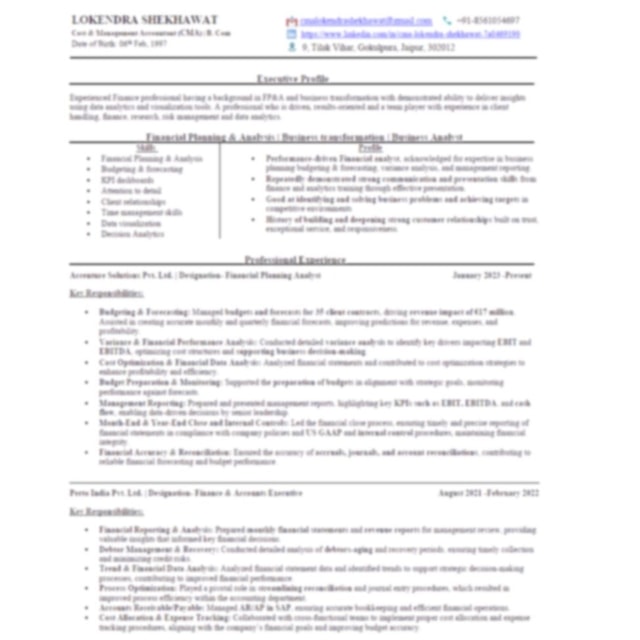
CV that lands me in JP Morgan and 6 offer letters

JP Morgan Roadmap 2026
1:1 Connect - Career Guidance in FP&A/Finance
Interview Preparation (Finance / FP&A Roles)
100+ Top firms Cold mails to send CV To Right Desk
JP Morgan FP&A Interview Questions List
Ask Anything DM
About me
Frequently asked questions
Is FP&A a good career in India?
Yes — FP&A is one of the most in-demand paths in corporate finance right now. Every large company, bank, and GCC needs teams that can budget, forecast, and explain what the numbers mean for the business, so demand has grown sharply over the last few years. Pay also scales faster than many traditional accounting roles once you move from analyst to FP&A manager, and the skills transfer well toward CFO-track positions. If you enjoy Excel-based modelling, business analysis, and stakeholder work rather than pure bookkeeping, FP&A is a good career to commit to.
What is an FP&A career?
FP&A stands for Financial Planning & Analysis. An FP&A career means working inside a company's finance function on forward-looking work — building annual budgets, preparing monthly and quarterly forecasts, running variance analysis, and helping leadership decide where to invest or cut costs. Unlike accounting, which records what has already happened, FP&A is analytical and works closely with sales, operations, and management. People typically progress from FP&A analyst to senior analyst, then FP&A manager, and onward to director-level finance roles.
How much does an FP&A analyst make in India?
An FP&A analyst in India typically earns around ₹5–10 lakhs per year at the entry level, depending on the city, company, and qualifications such as CA, CFA, CMA, or MBA. GCCs and large MNCs usually pay at the higher end, and investment banks or product companies can go well beyond that. With 5–8 years of experience, salaries commonly move into the ₹18–30+ lakh range as you grow into senior analyst and FP&A manager roles. The exact figures vary widely, but the growth trajectory is generally stronger than in many routine accounting jobs.
How can I find FP&A careers in India without prior experience?
It's difficult but very doable with the right route. Most people enter FP&A careers through adjacent roles such as financial planning, management reporting, audit, or accounting, and then move into core FP&A after 1–2 years. Target GCCs and mid-size MNCs, which hire freshers and CA/MBA/CFA candidates into FP&A-adjacent roles more often than the biggest brand names. Build strong Excel and Power BI skills, learn the three-statement model, and reposition your CV around analysis projects rather than routine tasks. Referrals and direct outreach to hiring managers consistently beat applying through job portals alone.
What are the most common finance interview questions for freshers?
Freshers are tested on fundamentals and communication, not deep experience. The usual finance interview questions for freshers include: "Walk me through your CV," "Explain the three financial statements and how they link," "What is working capital?", "Difference between NPV and IRR?", "What happens to the three statements if depreciation increases?", and "Why do you want a career in finance?" HR rounds add questions on strengths, weaknesses, and career goals. Interviewers mainly look for structured answers, basic accounting clarity, and genuine interest — so practise responding aloud in under two minutes per question.
How to answer finance interview questions?
Structure matters more than memorised technical depth. The reliable way to approach how to answer finance interview questions is: define the concept in one line, explain the logic or formula, give a quick example with numbers, and connect it to the role you're applying for. For behavioural questions, use the STAR format (Situation, Task, Action, Result) and keep answers under two minutes. If you don't know something, say so honestly and explain how you would figure it out — interviewers penalise bluffing far more than knowledge gaps. Two or three mock interviews are the fastest way to sharpen this.
What are common finance interview questions and answers for experienced candidates?
With experience, interviews shift from textbook theory to your track record. Expect finance interview questions and answers for experienced candidates to revolve around: "Describe a budget you built and how accurate it was," "Tell me about a variance analysis that changed a business decision," "Which KPIs did you own?", "How do you handle month-end pressure?", and scenario questions like "Revenue dropped 10% — what would you analyse first?" Structure every answer around quantified impact — savings delivered, forecast accuracy improved, processes automated. The most common mistake experienced candidates make is describing responsibilities instead of measurable results.
Where can I find a good finance interview questions and answers PDF?
You'll find plenty of free finance interview questions and answers PDF files on job portals, university sites, and LinkedIn, but most are generic lists recycled across websites. A stronger approach is to build your own document: collect questions specific to your target role — FP&A, credit, equity research, audit — write the answers in your own words, and get them reviewed by someone already working in that role. A focused, role-specific list of 30–40 questions with your own answers will beat any 200-question generic PDF.
How to start CFA Level 1 preparation while working full-time?
Start CFA Level 1 preparation around 5–6 months before your exam date. Cover Quant, Financial Statement Analysis, and Ethics early since they carry heavy weight and need revision, then keep a steady rhythm of 12–15 study hours on weekdays with a longer weekend block. Plan for the usual CFA exam preparation time of roughly 300 hours in total, and finish the syllabus at least six weeks before the exam so you have room for mocks and revision. Working candidates who clear treat study hours as fixed weekly commitments — not something left to motivation.
How much does CFA Level 1 exam cost in India?
For a first-time candidate, the CFA Level 1 exam cost typically works out to roughly ₹1–1.5 lakh depending on when you register. CFA Institute charges a one-time enrolment fee plus the registration fee, which is lower in the early-registration window and higher closer to the deadline, and applicable local taxes are added at checkout. Since fees are billed in US dollars, the rupee amount moves with the exchange rate. Registering early and applying for available scholarships are the two easiest ways to reduce the total.
Is the CFA exam hard to clear on the first attempt?
Yes, it is genuinely demanding — historically only around 40% of candidates clear Level 1 in a given attempt. The CFA exam is hard mainly because of volume: a wide syllabus, three levels, and questions that test application rather than recall. Most failures happen because of skipped question practice or rushed final topics, not lack of intelligence. With 300+ focused hours per level, consistent weekly study, and several full mocks before exam day, it is absolutely clearable even while working full-time.
How to get a job at JP Morgan?
Start by picking a specific function — operations, FP&A, analytics, or investment banking — and study the job descriptions for that role closely. Build the proof recruiters look for: an ATS-friendly CV with quantified impact, a LinkedIn profile aligned to the exact keywords in JP Morgan postings, and interview practice on questions actually asked for that function. Apply through the careers portal and, in parallel, seek referrals from employees through targeted outreach, since referred profiles get far more attention. Rejections are normal even for strong candidates — track feedback, refine your CV and answers, and keep applying consistently.
Can I switch to a finance career from a non-finance background?
Yes — people move into finance from engineering, IT, operations, sales, and consulting every year, but the switch needs proof, not just intent. If you want to switch to a finance career from a non-finance background, start by building the core toolkit: Excel modelling, accounting basics, and the concepts of your target role such as FP&A or financial analysis. Then reposition your CV so your domain experience becomes an advantage — for example, a supply-chain analyst moving into FP&A at a manufacturing firm is more valuable than a generic finance fresher. Enter through adjacent analyst roles, and prepare a clear, concrete story explaining your motivation for interviews.
How do I write an ATS-friendly CV for finance roles?
Keep the format simple: single column, standard fonts, no tables, graphics, or photos, with clear sections for summary, experience, education, skills, and certifications. An ATS-friendly CV mirrors the exact keywords from the job description — "financial modelling," "variance analysis," "FP&A," "SAP" — because the software filters applications by keyword match before a human sees them. Use reverse-chronological order, start each bullet with an action verb, and quantify results such as "reduced reporting time by 30%" or "handled budgets of ₹50 crore." Save it as a .docx or text-based PDF, and get it reviewed by someone in your target role before applying.
How do I write a cold email for a finance job?
A cold email for a finance job works only when it is short, specific, and sent to the right person. Write to the hiring manager or a team member on the relevant desk rather than a generic HR inbox, and keep it to 4–5 lines: who you are in one sentence, why you're writing to them specifically, one proof point such as a project or certification, and a clear ask — a referral or 15 minutes of their time — with your CV attached. Send 10–15 personalised emails a week, follow up once after seven days, and track responses. Volume plus personalisation is what gets replies.